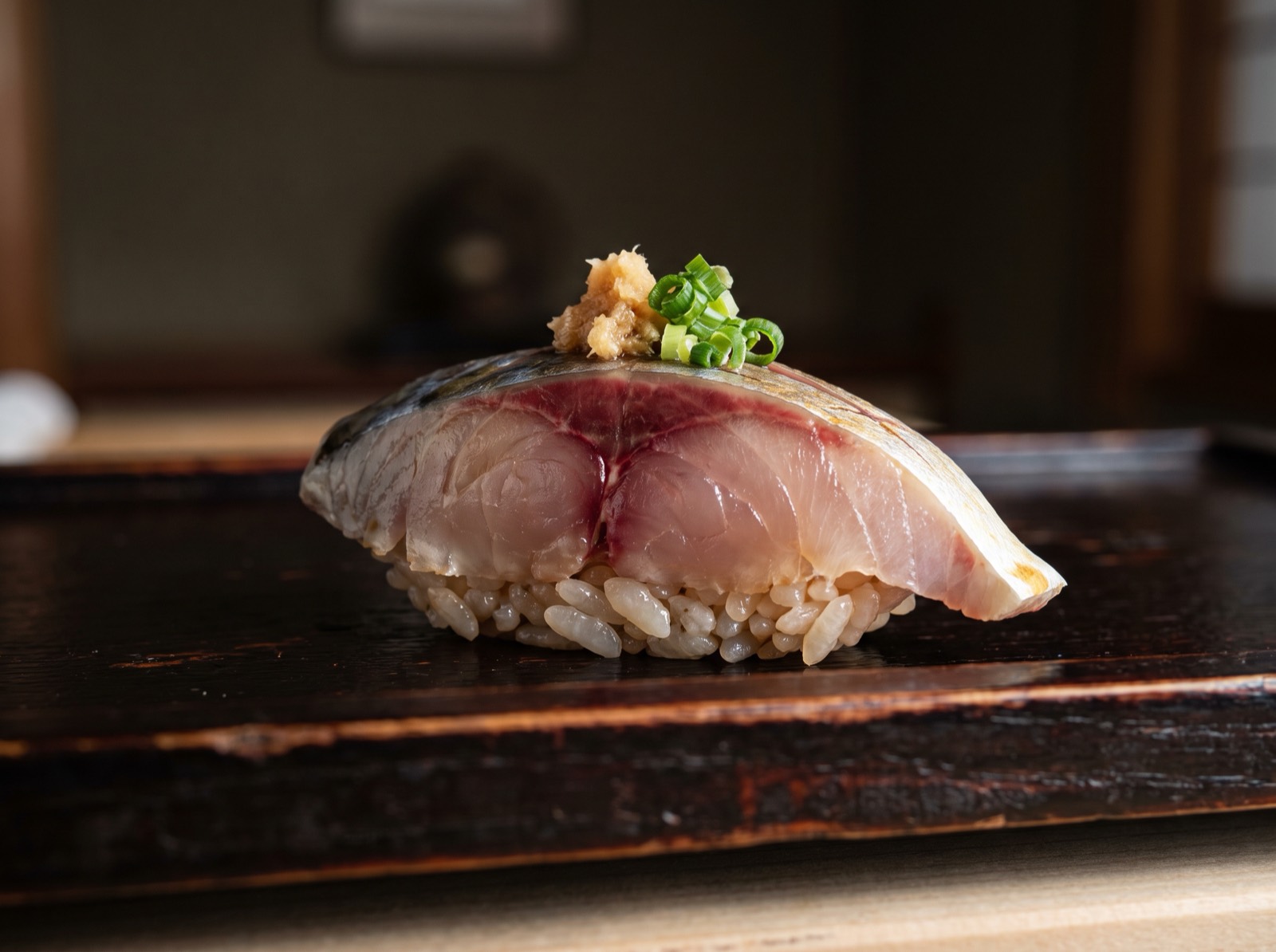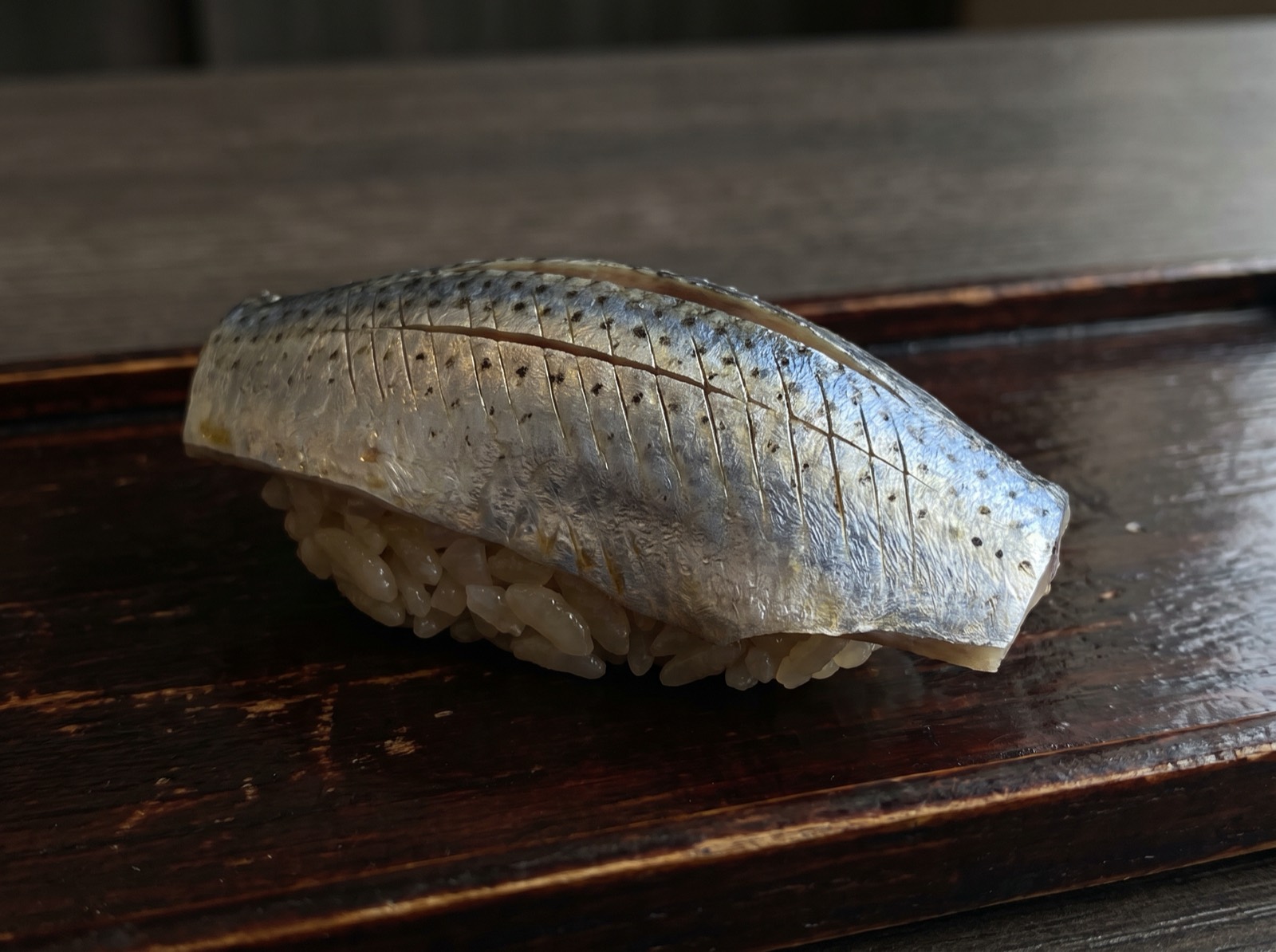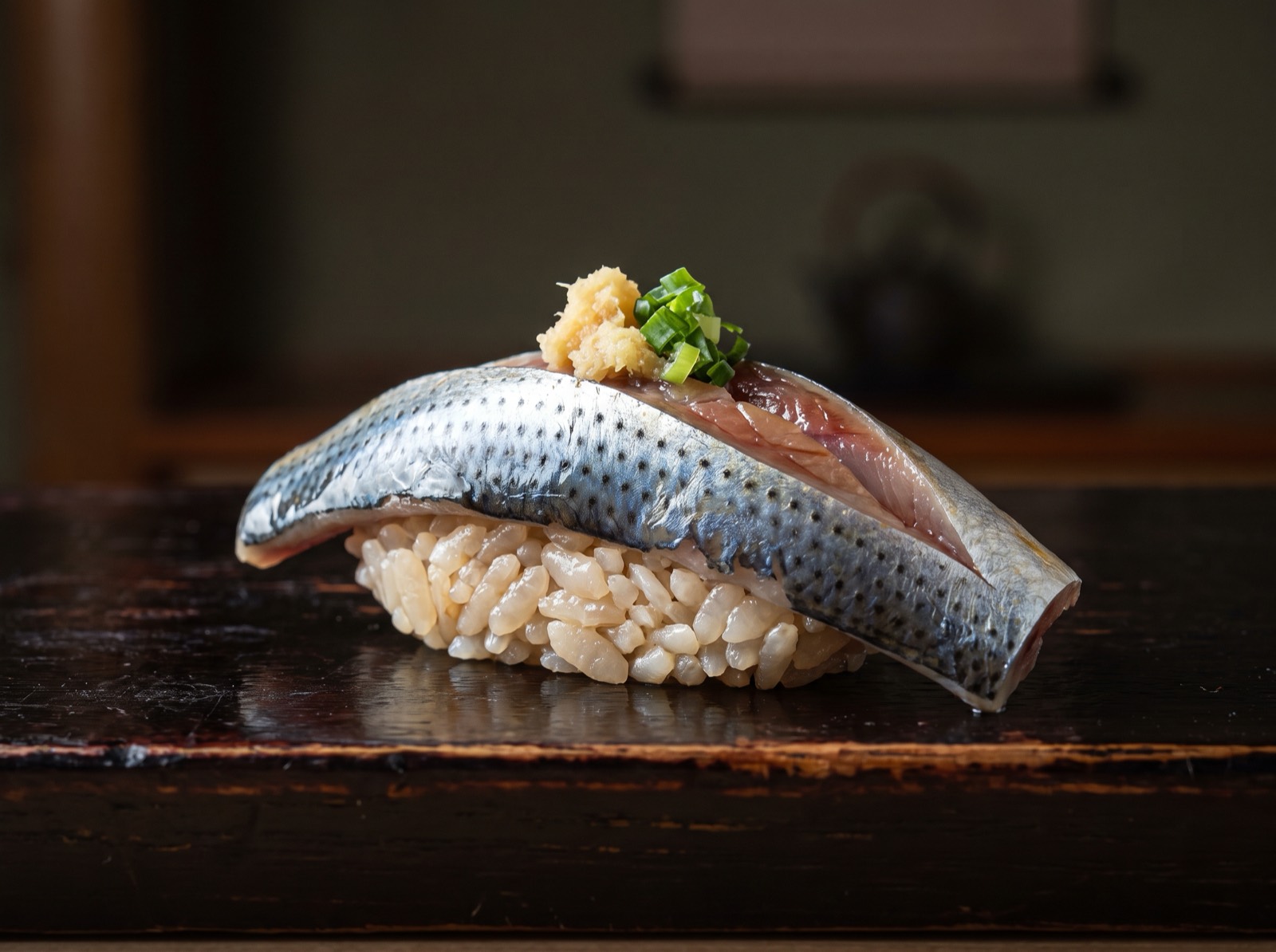
Iwashi (鰯, sardine) is written with the fish radical and the character for “weak”, and the name is a description rather than an insult: the fish dies almost the instant it leaves the water and begins to break down immediately. It is cheap, oily, strongly flavoured, and one of the few pieces at a counter where the fillet is opened with fingers rather than a blade.
What it is
Three different fish share the word in Japanese, and menus do not always distinguish them:
- Ma-iwashi (真鰯), the Japanese sardine. The default. A row of dark spots along the flank, oily, softly textured. This is what “iwashi” means when nothing else is said.
- Urume-iwashi (潤目鰯), round herring. Larger eyes, leaner, more often dried than served raw.
- Katakuchi-iwashi (片口鰯), the Japanese anchovy. Yes — in Japanese, the anchovy is a kind of sardine. It is also the fish behind niboshi, the dried stock ingredient, and behind most shirasu, the tiny whitebait sold by the bowl.
On the counter it is classed with the hikarimono, the “shining things” — the small silver-skinned fish that include kohada and aji. Of that group, iwashi is the softest, the oiliest and the least forgiving of time.
When it is best
Broadly summer into autumn, when the fat is up. In the Kantō trade the June fish, caught around the end of the rainy season, has its own name and its own following, and the autumn fish that follows it is fatter again.
Sardine stocks also swing on a scale that most fish do not — decades of abundance followed by decades of scarcity — which means that the availability and price of this fish across a human lifetime is not a straight line. A sardine that was a poor man’s food in one generation can be a considered order in the next.
What the chef does to it
The distinctive part is te-biraki (手開き), opening the fish by hand. The flesh is soft enough that a knife tears it, so the head is removed, a thumb is run down the backbone, and the fillet is opened flat and the spine lifted out in one movement. It is faster than filleting and it does less damage, and it is one of the few pieces of fish work at a sushi counter done without a blade.
After that, very little and very fast. A brief salting is common to firm the flesh and pull moisture; some shops give it a short vinegar contact in the manner of shime-saba, but a full cure is unusual because it flattens a fish that is already delicate.
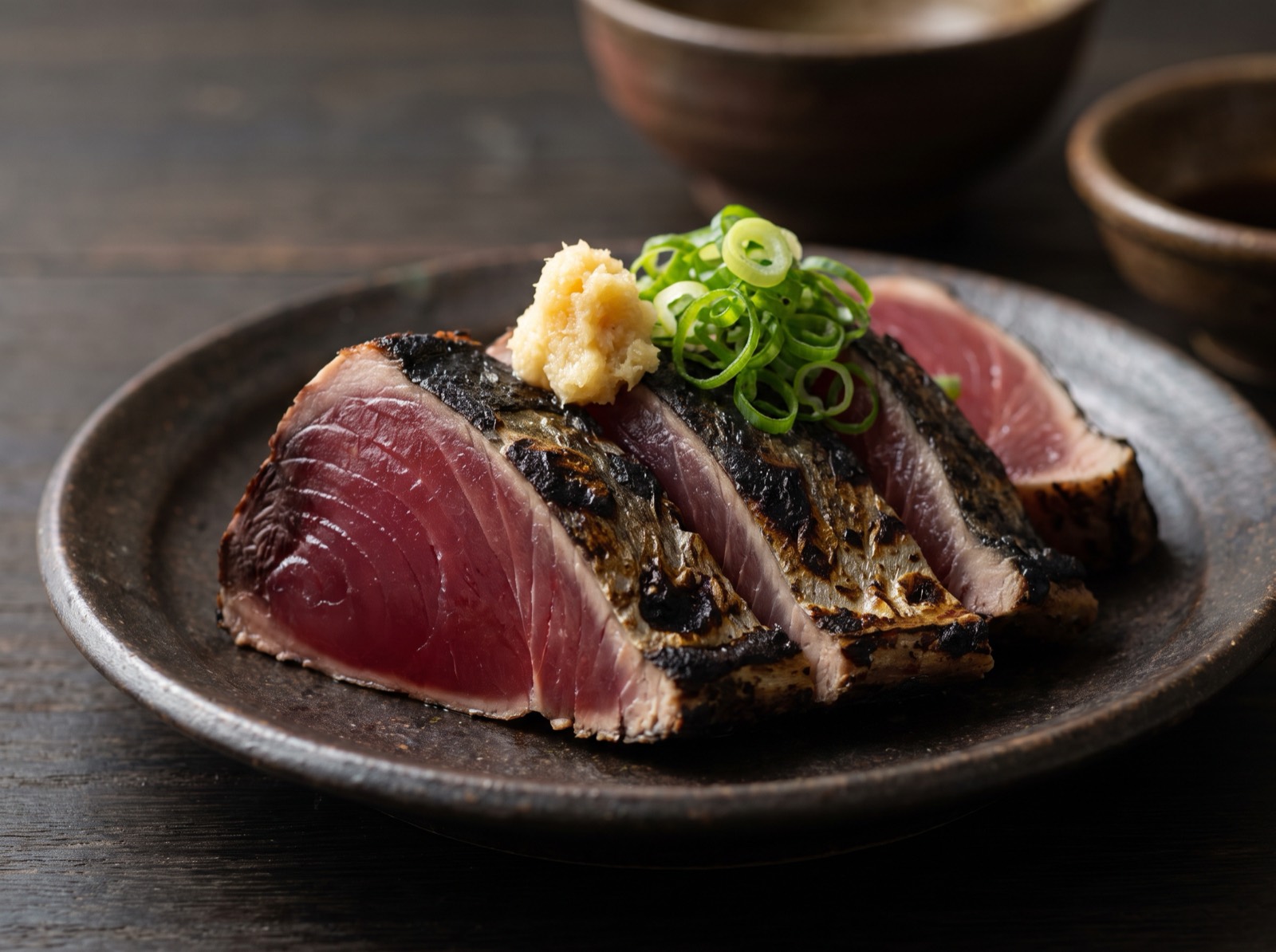
What arrives on top is not decoration. Grated ginger, thin spring onion, sometimes shiso or a scrape of garlic: the aromatics are answering the oil, in the same way they do on katsuo. A piece of iwashi served plain with nikiri is possible but rare, and it asks a great deal of the fish.
The other thing a good shop does is buy it late and use it up. Iwashi does not hold. If it is on the counter at all it should have arrived that morning, and a shop that lists it every day of the year is telling you something it may not mean to.
It is the cheapest thing in the case and the least forgiving. Those two facts are the same fact.
The parasite, and the aromatics
Japan’s Ministry of Health, Labour and Welfare names sardine among the fish in which Anisakis larvae are found, along with mackerel, horse mackerel, saury, bonito and squid. It also states plainly that vinegar, salting, soy sauce and wasabi do not kill them; freezing at −20°C for 24 hours or more, or heating to 70°C (60°C for one minute), plus removing larvae by eye, is what works.
Worth stating because iwashi is served with a great deal of ginger, and ginger has the same folk reputation as wasabi. The ginger is there for flavour and for the oil. The safety is in the buying, in the freezing rule above, and in the pair of eyes over the fillet. Our safety guide covers the regulatory side.
The fish underneath everything else
Like bonito, this fish has a second life as an ingredient rather than a dish. Small fish boiled and then dried — niboshi, most often the anchovy — make the other great Japanese stock, the one used where a katsuo dashi would be too refined: in miso soup, in the broth under a bowl of udon, in home cooking generally.
The same fish also turns up as shirasu (translucent whitebait, eaten raw or briefly boiled, and excellent as gunkan), as chirimen-jako (the dried version, scattered over rice), as mezashi (salted and dried on a skewer), and as tazukuri, the candied dried sardines eaten at New Year, where the name means “field-maker” because the fish was once used as fertiliser. That last detail is the whole history of the sardine in one word.
How it differs from what it is confused with
- Iwashi and aji. Both oily hikarimono served raw with ginger, but horse mackerel is firmer, cleaner and more structured. Aji is the one that holds; iwashi is the one that does not.
- Iwashi and saba. Both blue-backed and oily, but mackerel is much larger and is almost always cured. Sardine is smaller, softer and normally served with only a brief salting.
- Iwashi and shirasu. Same family, different stage. Shirasu are the larvae, translucent and tiny, eaten by the spoonful rather than as a fillet.
- Iwashi and anchovy. In English these are separate fish. In Japanese the anchovy is katakuchi-iwashi, one of the three sardines, which is why the word covers more ground than you expect.
How to say it
i-wa-shi, three even beats, with the i as in “machine” rather than as in “ice”. Te-biraki is te-bi-ra-ki, four beats. Shirasu is shi-ra-su, and the final u is barely voiced, so it comes out close to shi-ra-s.
Edomae and Kansai
Sardine is a Kantō fish in the sense that matters here: the Pacific coast north and east of Tokyo has been the centre of the catch, and hikarimono as a category is an Edomae idea — small, cheap, local fish, made worth eating by handling rather than by expense.
Kansai’s equivalent instinct went to pressed and cured forms rather than to raw silver fish; see our comparison of the two traditions. Sardine is eaten enthusiastically in the west, but more often grilled, dried or simmered than raw on rice.
Where you will see it, and roughly what it costs
At counters in season, at izakaya year-round in one form or another, and on conveyor belts occasionally — though a belt is the format least suited to it, because the piece is at its best within minutes of being made.
No per-piece figure from us. It is among the cheapest fish a serious counter will serve, and the reason to order it is not the price but the fact that it is the one item where you can taste, immediately, whether the shop bought well that morning. Our season calendar covers what runs alongside it.
Frequently asked questions
What is iwashi?
Sardine. In Japanese the word covers three fish: ma-iwashi, the Japanese sardine and the default; urume-iwashi, round herring; and katakuchi-iwashi, the Japanese anchovy. On a sushi counter it means the first of the three, served raw with ginger and spring onion.
Why is the character for sardine written with "weak"?
Because the fish dies almost immediately out of the water and begins to break down at once. The character combines the fish radical with the character for weak, which is a plain description of how it behaves rather than a judgement on its quality.
What is te-biraki?
Opening the fish by hand. Sardine flesh is soft enough that a knife tears it, so the head is removed, a thumb is run along the backbone and the fillet is opened flat with the spine lifted out in one motion. It is one of very few pieces of fish work at a sushi counter done without a blade.
Is sardine safe to eat raw?
Japan’s health ministry lists sardine among the fish in which Anisakis larvae are found, and states that vinegar, salt, soy sauce and wasabi do not kill them. Freezing at minus 20C for 24 hours or more, heating, and removal by eye during preparation are what work. The ginger served with iwashi is there for flavour, not for safety.
Why is iwashi served with ginger?
To answer the oil. Sardine is one of the strongest-flavoured fish on a counter, and grated ginger, spring onion or shiso cuts through it. The same logic applies to bonito. It is structural rather than garnish.
When is iwashi in season?
Broadly summer into autumn, when the fat is highest. The June fish caught around the end of the rainy season on the Kanto coast has its own following, and the autumn fish is fatter again.