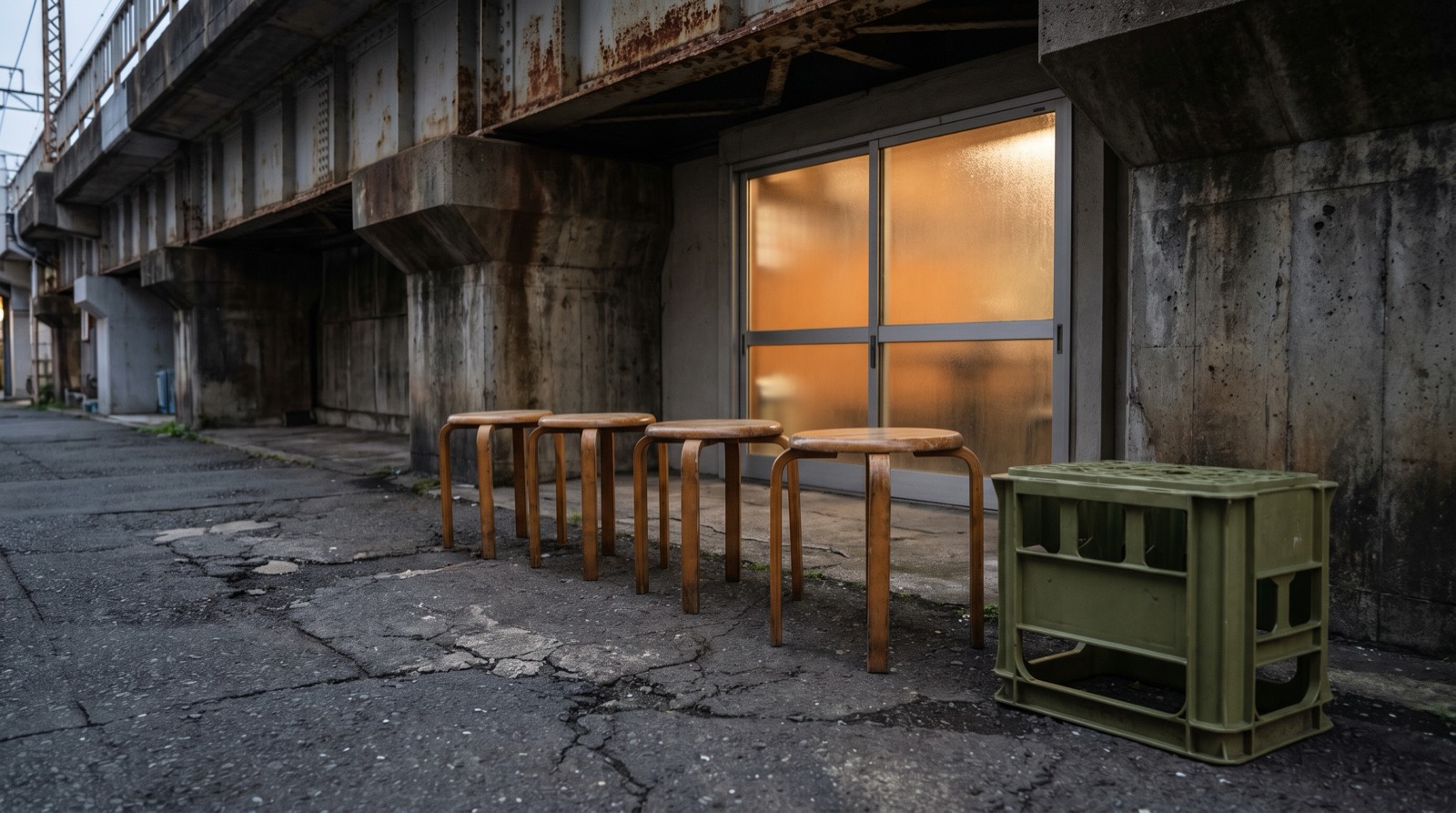
In most of the sushi writing about Japan, the difficulty is getting in. Somebody has to call, somebody has to hold a card, somebody has to be free on a Tuesday seven weeks from now. Osaka has all of that, and this journal has covered it elsewhere. This article is about the other Osaka, the one where you turn a corner at half past two on a wet Wednesday, stand at a counter for eleven minutes, pay less than a train fare and leave. That version of sushi is not a lesser version of the first. It is older than most of the restaurants in the first, and in one specific respect it was invented here.
Five counters are described below. Not one of them requires a reservation, and three of them cannot take one at all. Between them they span seventy-nine years of trading, a range of roughly ¥800 to ¥5,000 for a meal, a conveyor belt, a standing counter with no chairs, an L-shaped counter of twelve seats that has been in the same corner since 1951, a nine-seat counter where three of the recommended items have no printed price, and a takeaway window that also seats nine. Four of the five are inside the same hundred-metre corridor.
That corridor is the first surprise, and it is not a sushi corridor. It was built in 1950 as a welfare scheme for retired national railway staff, under a railway viaduct, and it now holds around a hundred businesses of which most sell noodles, skewers, offal, takoyaki, coffee or whisky. The density of walk-in sushi in Osaka is concentrated in a place that was never designed for sushi at all, and understanding why explains more about how you actually eat here than any list of restaurant names would.
The second surprise is a problem, and it is the reason this article had to be researched differently from the others. A restaurant that takes bookings has a commercial reason to keep a page accurate: the page is where the bookings come from. A restaurant that takes no bookings has no such reason. It has a queue, or it has a corridor full of people walking past the door, and neither of those is improved by updating a website. So the easiest restaurants in Osaka to walk into are among the hardest to find out anything about, and the gap is filled by other people — a landlord, a trade association, a listings platform, or the customers themselves.
What follows is the five, what each one publishes, who publishes it, and what is missing. There is no ranking. There are no photographs of any of these restaurants in this journal, and no links to book them, because four of them cannot be booked.
- Ganso Mawaru Genroku Zushi, main shop — Higashi-Osaka, forty counter seats, no reservations, the first conveyor belt sushi shop in the world, opened April 1958
- Tachizushi Shioya — Shin-Umeda Shokudogai, ten standing places, no reservations, opened May 2015 by a company that has run a standing noodle counter twenty metres away since 1969
- Harukoma — Shin-Umeda Shokudogai, twelve seats on an L-shaped counter, no reservations, trading since 1951, evenings only
- Akanoren — Shin-Umeda Shokudogai, nine seats plus stools, all three of its recommended dishes are priced at market rate, the only one of the five where smoking is permitted throughout
- Umeda Yoshino Zushi — Shin-Umeda Shokudogai, nine seats, open every day of the year from eleven in the morning, cash only
One practical note before the restaurants. Every figure below — hours, seat counts, prices, the days a shop is shut — is a published value read in the first days of August 2026, and restaurants in this corridor change all four without notice. Four of these five publish an average spend figure, and in every case it was published by somebody other than the restaurant. Keep that in mind when reading the numbers below. They are what a landlord or a trade association believes a customer spends, which is a different thing from a price list.
The plate colour is the price list
The origin story is short and it is told by the company itself, on a page that has not been redesigned in about a decade. In 1948 a restaurant operator in Osaka took an idea from a beer factory in Suita, on the northern edge of the city, where bottles moved past workers on a belt. It took nine years to turn the idea into a machine. The rotating conveyor table was completed in 1957. In April 1958 the first shop opened in Higashi-Osaka, a manufacturing city immediately east of Osaka proper, and in 1962 the company patented the table.
The company still exists at the same address as the first shop. Genroku Sangyo Co., Ltd. gives its founding as September 1947 and its incorporation as April 1962, states its business as “the sushi restaurant trade, and the franchising of revolving sushi by means of the rotating dining table”, and reports ten directly operated shops and around two hundred and fifty staff. The franchise side of that description is the part that went around the world. The first franchised shop opened in 1968, not in Osaka but in Sendai, six hundred miles to the north.
The year the company chooses to mark as the turning point is 1970, when it exhibited at the World Exposition held in Osaka and was commended as an outstanding food service. Its own summary of what happened next is four words long in Japanese and worth translating carefully: the format took hold in society with low prices and displayed prices as its weapons. Not the belt. The belt is the part everyone remembers, and it is the part that got patented, but the company itself names the price and the visibility of the price as what won.
The belt is what everyone remembers. The company itself says the weapons were the low price and the fact that you could see it.
This is worth sitting with, because it is the exact inversion of the sushi that this journal has spent most of its Osaka coverage on. At the top of the market you are told a total and nothing else: a course number, a person-count minimum, and a room. Here you are told nothing except the price, over and over, on every plate that passes you, and the total is something you assemble yourself and can stop assembling at any moment. Two entirely different theories of how to be trusted, and the second one was formalised in a shop in Higashi-Osaka in 1958.
What the first shop charges, and what its city-centre branches charge
The main shop is at 1-12-1 Ashiro in Higashi-Osaka, next door to a bank, at the same address as the head office. It has forty counter seats. It opens at 11:15 on weekdays and 10:45 at weekends and public holidays, and closes at 22:00 and 22:15 respectively. It takes no reservations of any kind. The only booking function anywhere on the company website is a telephone order form for a wooden tub of sushi at New Year and for family ceremonies, which is a different business entirely.
The price structure is three tiers, and the company publishes both the eat-in and the takeaway figure for each:
- Eat in: ¥165, ¥193 and ¥253 per plate, tax included
- Take away: ¥162, ¥189 and ¥248 per plate, tax included
- The pre-tax figures are identical — ¥150, ¥175 and ¥230 — and the difference is entirely the consumption tax rate, eight per cent on food to take away against ten per cent to eat in
That difference is three to five yen. It is published anyway, on the same line, in the same size. A restaurant that has built its entire proposition on displayed prices does not round the tax away, and once you have noticed that you start noticing which restaurants do.
There are ten shops. One is the main shop in Higashi-Osaka. Seven are in the city and its inner suburbs: Umeda, Shinsaibashi, Sennichimae, Tenroku, Noda, Dotonbori, plus Sakai-Higashi, Takatsuki and Amagasaki, the last of these across the prefectural border in Hyogo. On a map they look like one chain with one menu. They are not.
Read the menu pages and you find every item tagged with the shops that carry it, and the tags fall into two groups that do not overlap. There is a group of nine items at ¥385 and four at ¥750 marked “Dotonbori, Sennichimae and Shinsaibashi only”. There is a separate group marked “main shop, Umeda, Noda, Amagasaki, Tenroku, Sakai-Higashi and Takatsuki only”. The second group’s most expensive item is a scallop at ¥298.
- Tourist-facing three (Dotonbori, Sennichimae, Shinsaibashi): premium salmon, red prawn, seafood pile, roast beef, eel and beef, grilled beef, bluefin chutoro, seared pen shell, Kobe beef hamburger at ¥385; snow crab, bluefin kamatoro, a three-kind seared salmon plate and seared kamatoro at ¥750
- The other seven, including the shop where the belt was invented: cheese hamburger at ¥165, red prawn at ¥253, scallop at ¥298
The ceiling at the birthplace is ¥298. The ceiling two stations away in the tourist quarter is ¥750, two and a half times higher, and both ceilings belong to the same ten-shop company with the same logo over the door. Nobody is being deceived; every plate still carries its price. But if you want to eat at the shop where this was invented, and you assume that the shop where it was invented is the flagship with the biggest menu, you have it backwards. The founding shop has the smaller, cheaper, older menu, and the expansion of the range happened where the visitors are.
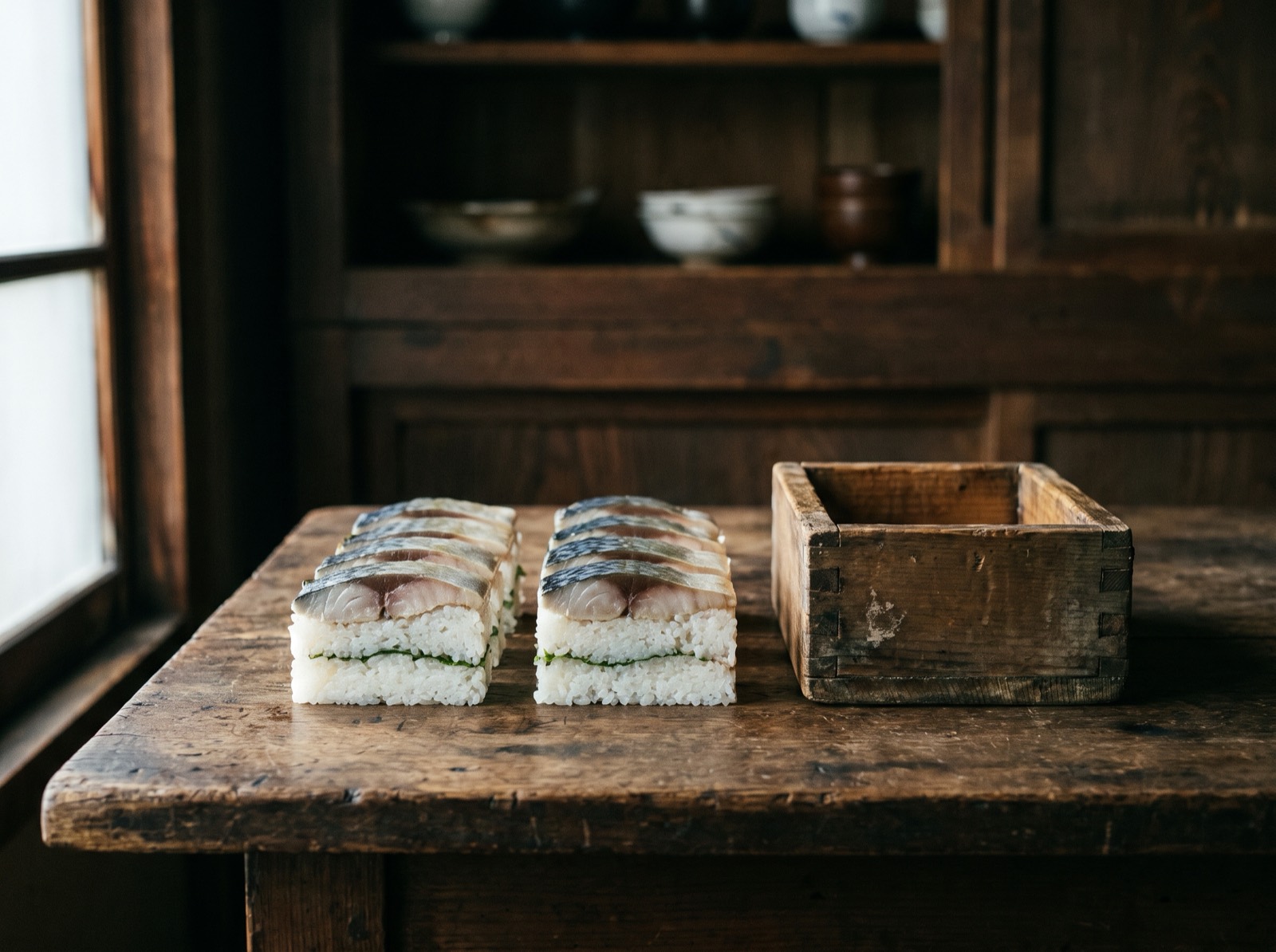
One more detail, because it connects to an earlier article in this series. On the maki page, at ¥165, between the cucumber roll and the pickle roll, sits battera. Pressed mackerel sushi was the subject of an entire article in this journal about four-hundred-year-old Osaka houses that still make it by hand in wooden moulds. Here it is the cheapest thing on the belt, at the same price as a cheese hamburger, and it has been sitting there quietly for years. Both statements are true at once, and neither cancels the other.
A corridor built for people who were passing through
Shin-Umeda Shokudogai opened on 15 December 1950 in the space under the elevated railway tracks on the east side of Osaka Station. Its own history page is unusually candid about why. It was set up as a relief scheme for people who had retired from facilities work in the national railway era — that is, it was a job creation project for former railway staff, not a restaurant development. The association’s own account says the founders were amateurs at catering, and reasoned that in Osaka, a city that eats itself into ruin, they could probably manage; they persuaded two or three professionals already trading to join and take the others through it.
It opened with eighteen shops. It now has around a hundred, on two floors, in an area you can walk end to end in under two minutes. By 1956 it was up to forty. In 1969 the Hankyu department store railway terminal moved to its present position and the northern end of the corridor found itself facing the entrance of a new station. In 1970 the World Exposition filled the passageway itself with people who could not get into the shops.
The name is worth a paragraph because it is the corridor explaining itself. In Japanese the ordinary word for a group of eating places is shokudo-gai, written with a character meaning hall. This place is shokudo-gai written with a different second character, the one meaning road or way, which makes the compound read as alimentary canal. The association credits the naming to the late head of one of its member restaurants, and records his reasoning: a hall is where everyone under one roof does the same thing, whereas here you have shops feeding you and pouring for you all lined up along a narrow passage, so it is a road, not a hall.
The first half of the name got the same treatment. The association lists three accounts of why it is New Umeda rather than Umeda, and the one it gives most weight to is deference: the corridor is renting space under the tracks of the national railway’s Osaka Station, and calling yourself Umeda — which is what the private railways call the same place — was not something you did while standing on that particular piece of ground.
A hall is where everyone under one roof does the same thing. Here the shops are lined up along a narrow passage, so it is a road.
None of this is sushi history, and all of it is why the sushi is there. The corridor was built for the traveller and the shift worker: someone with a train to catch, twenty minutes, and a fixed amount of money. Every format that solved that problem migrated in. Standing noodles arrived in 1969. Takoyaki arrived in 1982. Sushi was already there in 1951, one year after the corridor opened, and it is still there under the same name.
Four of the five counters in this article are inside it. That concentration is not an editorial convenience; it is the finding. If you want sushi in Osaka without a reservation, without a phone call and without a plan, a large concentration of it is in a passage built by a railway welfare committee for people who were not staying.
The standing sushi counter that a noodle shop invented
Tachizushi Shioya occupies a small frontage on the ground floor. The corridor association’s page for it calls it a pioneer of standing sushi, describes a bright room that a woman on her own would walk into without hesitating, and gives the following:
- Ten places, standing; telephone 06-6366-0246
- Open 11:30 to 23:00; closing days irregular
- Reservations: not accepted. Cards: accepted. Takeaway: not available. Large groups: no. Non-smoking throughout
- Average spend as published by the association: ¥1,000 at lunch, ¥2,000 in the evening
- House speciality is abalone three ways — live, seared, and liver — one piece each, taken from a tank in the room when you order; there is also an eight-piece nigiri set for people in a hurry, and any single piece can be ordered on its own
Pioneer of standing sushi is the association’s phrase, not the restaurant’s, and the company’s own corporate site quietly contradicts it. Shioya Co., Ltd. was incorporated in February 1969, has its office in Nishitenma about a kilometre south, and publishes a company history. The history says the company opened Shioya Umeda in the corridor in November 1969 and a noodle factory in Nakazaki-cho the same month. Shioya Umeda is a standing soba and udon counter. It is still there, twenty metres from the sushi.
The company’s statement of vision names what it thinks it pioneered, and it is not sushi. It says the company was the pioneer of serving soba and udon — which it calls Japan’s original fast food — in a self-service standing format, and describes itself throughout as a standing noodle operator. Its stated method is to keep the price at fast-food level while doing the work at specialist level: fresh noodles from its own factory delivered to the shops every morning, stock built from Kushiro kelp and a blend of dried fish from Kumamoto and Kagoshima.
The sushi counter opened in May 2015. That is forty-six years after the udon counter, and the company history lists it in one line among the other openings. What the corridor calls a pioneering standing sushi shop is, by its operator’s own account, a standing noodle shop’s method applied to fish: no seat, no booking, order one item at a time, pay a fast-food price, and get work that is better than the price implies. The pioneering happened in 1969 and it happened with udon.
What the corridor calls a pioneering standing sushi shop is a standing noodle shop’s method applied to fish, forty-six years later.
You can see the whole method laid out along one stretch of the corridor, because the company put all of it in the same corner. The association’s page for the curry bar says as much in passing: the northern end of the ground floor is a run of Shioya shops. Five of them, opened across fifty-three years, spelling the same family name five different ways in Japanese script and Latin letters.
- Shioya Umeda, standing soba and udon, opened November 1969: twenty-three standing places, open 6:40 to 23:00, never closed, no reservations, cash only, average spend ¥300 to ¥1,000
- Shioya honten, the sit-down izakaya, descended from a 1971 opening and rebuilt twice, on two floors, the one shop in the group that takes a large party
- Takoyaki Shioya, opened September 1982: half a tsubo of floor area, about eighteen square feet, no seating at all, you eat under the eaves; average spend ¥600
- Tachizushi Shioya, opened May 2015: ten standing places
- Spice curry and wine bar Shioya, opened November 2022: nine counter seats, 11:00 to 22:30, curry at lunch and wine at night
The udon counter opens at twenty to seven in the morning and does not close on any day of the year. That is the anchor tenant of the group and it tells you what the corner is for. In December 1982 the company joined the national association of railway premises caterers, which is the trade body for businesses that feed people inside stations, and that is the correct category for all of this. It is station food, held to a standard that station food is not usually held to, and the sushi counter is the newest member of the set.
What that inheritance means in practice, if you walk in: you will not sit down, you order piece by piece rather than by set unless you want the eight-piece, the rice is seasoned with a kelp stock rather than left plain, and nobody will ask whether you have a booking because there is nothing to book. Ten places. If all ten are taken you wait in the corridor, which at lunchtime is also full of people waiting for udon.
The counter that has been in the same corner since 1951
Harukoma sits at roughly the midpoint of the corridor, on a corner, with two doors; the association’s photograph caption says you may use either. It has been trading here since 1951, which makes it one year younger than the corridor and older than every other restaurant in this article. The room is one L-shaped counter and a glass case, and the case is the menu: what is in it that day is written up on the wall that morning.
- Twelve seats, one L-shaped counter; telephone 06-6311-1816
- Open 17:30 to 23:00, last orders 22:30; closed Sundays and public holidays
- Reservations: not accepted. Cards: accepted. Takeaway: not available. Large groups: no. Non-smoking throughout
- Average spend as published by the association: ¥4,000 to ¥5,000
- Dishes the owner puts forward: sea bream steamed on the bone with kelp, from the Inland Sea; a sake-lees soup served only from around October to March; sea eel grilled plain without sauce; in summer, matsutake in a teapot broth
Look at the third and fourth lines together, because the combination is the unusual thing. Four to five thousand yen a head, in the evening, with a chef choosing, is roughly the price band of a small booked counter anywhere in the city. This one does not take the booking. There is no phone reservation, no online form, no platform. Twelve seats, first come, and when they are gone you stand in the corridor or you go somewhere else.
That is a deliberate position rather than an oversight, and the corridor is full of it. Of the six restaurants examined for this article that trade inside Shin-Umeda Shokudogai, five accept no reservations at all. The corridor is two minutes from the concourse of one of the busiest stations in Japan. A booking system would allocate the seats in advance; the corridor allocates them to whoever is standing there. Both are rationing systems. One of them favours the person who planned four weeks ago, and the other favours the person who is hungry now, and this corridor has picked a side and held it for seventy-five years.
The seasonal detail is worth taking seriously, because it is the part that cannot be faked by a chain. A sake-lees soup for five months of the year, matsutake in a teapot in late summer, sea bream steamed whole on the bone so the broth left behind is the point: these are the movements of a small kitchen that buys what is there. The counter that serves them is the same size it has been for three quarters of a century, and it opens at half past five in the afternoon and not before.
And at the bottom of the association’s page for it, after the dishes and before the photographs, there is one line in smaller type that is the reason this restaurant leads to the next section. It reads, in full: this restaurant has no connection whatsoever with the Harukoma in Tenjinbashi.
The other Harukoma, and the question of who writes the page
A restaurant does not print a disclaimer unless it is being confused with something, repeatedly, by enough people to make printing it worthwhile. The 1951 counter under the railway arches has to spend a line of its own description telling you it is not the other one. That single sentence reveals something real about how sushi information moves around Osaka.
The other Harukoma is real and it is about three kilometres north-east, in the Tenjinbashi district, on a long covered shopping street. It is a different business with a different telephone number, and by the ordinary evidence of the internet it is much better known than the one in the corridor. Here is everything a visitor can establish about it from the page that ranks for its name, which is a listing on a large national restaurant platform:
- Address 5-5-2 Tenjinbashi, Kita-ku, Osaka; telephone 06-6351-4319
- Open 11:00 to 21:30, Monday and Wednesday to Sunday; closed Tuesdays
- Three minutes on foot from exit 12 of Tenjimbashisuji 6-chome station
- Category: sushi restaurant
- Seats: not stated. Private rooms: not stated. Smoking policy: “please contact the restaurant”. Cards: not stated. Average spend: not stated
The machine-readable data embedded in that same page carries a price range field, and the value in it is a yen sign followed by a zero. The photographs on the page are labelled as supplied by users. The menu section carries a note saying the items listed are based on customer reviews. In the place where the seat count would go, the platform prints an invitation asking readers to submit the seating and facility information themselves.
So the better-known of the two Harukomas has a public record consisting of an address, a phone number, opening hours, and a set of dishes reconstructed by strangers from memory. The lesser-known one, the 1951 counter, has twelve seats, a last order time, a card policy, a smoking policy, a spend band and four named dishes, because a trade association whose job is to fill a corridor wrote them down.
The better known of the two publishes a price range of zero yen. The lesser known publishes its seat count, its last orders and its winter soup.
There is a mechanism behind this and it is not carelessness. Earlier in this series, looking at five counters in Umeda and Kitashinchi, the finding was that the most reliable page about those restaurants was usually the booking engine, because that is the one page a restaurant has a commercial reason to keep current. This article is the same finding seen from the other end. Take away the booking, and you take away the reason. A restaurant with a queue at the door does not lose a single cover by letting its listing rot, so the listing rots, and what fills the vacuum is a platform’s template and other customers’ recollections.
The practical consequence for anyone planning a trip is uncomfortable but simple. The easier a restaurant is to walk into, the less you should expect to know before you arrive, and the more of your checking has to happen on the pavement: reading the case, reading the wall, reading the prices on the plates. That is not a failure of research. It is the shape of this part of the market, and the five restaurants here are all legible in person and all partly illegible in advance.
A price that is not published at all
Akanoren is the third of the corridor counters and the one that most resembles a neighbourhood sushi bar that happens to be indoors under a railway. It is run by its proprietress, it is counter seating only, and the first thing in front of you when you sit is a glass case that the association’s writer describes as unusually colourful for a sushi case: fish arranged with lemon, myoga ginger and vegetables among them.
- Nine seats plus additional stools; telephone 06-6313-4466
- Open 15:00 to 22:30 Tuesday to Saturday, 13:00 to 22:30 on Sundays and public holidays; closed Mondays
- Reservations: accepted. Cards: accepted. Takeaway: available on some items. Large groups: no. No private room
- Smoking permitted throughout — the only one of the five where this is so
- Average spend as published by the association: ¥3,000
Three dishes are singled out on that page: bonito sliced as sashimi, filefish nigiri, and scabbard fish nigiri seared on the outside only. Against each of the three, where a price would be, the page prints the two characters that mean market rate. Not a range, not a from-price, not an approximate figure. The restaurant sells the things it is proudest of at whatever they cost that week, and says so.
This is the exact opposite pole from the conveyor belt in Higashi-Osaka, and the two are twenty minutes apart on the same railway. One shop stakes its reputation on the fact that you can read the price of every single item before it reaches you. The other names three dishes and declines to price any of them. Neither is hiding anything; they are answering different questions. The belt answers what will this cost. The case answers what is good today, and treats the price as a consequence of the answer rather than a term of the deal.
If a counter tells you a dish is at market rate and you would rather not find out at the end, the way to handle it is to ask before ordering, in yen, and it is a completely normal question here. Osaka is not a city where asking what something costs is considered a breach of manners. It is the city whose most exported restaurant format was built specifically so that nobody would ever have to ask.
The sourcing line on this restaurant is the one that links back through this journal. Its fish comes, and has come since the previous generation of the family, from Kuromon market. Kuromon is in Nipponbashi in the southern half of the city, a covered market where an earlier article in this series looked at five counters that sit inside it or beside it and buy from the stalls around them. Akanoren is at the opposite end of Osaka from that market, under the tracks on the north side, and the fish still comes up from there every day. The two halves of the city that this journal has treated as separate chapters are, at the level of the boxes moving at six in the morning, one system.
The smoking policy deserves emphasis because it is unusual now and because it is the kind of thing that ruins an evening if it is a surprise. Japan tightened its indoor smoking rules substantially in 2020, and small establishments that were already trading were able to continue permitting it under transitional arrangements. Four of the five counters in this article are non-smoking throughout. This one is not, and the corridor publishes that plainly, which is more than the platform page for the other Harukoma manages.
Nine seats, a takeaway window, and no card machine
Umeda Yoshino Zushi is the fifth, and it is the one that most obviously does two jobs at once. It faces the passage near the station end, next to a fast food counter, and a substantial part of its trade walks up, buys sushi in a box and keeps going. Behind that window are nine seats, and the same people making the boxes will make you whatever you point at, one piece at a time.
- Nine seats; telephone 06-6315-0151
- Open 11:00 to 22:30 every day, weekdays and weekends alike; no closing day at all
- A lunch service runs 11:00 to 14:00, on weekdays, weekends and public holidays
- Reservations: accepted. Takeaway: yes. Cards: not accepted. Large groups: no. Non-smoking throughout
- Average spend as published by the association: around ¥800 at lunch and around ¥2,000 in the evening
Read the fourth line again. This is the only restaurant of the five that takes reservations and does not take cards, which is precisely the reverse of what a visitor would guess. The two conveniences do not travel together. Elsewhere in the corridor, the standing sushi counter takes no booking and takes cards; the 1951 counter takes no booking and takes cards; the belt shop in Higashi-Osaka takes neither. There is no rule here that you can apply. There is only the per-restaurant fact, published by a trade association, and it is worth reading before you join a queue with an empty wallet.
The always-open figure is the other thing to notice. Eleven in the morning until half past ten at night, seven days a week, with no closing day in the year. In a district where the counters open at three, at half past five, or not at all on a Sunday, one nine-seat sushi bar is simply always there. If you arrive in Osaka at an awkward hour with luggage and no plan, that is a genuinely useful fact and it costs about eight hundred yen to use at lunchtime.
There are two named sets. An omakase set at ¥1,350, which is the chef choosing what to hand you, and an early-evening set that pairs three small things — sashimi, egg, salted squid — with a drink, aimed squarely at somebody stopping between the office and the train. The word omakase is doing very ordinary work in that first sentence, and the contrast with what the same word buys three stops away is the whole argument of the previous article in this series, which followed five lunchtime omakase counters in Osaka from ¥4,000 to ¥20,000. Here it is ¥1,350 and it means the same thing: you are not choosing.
The owner is quoted on the association’s page saying something that the rest of this article has been circling. Younger people, he says, seem to feel a sushi restaurant is a high threshold, hard to walk into; but this is not a place that puts on airs. That is a sentence about a doorway, not about fish, and every restaurant in this article is in the business of lowering that doorway by a different method — a belt, a standing rail, a corridor, a takeaway window.
One footnote on the name, offered as a curiosity and not as a claim. An earlier article in this journal covered the old Osaka houses that make pressed box sushi, and one of them, founded in 1841 and still trading in Awajimachi, is called Yoshino Sushi. This nine-seat counter in the corridor is called Umeda Yoshino Zushi. The corridor’s page says nothing about any relationship between them, in either direction. Compare that with Harukoma, whose page states flatly that it has no connection to its namesake. When a restaurant wants the confusion cleared up, it clears it up; when the page is silent, the honest answer is that we do not know.
When a restaurant wants the confusion cleared up, it says so on the page. When the page is silent, the honest answer is that we do not know.
Three ways to declare a price, and a fourth
Put the five side by side and what separates them is not quality, region or formality. It is the method each one uses to tell you what the meal will cost, and there are only three methods in use here.
The first is the plate. The belt shop prints three figures — ¥165, ¥193, ¥253 — and attaches one of them to every object that passes your seat, along with the takeaway equivalent, three yen lower, because the tax rate differs. The total is not stated anywhere because the total is your decision, taken plate by plate, and revisable until you stand up. This is the format Osaka exported to the world, and the company that built it says in its own history that the displayed price was the weapon.
The second is the band. Four of the five have an average spend published for them — ¥1,000 and ¥2,000, ¥4,000 to ¥5,000, ¥3,000, ¥800 and ¥2,000 — and in every case the publisher is the corridor’s trade association rather than the restaurant. It is an estimate written by a landlord about its tenant. It is also, for four of these five, the only price information we could find, and it is more useful than nothing by a wide margin. Treat it as an order of magnitude, not a bill.
The third is market rate: the price is not declared, because it is not known until the fish is bought. One counter here does this on all three of its recommended dishes. It is the oldest arrangement of the four and the one that requires the most trust in both directions, and it survives at a nine-seat counter under a railway line charging around three thousand yen.
The fourth method is the one this journal has spent most of its Osaka coverage on and which does not appear in this article at all: the course. A number, a duration, a minimum party size, and no itemisation whatsoever. It is the method of the booked counter, and it is the only one of the four that requires you to decide the total before you have seen the fish. The five restaurants here have between them seventy-nine, seventy-five, sixty-eight and eleven years of trading and not one of them uses it.
What taking no reservation actually costs you
Walking in is not free. It is paid for in a different currency, and these are the terms as far as they can be established from what these restaurants publish.
- Seats: ten standing, twelve, nine plus stools, nine, and forty. Four of the five are single-figure or barely above it, so a party of three is already a hard problem and every one of the five states that it cannot take a large group
- Timing: the corridor counters open at 11:30, 15:00, 17:30 and 11:00 respectively, and close between 22:30 and 23:00. The evening counter is shut on Sundays and public holidays; the market-rate counter is shut on Mondays; the takeaway counter never shuts
- Payment: cards are accepted at the standing counter, the 1951 counter and the market-rate counter, and not accepted at the nine-seat takeaway counter or at the belt shop’s own reservation-free service. Carry cash
- Air: one of the five permits smoking throughout. The other four do not
- Language: none of these five publishes an English menu, and the corridor’s own site is the only one of the sources here that exists in English, Chinese and Korean at all. The belt shop needs no language because the plates carry prices; the others will need pointing
- Certainty: no restaurant in this article can promise you a seat at any hour, and three of them cannot even be asked
The busy hours are predictable from the geography. The corridor sits between a national railway terminus and two private railway terminals, so it fills when the trains fill: roughly noon to half past one, and again from six to eight in the evening. A nine or ten-seat counter turns over quickly, and a quarter of an hour outside those windows is usually the difference between waiting and walking in.
If the counter you wanted is full, the corridor is the answer to its own problem. There are about a hundred businesses in it and several of the others also sell sushi — among them a standing sushi and drinking bar with fifty-eight places, two pieces from ¥165, single dishes from ¥319 and a glass from ¥385, which is the same entry price as the belt shop with a different room around it. Nothing in this corridor asks you to have decided in advance, which means nothing in it can disappoint you by being full.
How to use these five
The four in the corridor are within ninety seconds’ walk of each other on the east side of Osaka Station, and the sensible way to treat them is as one address with four doors: lunch at the nine-seat counter or the standing counter, mid-afternoon at the market-rate counter when the rest of the city is closed, evening at the 1951 counter if you are in the corridor by half past five, and the standing counter again at eleven at night when almost everything else has stopped.
The fifth is a separate journey and it is a pilgrimage rather than a meal. The main shop in Higashi-Osaka is fifteen or twenty minutes east of the centre and it is where the conveyor belt began in April 1958. What you get there is a smaller and cheaper menu than the branches in the tourist quarter, forty seats, and the plainest possible demonstration of the idea that made this a widely copied restaurant format in Japan: every price visible, no total, no booking, leave when you like.
And that is the thread running back through all five. This journal has written a great deal about the sushi you have to earn access to, and it will write more. But the format that actually left Osaka and went everywhere was not the booked counter. It was the corridor and the belt: a hundred small businesses under a railway viaduct built for people who were not staying, and a rotating table built for people who wanted to know the price. Everything in this article is still doing that job, seventy-five years later, without asking your name.
Frequently asked questions
Can I really eat sushi in Osaka tonight without booking anything?
Yes, and in more places than the five here. Three of these five accept no reservation of any kind, so arriving is the only method available. The constraint is not access, it is size: the counters have ten standing places, twelve seats, nine seats plus stools and nine seats respectively, and all four state that they cannot take a large party. A single diner or a pair will usually get in within fifteen minutes outside the peak windows of roughly noon to 13:30 and 18:00 to 20:00. A group of four should expect to split up or to eat somewhere else. The fifth restaurant, the conveyor belt shop, has forty seats and takes no reservations either, which in practice makes it the easiest of the five to walk into.
Why is it so hard to find information about restaurants that take no reservation?
Because the incentive that keeps a restaurant page accurate is the booking that comes through it. Remove the booking and the page stops earning its keep, so it is not updated, and other people fill the gap. In this article the gap is filled well in four cases, by the trade association that runs the corridor: it publishes seat counts, last order times, card policy, smoking policy and an average spend for each tenant. In the fifth case, a well-known sushi restaurant elsewhere in the city, the gap is filled by a national listings platform whose page carries a price range of zero yen, no seat count, a smoking field that reads “please contact the restaurant”, and a menu section that says openly it was assembled from customer reviews.
What is Shin-Umeda Shokudogai and why is so much of this article inside it?
It is a passage of about a hundred small restaurants under the elevated tracks on the east side of Osaka Station, opened on 15 December 1950. Its own history says it was created as a relief scheme for people who had retired from facilities work under the national railway, that it opened with eighteen shops, and that most of the founders had never run a restaurant. It is in this article because the highest concentration of walk-in sushi in Osaka is inside it: four of the five counters here, plus a standing sushi and drinking bar with fifty-eight places, plus others. The corridor was built for travellers and shift workers with twenty minutes and a fixed amount of money, and every restaurant format that solves that problem has migrated into it.
Is the conveyor belt shop in Higashi-Osaka worth the trip out of the centre?
It depends what you want from it. It is not the biggest or the most elaborate branch of its own chain — the opposite. Its menu tops out at a ¥298 scallop, while the three branches in the Dotonbori and Shinsaibashi tourist quarter carry items at ¥385 and ¥750 that the main shop does not stock. What the main shop has is the address where the format started: the rotating table was completed in 1957, the first shop opened here in April 1958, and the company patented the table in 1962. Forty counter seats, no reservations, opening at 11:15 on weekdays. If you want the best plate of fish, stay in the centre. If you want to see where this began, it is fifteen to twenty minutes east.
Do these restaurants take cards, and do any of them allow smoking?
Cards and reservations do not travel together here, so check each one. Of the five, the standing sushi counter, the 1951 counter and the market-rate counter accept cards; the nine-seat takeaway counter does not, and it is also the only one of the five that accepts reservations. Carry cash. On smoking, four of the five are non-smoking throughout and one permits it in the whole room — small establishments already trading when Japan tightened its indoor smoking rules were able to continue under transitional arrangements, and this is one of them. The corridor publishes both facts plainly for every tenant, which is more than most restaurant listings anywhere manage.