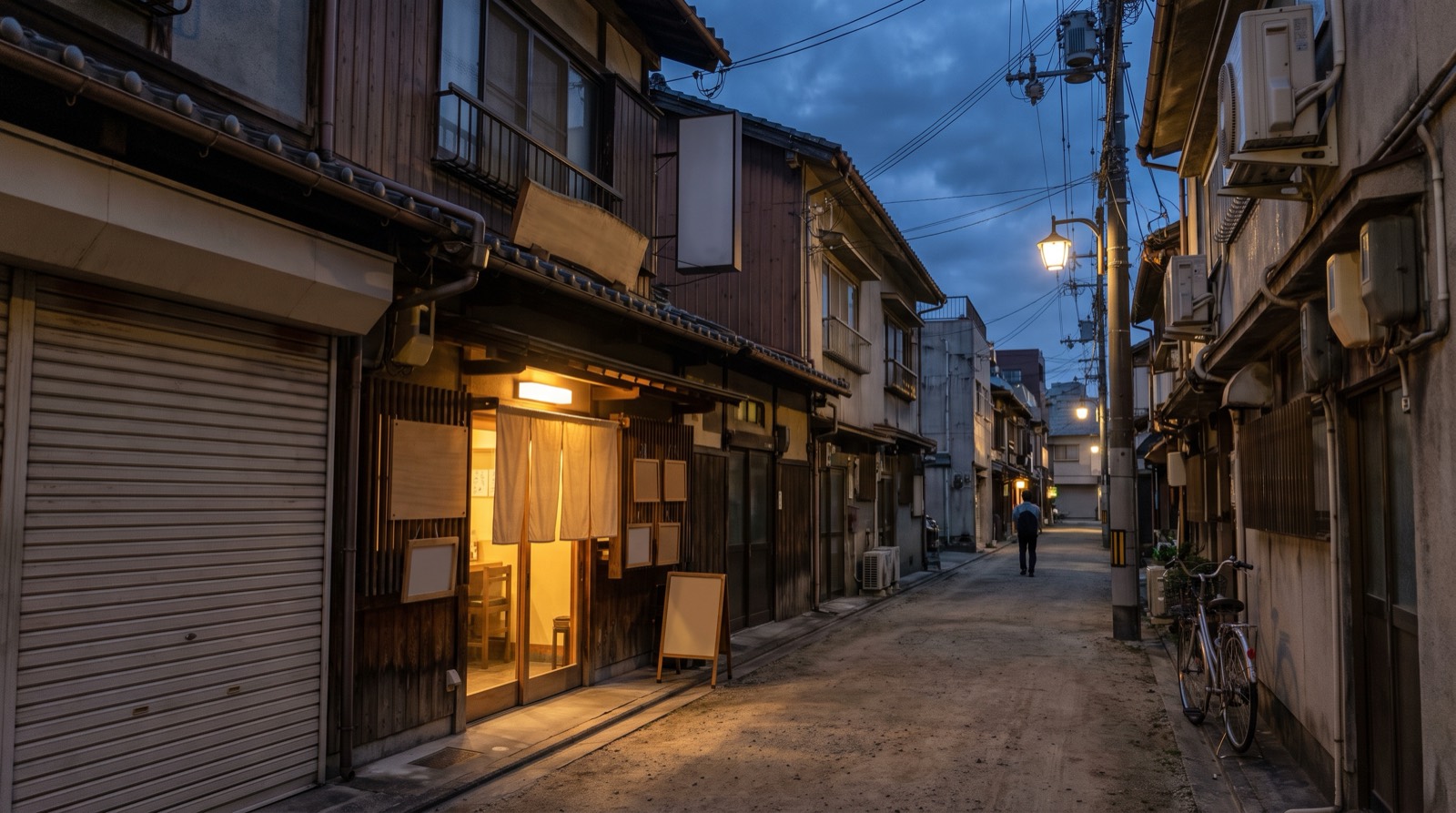
Tokyo spent nine chapters on one question asked nine different ways — not what a sushi counter is like, but what its own page is actually saying — and ended, in Akasaka, on what a printed price covers. Osaka has run three chapters so far, and each one asked a different kind of question about the same word, official: in Shinsaibashi it was who publishes the page that calls itself that, the shop’s own domain or a reservation platform’s template; in Tennoji it was closing day, the one question all five shops should have answered the same way and did not. In Kyobashi it was how many booking or ordering routes an official page actually lists, a count that ran from zero to five without two shops landing on the same number. This is the fourth and last Osaka chapter, and it moves to Fukushima — not Fukushima Prefecture, in Japan’s northeast, but Fukushima-ku, a ward of Osaka City a few minutes’ walk from Fukushima and Shin-Fukushima stations. All five shops here publish a price, somewhere on a page they control. This is not the Akasaka question of what that price includes. It is a narrower one: whether the price is reachable at all, on the path the shop’s own site lays out to reach it, and no two of the five lay out the same kind of path.
All five publish a course price on a page they control, and none of the five hides it on purpose. At the first, the price exists but sits one click below the page a visitor lands on first, absent from the front page entirely. At the second, the price itself does not move, but a companion figure does — the hour the shop says it opens, which reads one way in Japanese and another in English, on the same site. At the third, the evening price is published in full and a lunch time slot is published beside it, and the lunch price simply never appears, on any page, in any language. At the fourth, the price is there, tax marked as included, but it sits inside a menu where two course systems reuse the same two grade names for their tiers, and the cheaper-sounding name in one system costs more than the pricier-sounding name in the other. At the fifth, the official page never states a price at all, and the two links a reader would follow to find one — the course link, the photo link — both leave the shop’s own domain and land on a third-party site this publication does not use as a source. They are set out below in that order: not by rank, but by how far a reader has to travel, inside pages the shop itself controls, before the number actually shows up.
How this was put together
Everything below was read on 8 August 2026, from pages each shop publishes itself. Tabelog, Gurunavi, Retty, Ikyu and Hotpepper are not quoted for a fact here, even at the one shop whose own official page sends a reader directly to one of them for the number this article is about; a price or a course list found on a third-party site is a fact about that site, not about the shop. One of these five pages is built on a platform template rather than a page the shop wrote from scratch, and one more sits on a page-builder service tied to a restaurant directory; both were read as the pages a visitor actually sees, and both are still counted as the shop’s own site because the shop controls the domain.
Where a shop publishes no price, no lunch, or no founding date, the line is left empty rather than filled in from a listing site that does happen to carry one. Where a shop’s own pages disagree with each other — and one of these five does, on a figure that is not the price itself — both versions are printed as found. The order below is not a ranking and it is not evaluative: it runs from the shop where the price sits closest to the front page to the shop where it cannot be reached inside the shop’s own site at all.
Sushi Arai — the price is real, and one click away
One minute from Hanshin Fukushima station, five from JR Tozai Line’s Shin-Fukushima, seven from the JR Loop Line’s Fukushima — the shop’s own front page gives all three walks from three different stations, in that order. Ten seats, counter only, no tables; open for dinner only, 18:00 to 23:30, closed Sundays. The word lunch does not appear anywhere on the site. It opened in February 2025, which makes it the newest of the five here.
The course price is not on that front page. It is not on any page a visitor is likely to land on first. It sits on a separate page headed Menu, one click into the site: a single omakase course, twenty-two thousand yen, tax included, nine courses long. The front page — the one carrying the address, the walking times, the hours and the phone number — states no figure at all.
Booking runs three ways from that same front page: the shop’s own telephone number, a Japanese-language form on TableCheck, and a set of links to My Concierge Japan in English, Traditional Chinese, Simplified Chinese and Korean, each its own address, each linked directly from the shop’s site. None of the shop’s own prose is in anything but Japanese; the four-language reach belongs to the booking step alone, not to the pages that describe the food.
- Where. 1-6-4 Fukushima, Fukushima-ku, Osaka 553-0003 (no English-language address is published; assembled here from the shop’s Japanese postal address). 1 minute from Hanshin Fukushima, 5 minutes from JR Tozai Shin-Fukushima, 7 minutes from the JR Loop Line’s Fukushima station, per the shop’s own page.
- Booking. Phone 06-4300-6700, a Japanese-language TableCheck form, or My Concierge Japan in English, Traditional Chinese, Simplified Chinese or Korean — all linked directly from the shop’s own site.
- Hours. Dinner only, 18:00–23:30. No last-order time is published, and no lunch service is mentioned anywhere on the site.
- Closed. Sundays.
- Price. One omakase course, ¥22,000, tax included, nine courses. The figure is on a separate page headed Menu; the front page states no price at all.
- Seats. 10, counter only. The shop’s own page states explicitly that there are no tables.
Sushi Fumi — the price agrees, the hour does not
Three minutes from the JR Loop Line’s Fukushima station, five from the Tozai Line’s Shin-Fukushima: fourteen seats, ten at the counter and a four-seat private room. The shop states 2015 as the year it first opened, without saying whether this address is the same one. Closed Wednesdays, with the same holiday exception written out identically on the Japanese and English pages: open if a national holiday falls on a Wednesday, or if the following Thursday does.
The price is the one figure here that does not move. Two omakase courses, ¥15,400 and ¥19,300, both stated to include tax and service — and the English page, which the shop built by hand rather than ran through a translator, states the identical two figures in the identical two places. Of the five shops in this piece, Fumi is the only one with prose of its own in English, plus a separate page in Chinese.
What disagrees is not the price but the hour. The Japanese front page gives two starting times in one line — 17:00 as the ordinary opening, 17:30 for a reservation made the same day. The English page drops that distinction and states one figure only: Opening Hours, 17:30 to 23:00. A reader working from the Japanese page and a reader working from the English page would each walk away with a different answer to when the restaurant opens on any night that is not booked at the last minute — not the shape of mismatch this series found across two pages of the same site in Shinjuku, where a price itself split in two, but the same kind of split, landing on a different field.
- Where. 3S Bldg. 1st floor, Fukushima 7-7-24, Fukushima-ku, Osaka 553-0003, in the shop’s own English-language wording. 3 minutes from JR Loop Line Fukushima, 5 minutes from JR Tozai Line Shin-Fukushima.
- Booking. Phone 06-6345-4423, a Tabelog reservation link, or LINE — all linked from the shop’s own site.
- Hours. The Japanese page states 17:00–23:00 (food last order 21:30), with same-day reservations from 17:30. The English page states only 17:30–23:00 (L.O. 21:30). The two pages do not agree on when the restaurant opens on a night that is not booked same-day.
- Closed. Wednesdays; open if a national holiday falls on a Wednesday or the following Thursday does, per both the Japanese and English pages.
- Price. Two omakase courses, ¥15,400 and ¥19,300, both stated to include tax and service. Both figures appear identically on the shop’s Japanese and English pages.
- Seats. 14: ten at the counter, plus a four-seat private room.
Sushi Yugen — a lunchtime with no price in it
One minute from JR Tozai Line Shin-Fukushima exit 2 and from Hanshin Fukushima station; five minutes from the JR Loop Line’s Fukushima. Fourteen seats, with no published split between counter and table. It opened in May 2023, and closes on no fixed day — the shop’s own word for its schedule is irregular, decided week to week rather than announced as a weekday.
Dinner has a published price: eleven thousand yen, tax included, for a nineteen-dish course; the shop also lists that figure as its average budget. That figure is stated once, plainly, with no tilde and no qualifying note.
Lunch exists on the same site and has no price attached to it anywhere. The shop states a lunch time slot, twelve to two, and a rule for booking it — by nine the evening before — but the amount a lunch actually costs is never written down, not on the page that carries the dinner figure, not anywhere else on the site. A reader can find out when lunch runs and how to book it before knowing what it will cost. The domain, sushi-yugen.com, reads as the shop’s own; the page it resolves to is in fact built on Tabiiro, a local-listings template service run by NTT Docomo, though the restaurant behind it is independent rather than a chain.
- Where. 2-10-22 Fukushima, Fukushima-ku, Osaka 553-0003 (no English-language address published; assembled here from the Japanese). 1 minute from JR Tozai Shin-Fukushima exit 2 and from Hanshin Fukushima station, 5 minutes from the JR Loop Line’s Fukushima.
- Booking. Phone 06-7777-5640 is the route the shop itself publishes. A separate booking link on the same page leads to Tabiiro, the platform the page is built on, rather than to a second route the shop maintains itself.
- Hours. Dinner 17:00–22:00, no last-order time published. Lunch 12:00–14:00, booking required by 21:00 the day before.
- Closed. No fixed day.
- Price. Dinner: one course, ¥11,000, tax included, nineteen dishes. Lunch: not published anywhere on the site, though the time slot and the booking deadline both are.
- Seats. 14. No published split between counter and table.
Sakana to Sushi Hoshitsuki — a grade name that means two different prices
Two minutes from the JR Loop Line’s Fukushima station, four from the Tozai Line’s Shin-Fukushima. Fourteen seats, six at the counter, eight at tables. Dinner runs 18:00 to 22:00 on weekdays and half an hour earlier, from 17:30, on Saturdays, Sundays and public holidays; last order is 21:30 either way. Closed Mondays, plus the first and third Sunday of the month. No lunch service is published anywhere on the site, and no opening date for the shop is either.
The price is published, on one page, in full — four courses, tax included, and the page states plainly that all four figures already include tax: 11,000 yen and 13,200 yen under a heading called kaiseki, 9,900 yen and 7,700 yen under a separate heading simply called course. Within each heading the courses are named take (bamboo) for the lower tier and matsu (pine) for the higher, the standard grade names used across Japanese menus generally.
Read within either heading on its own, that ordering holds: matsu costs more than take, in both cases. Read across the two headings, it does not. The kaiseki heading’s take course, ¥11,000, costs more than the course heading’s matsu course, ¥9,900 — the name that is supposed to mark the lower tier, in one system, outpricing the name that is supposed to mark the higher tier, in the other. A diner choosing by the word matsu alone, rather than by which of the two headings it sits under, could land on either the more expensive or the less expensive course without realizing it.
- Where. Izumi Bldg. 2nd floor, 7-5-15 Fukushima, Fukushima-ku, Osaka 553-0003 (no English-language address published). 2 minutes from JR Loop Line Fukushima, 4 minutes from JR Tozai Line Shin-Fukushima.
- Booking. Phone 06-6452-4848, or a Tabelog reservation form linked from the shop’s own site.
- Hours. Dinner 18:00–22:00 on weekdays, 17:30–22:00 on Saturdays, Sundays and public holidays; last order 21:30 either way. No lunch service is published.
- Closed. Mondays, plus the first and third Sunday of each month.
- Price. Kaiseki take ¥11,000, kaiseki matsu ¥13,200; course matsu ¥9,900, course take ¥7,700. All four stated to include tax. The take (bamboo) course under kaiseki costs more than the matsu (pine) course under course.
- Seats. 14: six at the counter, eight at tables.
Both courses are named matsu. Both courses are named take. Read the heading above them and the ordering is exactly what it should be. Read across the two headings and the eleven-thousand-yen take costs more than the nine-thousand-nine-hundred-yen matsu.
Sushi Tsumami — the price that is not on the shop’s own page at all
One minute from the JR Loop Line’s Fukushima station, sixty-two meters by the shop’s own count; one minute from Shin-Fukushima, sixty-six meters — the only shop of the five to give its walking distances in meters rather than minutes alone. Twenty-four seats: eight at the counter, two four-seat tables, and an eight-seat private room. Open Monday, Tuesday, Thursday and Friday from 17:00, Saturday and Sunday from 16:00, both to 23:30 with last order at 23:00. Closed the second Tuesday of every month, and every Wednesday.
There is no lunch service and no course price anywhere on the shop’s own page. The site states the address, the walking distances down to the meter, the phone number, the seating breakdown, the hours and the closing days — all of it in the kind of detail the other four shops in this piece do not always match — and then states no figure for what an evening actually costs.
Two links on that page look like the way to find out: one marked Course, one marked All Photos. Neither stays on the shop’s own domain. Both lead directly to Retty, a review platform this publication does not use as a source for price, for the same reason a figure quoted by a booking platform elsewhere in this piece is treated as a fact about the platform rather than about the shop. The shop’s reservation form is on Retty as well. Of the five shops here, Tsumami is the only one where following the page to the end never produces a price at all.
- Where. Fukushima 2-8-1, Fukushima-ku, Osaka (no English-language address published). 1 minute / 62 meters from JR Loop Line Fukushima station; 1 minute / 66 meters from Shin-Fukushima station, both distances as stated by the shop’s own page.
- Booking. Phone 050-5462-5275, or a reservation form on Retty, linked directly from the shop’s own site.
- Hours. Monday, Tuesday, Thursday, Friday 17:00–23:30 (L.O. 23:00). Saturday, Sunday 16:00–23:30 (L.O. 23:00). No lunch service is published.
- Closed. The second Tuesday of each month, and every Wednesday.
- Price. Not published. The page’s own Course and All Photos links both leave the shop’s domain and lead to Retty, a review platform this publication does not use as a source.
- Seats. 24: eight at the counter, two four-seat tables, and an eight-seat private room.
What the five have in common
All five publish a price somewhere inside pages they control, and at no point does any of them try to hide that a course costs money. What differs is the distance between the page a visitor lands on and the number itself. At one end, the number sits one click below the front page and nothing more. At the other, the number does not exist on the shop’s own domain at all, and the two links that promise to lead to it both hand the reader to a site this publication will not use as a source. Arranged that way, the five run: a price behind one click; a price that agrees with itself but disagrees with a companion figure across languages; a price that exists for dinner and is simply silent for a lunch the same page describes; a price that is fully published and still hard to read correctly because of what its own labels do to it; and a price that never appears on the shop’s page at all.
That order is not a ranking of the five restaurants, and it says nothing about which is better or which is worth more of a visit — this publication has not eaten at any of them. It is only the order of one specific kind of difficulty: how far a reader travels, inside a website the shop itself built and controls, before a number that is genuinely published becomes a number they can actually use.
Finding a price in about a minute
- Do not stop at the front page. One of these five keeps its only price on a separate page headed Menu, reachable in one click and nowhere else; another keeps figures on a page called Course, a name several sites in this series have used for a page that turns out to hold none.
- If the shop publishes pages in more than one language, check whether the hour, not just the price, is the same on both. One shop here states two different opening times for an ordinary weeknight, one on its Japanese page and a different one on its English page.
- A published time slot is not a published price. One of these five states exactly when lunch runs and how far ahead to book it, and never states what it costs; treat the two as separate facts until a figure actually appears.
- Read every price on a menu against the heading above it, not against its name alone. One of these five uses the same pair of grade names, take (bamboo) and matsu (pine), across two separate course systems on the same page, and the cheaper-sounding name in one system costs more than the pricier-sounding name in the other.
- If a link marked Course or Photos leaves the shop’s own domain, follow it before assuming the price is simply missing. On one of these five sites, both of those links lead to a third-party review platform, and the shop’s own page never states a price at all.
That is Osaka’s fourth chapter and, for now, its last. Four questions, in four Osaka districts, about the same word official and the same instinct to trust a number once it is printed: who publishes the page, in Shinsaibashi; how five shops answer one simple question, in Tennoji; how many routes a page actually lists, in Kyobashi; and here, in Fukushima, whether a price the shop has genuinely published can be reached at all before a reader gives up and asks at the door.
If you want to book one of these
Several of the counters described above answer the telephone only in Japanese, and a few of them take bookings by no other route. AutoReserve is a Japanese reservation service with an English interface, and it states that it will place the call on a diner’s behalf where a restaurant takes reservations by telephone alone. We have not tested it against every restaurant on this page, and a listing there is not a guarantee of a seat — the doors described above are the doors either way.
Frequently asked questions
Do all five of these shops publish a price?
Four of the five state a course price somewhere on a page they control. Arai’s is a click below its front page; Fumi’s and Yugen’s dinner prices are stated plainly, though Yugen never states a lunch price; Hoshitsuki’s four course prices are all published on one page. Tsumami is the exception: its own page states no price at all, and the two links that look like they lead to one both go to Retty, a review platform this publication does not use as a source.
Which of these shops does not publish a price at all?
Tsumami. Its own page — sushi-tsumami.foodre.jp — states the address, phone number, walking distances to the meter, seating breakdown, hours and closing days, and then states no course price. The two links marked Course and All Photos both lead away from the shop’s own domain to Retty, a review platform this publication does not use as a source.
Do the Japanese and English pages agree, where both exist?
Only two of the five shops publish English-language content of their own — Arai’s booking links and Fumi’s full English page. At Fumi, the price is identical in both languages, but the opening hour is not: the Japanese page gives 17:00 as the ordinary start, with 17:30 for same-day bookings; the English page states only 17:30. Arai’s English-language reach is limited to its booking links, not to any prose about the food or the price.
Is there a lunch service at any of these five?
Two. Yugen serves lunch, 12:00 to 14:00, booked by 21:00 the day before, and never states what it costs. Fumi and Hoshitsuki state no lunch service at all. Arai’s site never uses the word lunch anywhere. Tsumami’s hours begin at 16:00 or 17:00 depending on the day, with no midday service published.
How should a reader treat a grade name like matsu or take on one of these menus?
Carefully, and against the heading above it rather than the name alone. Hoshitsuki publishes four courses under two separate headings, kaiseki and course, and both headings use the same pair of grade names — take for the lower tier, matsu for the higher. Read within one heading, that ordering holds; read across the two, it does not, because the kaiseki heading’s take course costs more than the course heading’s matsu course.