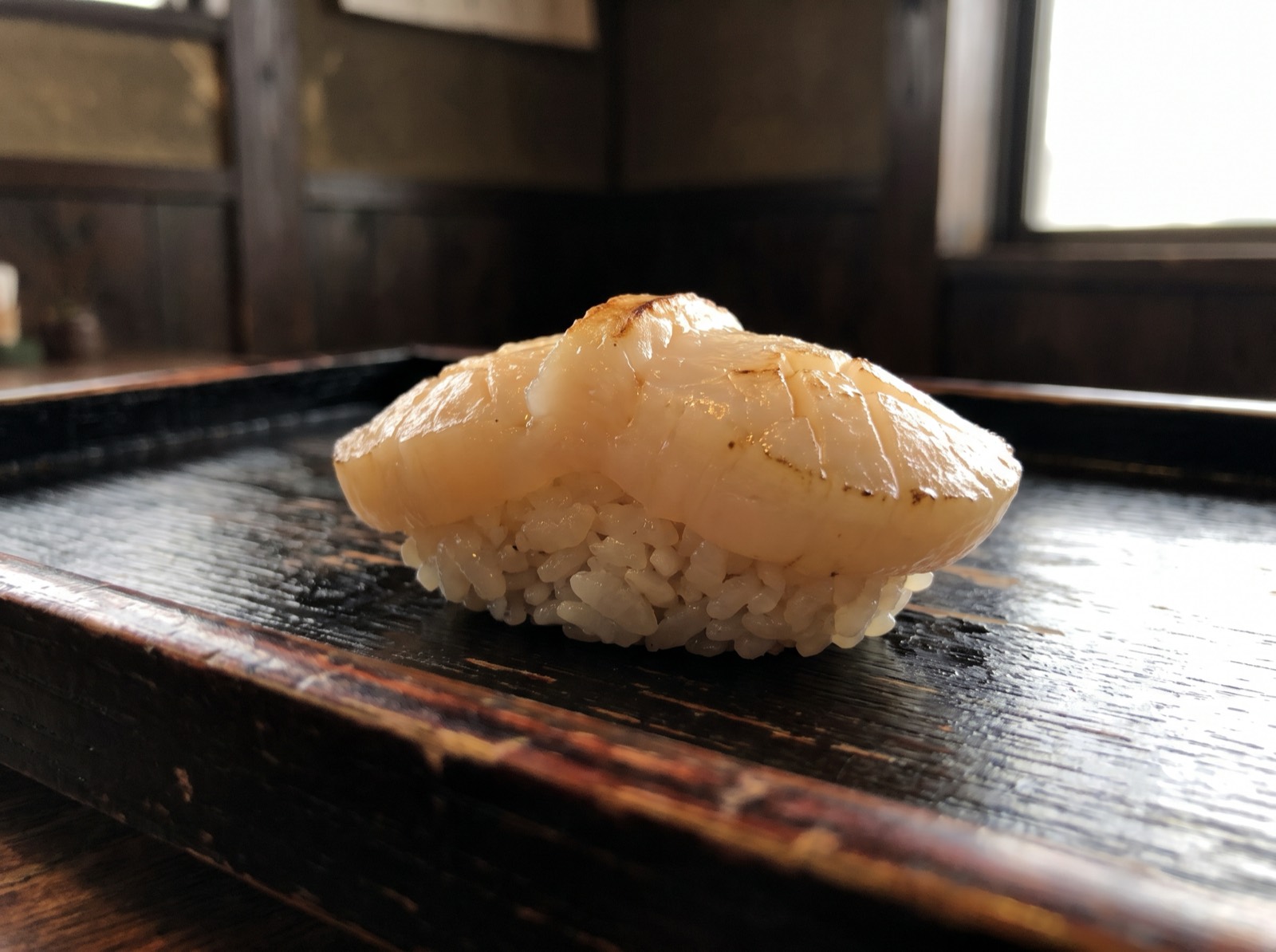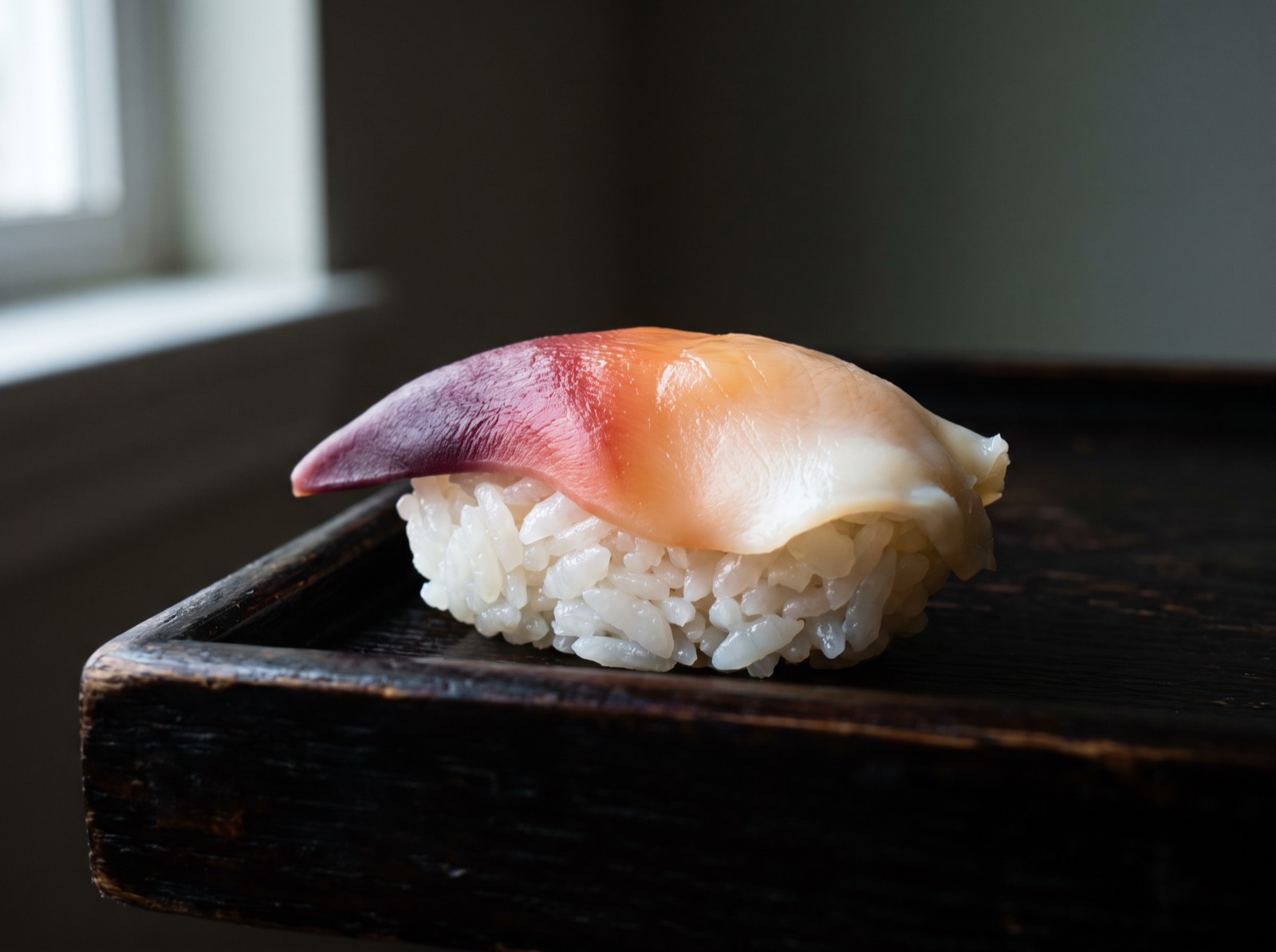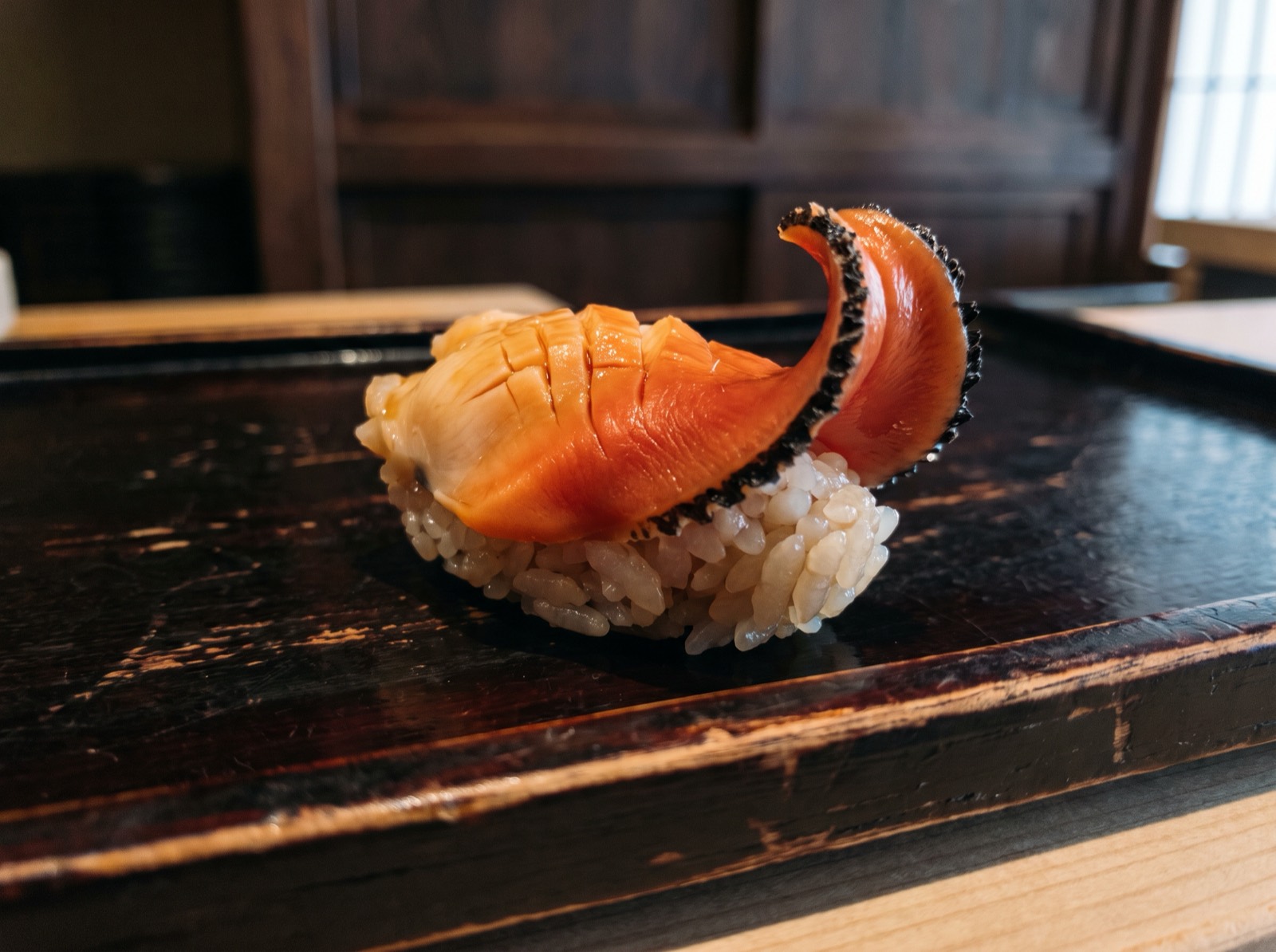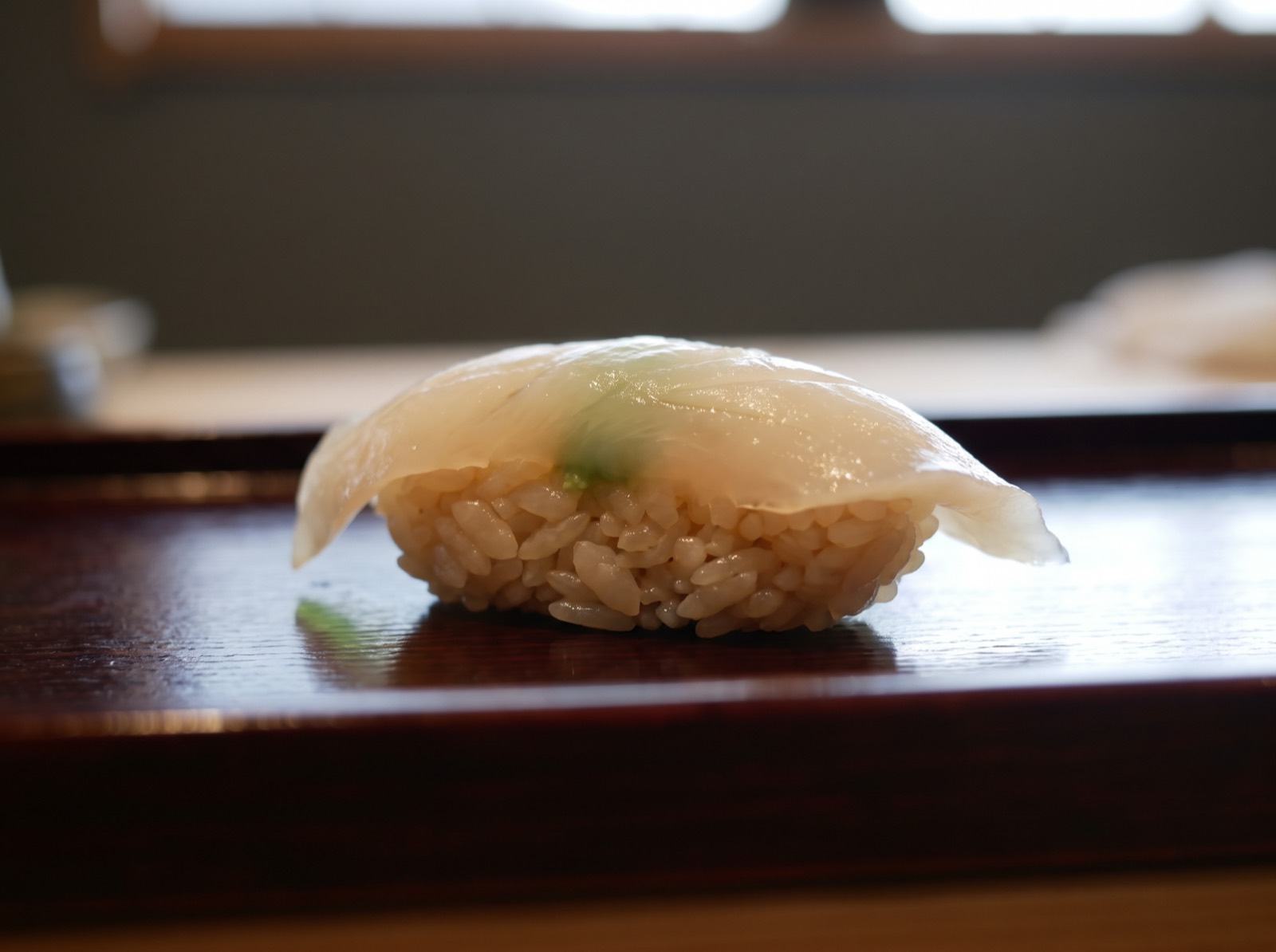
Tairagai (平貝, pen shell) is printed on the menu as its own line, usually a line or two from hotate, and when the two pieces land on the rice they can look like variations on the same idea: pale, faintly glossy, thick-veined muscle. That resemblance is not styling. It is the same organ.
What it is
Tairagai is a large, triangular bivalve that lives buried point-down in the soft mud and sand of sheltered bays, most of its wedge-shaped shell hidden below the surface. What reaches the counter is never the whole animal. It is one piece of it: the large adductor muscle at the centre of the shell, the single muscle that pulls the two halves shut. The mantle, the gut and the rest of the body stay in the kitchen or go in the bin.
In Japanese that muscle has its own word: kaibashira (貝柱), literally “the shell’s pillar”. The word is not specific to tairagai. Any bivalve served as a single opaque disc of muscle — hotate among them — is being served as kaibashira, whatever species name is printed above it on the menu.
The flesh itself is milky white, faintly translucent, with a soft pearl-like sheen under counter lighting. Cut correctly it is thin enough that a smear of wasabi underneath shows through as a shadow rather than a colour, which is most of the reason the cut is thin rather than thick.
The organ it shares with hotate
Order tairagai and hotate on the same course and you are eating the same kind of muscle twice, from two different animals. Both pieces are a single adductor, cut to roughly the same size, and it is that resemblance in shape and size — not just the shared word underneath — that makes the comparison worth making. Plenty of bivalves are served this way; tairagai and hotate are simply the pair most likely to appear side by side on one course and invite the question.
What actually separates them is not the organ. It is what the kitchen does to it next.
When it is best
Late autumn into early spring, the same broad window several cold-water bivalves on this list share, as the animal builds reserves ahead of spawning. The shell is unusually large for something that is ultimately served as a single muscle, and that size turns out to matter for more than the season — it shapes where this piece shows up at all, which the section below on supply gets into.
What the chef does to it
- Sliced thin. Cut lengthwise into a slice rather than a block — the reverse of hotate, which is cut thick specifically to keep its fibre readable. A properly cut tairagai slice is close to translucent.
- Left mostly plain. The flavour is mild rather than sweet, so most counters serve it with little more than a trace of wasabi and nothing on top competing with it.
- Scored, sometimes. A light knife mark across the face, the same logic used on hotate and on cuttlefish: it helps the piece sit flat and lets the surface take seasoning evenly.
- Grilled, occasionally. Away from raw nigiri it also appears seared or lightly grilled, sometimes finished with a strip of nori — a different presentation of the same muscle, not a different ingredient.
The bite is crisp rather than yielding, and more than one reference ranks it ahead of hotate specifically for crunch. The flavour is the mildest of the sushi-counter shellfish: clean, faintly sweet, without the iron note of akagai or the brine of a blanched clam. That firmness is also why the cut is thin: worked into a thin slice, a stiff muscle turns crisp; left thick, the same muscle just chews.
Hotate is cut thick to show its grain. Tairagai is cut thin enough to show the wasabi through it. Same muscle, opposite instinct.
The economics of one shell, one muscle
Hotate is farmed at scale in the north and turns up everywhere from a supermarket case to the cheapest conveyor belt. Tairagai runs the other way. The wild catch has been declining, and aquaculture for it remains at an exploratory stage rather than the established one hotate reached long ago.
Add to that the anatomy itself: each shell, opened by hand, yields exactly one piece of usable muscle. There is no equivalent of buying a case of small ones the way a kitchen might with, say, kobashira, the much smaller adductor muscle taken from a different clam (more on that below). A shrinking wild fishery, no aquaculture at scale, and a single-muscle yield per animal is most of why tairagai stays closer to a counter item than a belt one.
How it differs from what it is confused with
- Tairagai and hotate. Both hand over a single large adductor muscle, and a piece of either can look similar laid on the rice. Tairagai’s is squarer in cross-section, firmer and less sweet — the same organ, in a different animal.
- Tairagai and hokkigai. Both are large shellfish that turn up at the same kind of counter, but the parts don’t match. Hokkigai is the clam’s foot, blanched for a few seconds until the tip turns pink. Tairagai is the adductor muscle, served raw.
- Tairagai and kobashira. Kobashira is also an adductor muscle, but a much smaller one, taken from aoyagi and served as a heap of small pieces rather than one wide slice. Same word underneath, different scale entirely.
- Tairagai and a fish neta. A tuna or salmon nigiri is sliced from a fillet that yields many identical pieces. A tairagai nigiri is close to the entire usable return on one shell, opened once. That is a structural difference, not a matter of taste, and it is most of why the two rarely share a price band.
How to say it
tie-rah-guy will be understood. Closer to the Japanese it is five even beats, ta-i-ra-ga-i, with no syllable stressed harder than the others.
Edomae and Kansai
There is no strong regional story to tell here, and inventing one would be dishonest. Tairagai is not emblematic of Tokyo’s tradition the way kohada is, and it is not tied to Osaka’s pressed styles the way oshizushi is. What connects it to both cities is scarcity rather than geography: at this size, cost and yield per shell, it turns up wherever a kitchen is buying for quality over volume, in Tokyo and in Kansai alike.
Where you will see it, and roughly what it costs
Mostly at counters working in the Edomae style, or toward the higher end of an omakase course. Rarely on a conveyor belt, and rarely at a supermarket fish counter the way hotate is. Because each piece is close to the entire yield of one shell, it tends to appear as its own named item rather than folded into a mixed shellfish plate — a small tell about how deliberately the kitchen bought for that night.
No per-piece figure from us. The comparison worth making, if the menu allows it, is to order tairagai and hotate at the same sitting: the same organ, from two animals, cut in opposite directions for opposite reasons. Little else on the counter makes that point so plainly. See omakase price tiers for what the courses around it cost.
Frequently asked questions
What part of the tairagai is used for sushi?
The large adductor muscle at the centre of the shell — the muscle that closes it — known in Japanese as kaibashira. It is the same kind of muscle served as hotate, taken from a different animal.
Is tairagai the same as hotate?
No. They are different bivalves that happen to be served as the same kind of organ, the adductor muscle. Tairagai’s is squarer in cross-section, firmer and less sweet than hotate’s, and it is cut thin rather than thick.
Why is tairagai sliced thin instead of thick like scallop?
The muscle is firmer than a scallop’s, and cut thin it turns crisp rather than chewy. A thin slice is also translucent enough that a trace of wasabi underneath shows through as a shadow.
How is tairagai different from hokkigai?
A different organ entirely. Hokkigai is the clam’s foot, blanched for a few seconds until the tip turns pink. Tairagai is the adductor muscle, served raw. Both are large shellfish that turn up on similar counters, but the anatomy does not match.
When is tairagai in season?
Late autumn into early spring, the same broad window several cold-water bivalves share, as the animal builds reserves ahead of spawning.
Why is tairagai less common than hotate?
Hotate is farmed at scale; tairagai mostly is not. Wild catch has been declining, aquaculture for it remains exploratory, and each large shell yields exactly one piece of muscle, which keeps it a counter item rather than a belt one.