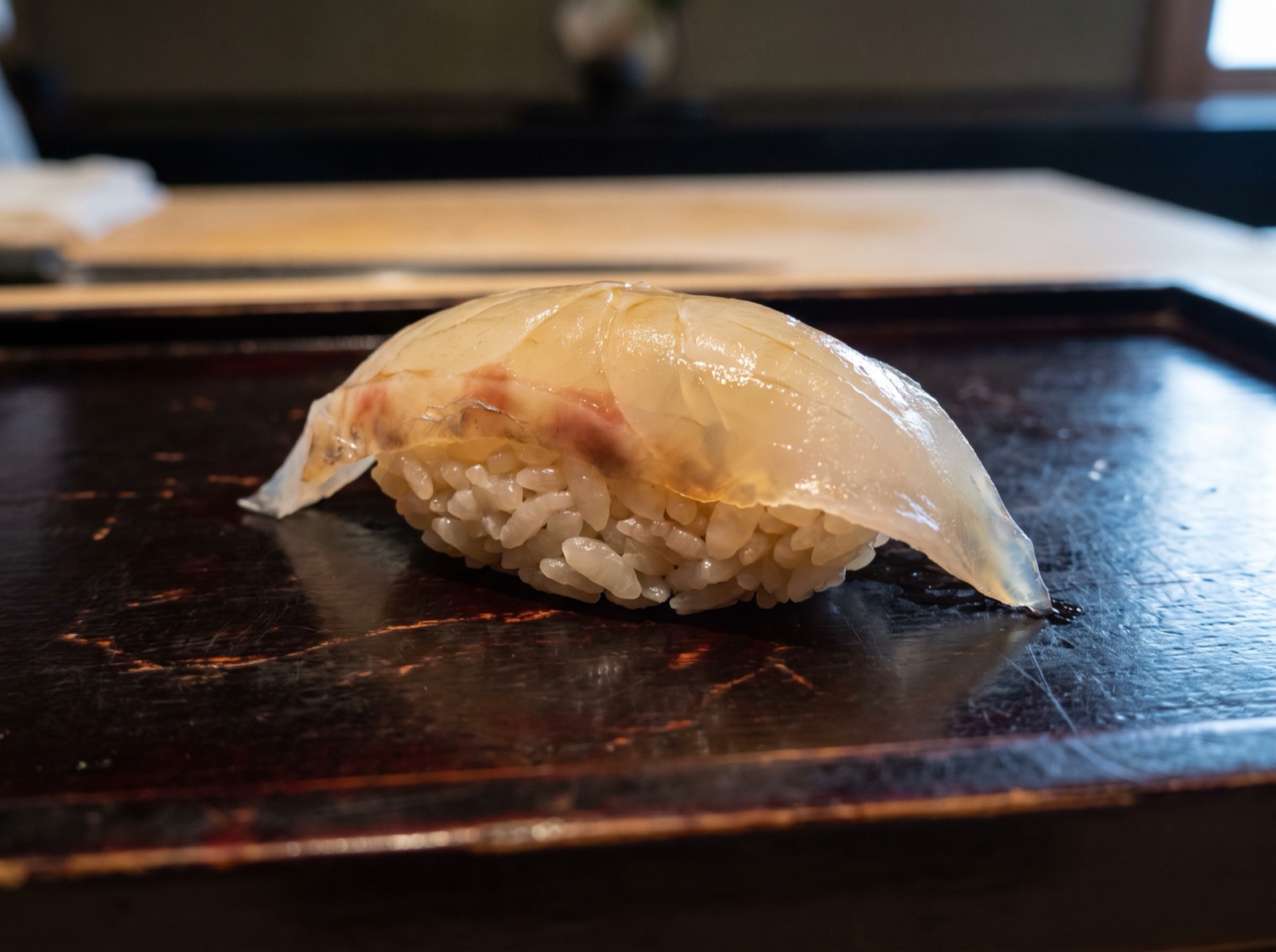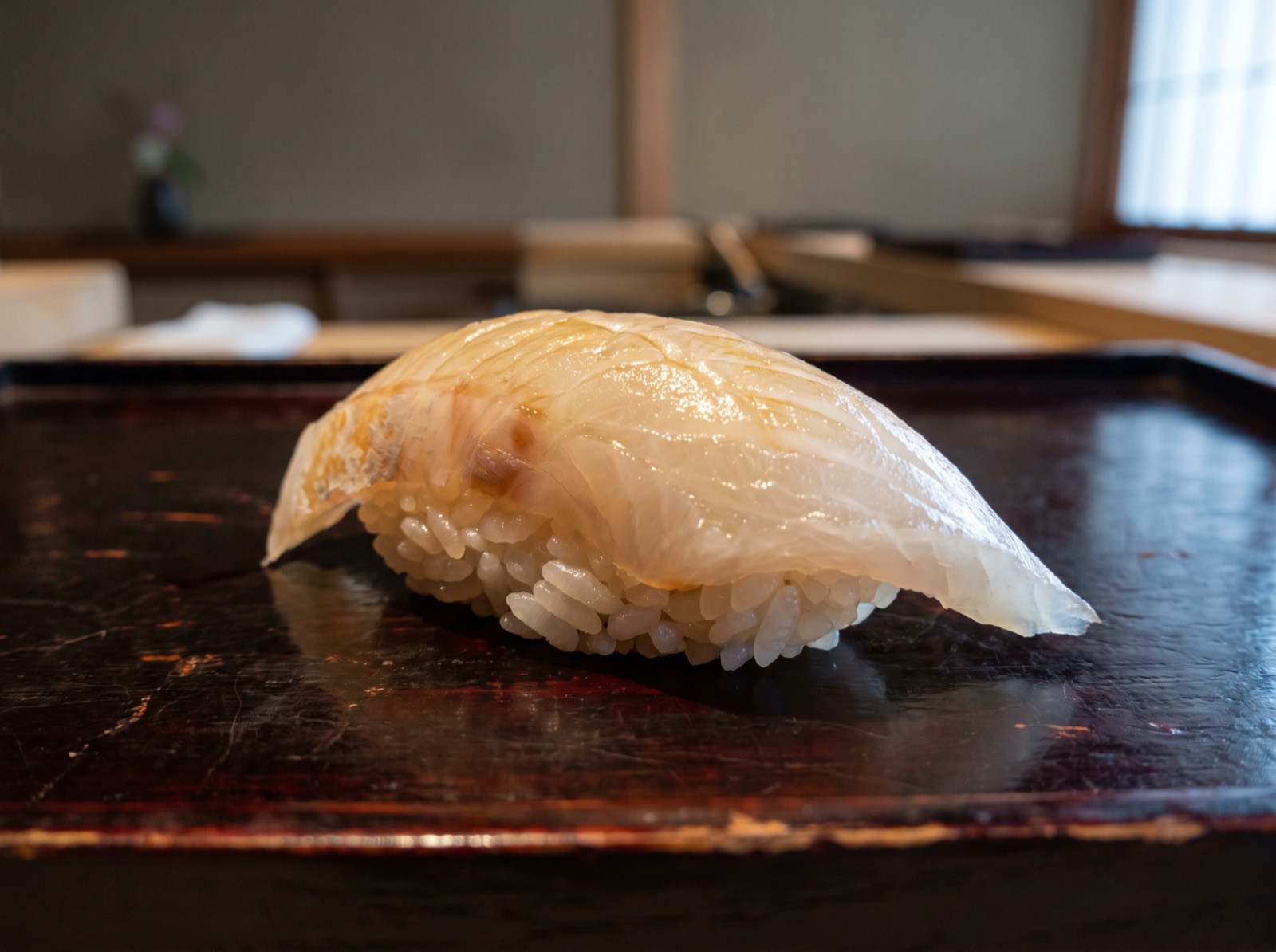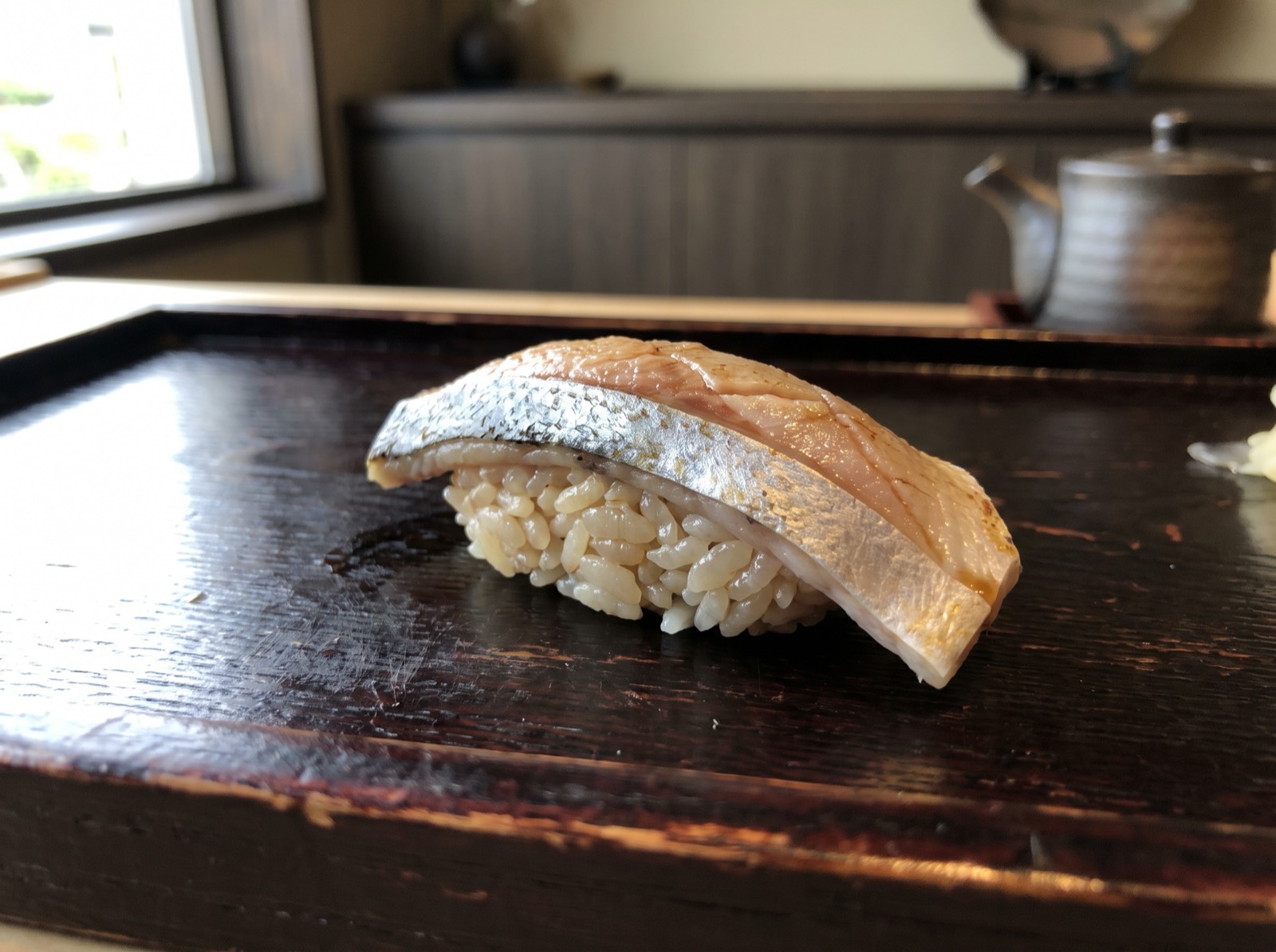
Isaki (イサキ, chicken grunt) is a white fish that peaks in early summer, around and just after the rainy season. It sits between the lean fish and the oily ones: the flesh is white and firm but carries enough fat to be openly rich, and the skin is good enough to keep. It is the fish a Tokyo counter uses to mark the turn of the year into summer.
What it is
A coastal fish of the warmer waters around central and southern Japan, caught at moderate size. The English name comes from the grunting sound the family makes with its swim bladder, which is accurate and does the fish no favours; almost no English menu uses it, and most simply write “white fish” or leave the Japanese.
What distinguishes isaki from the leaner white fish is fat. Madai is a study in restraint; isaki is not. The flesh has a soft richness closer to a light silver-skinned fish, without the assertive character that would put it in that category. It is a fish that reads as generous rather than subtle.
When it is best
Early summer, in the weeks around the rainy season, roughly the period the calendar calls tsuyu. The trade has a name for the fish at this point, mugiwara-isaki (麦藁イサキ), “wheat-straw isaki”, after the time of the wheat harvest. That is when the fat is at its heaviest and when the fish is worth going out of your way for.
This makes it one of the few white fish of real standing that peaks in warm weather. Kinmedai, madai before it spawns, hirame, and most of the fish a counter treats as serious white fish are winter or spring items. Isaki fills a gap in the year that would otherwise be thin. See our seasons guide.
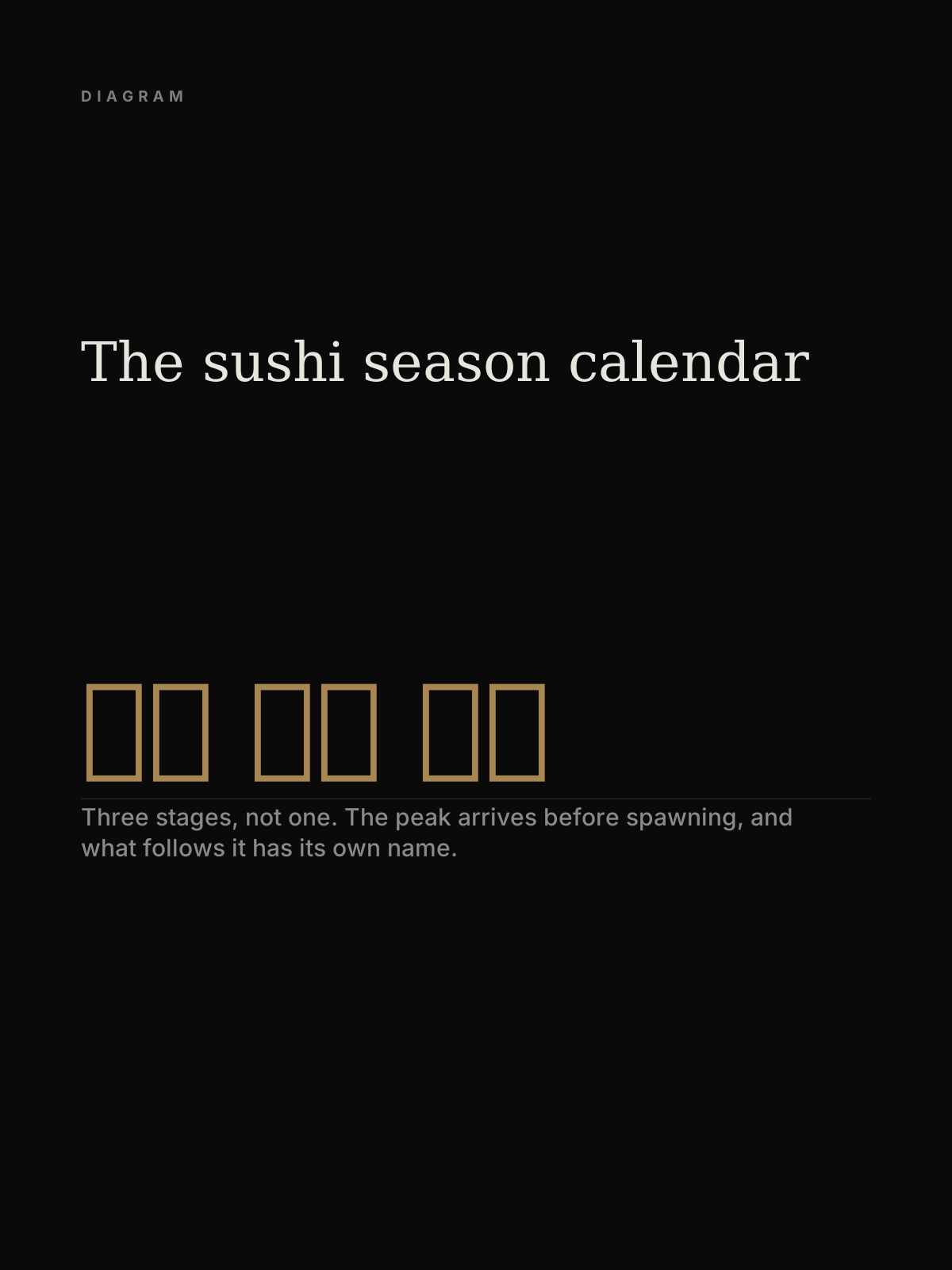
Two things are worth knowing about how that season is described. The trade splits any fish’s year into three: hashiri, the first of the season, thin but wanted for being early; sakari, the peak; and nagori, the tail end, when the catch is large and the fish is past its best. Mugiwara-isaki is the sakari, and it is a narrow window.
The second is that the peak sits before spawning rather than during it, which is the general rule for fish in Japan and the reason a season can end abruptly rather than fade. And because Japan runs a long way north to south, the same fish spawns at different times in different places, so the rainy season that gives isaki its timing is itself a moving date. There is no national calendar entry for this fish, only a shop that has it and a shop that does not.
Almost every prestige white fish in Japan is a cold-weather fish. Isaki is the summer exception, and counters use it as one.
What the chef does to it
- Skin on, treated. Either yubiki, boiling water over the skin side then immediate chilling, or a brief sear. The skin is thin and flavourful and the fat sits under it, so removing it throws away the best part.
- A light salt cure, commonly, to firm the flesh and draw a little moisture.
- Rested rather than served instantly. Like most fish with fat in the flesh, isaki improves over a day.
- Salt and citrus at least as often as soy, for the same reason as other fatty white fish: soy flattens the sweetness.
- Grilled with salt outside the sushi context, which is the classic treatment and an excellent one.
How it differs from what it is confused with
- Isaki is not a bream, though it is often placed next to madai on a course and though the shape invites the comparison. Different family, and a much fatter fish.
- Isaki is not aji. Aji is a silver-skinned oily fish served with ginger and spring onion; isaki is a white fish served plain, and applying the aji treatment to it would be wrong.
- “Chicken grunt” is the correct English name and is essentially never used. If you see “grunt” on a menu, this is probably it.
- The bones are notably firm. This matters to the chef rather than to you, but it is part of why the fish takes work.
How to say it
ee-SAH-kee. Three beats, i-sa-ki, all the same length. The first syllable is a short “ee”, not the English “eye”.
Edomae and Kansai
Both, without much difference in handling. This is a fish that suits the hand-formed style in either city, and the grounds that supply it run along the Pacific and Inland Sea coasts. Where it is treated as a marker of the season, that is a Tokyo habit as much as a regional one. See Osaka vs Tokyo.
Where you will see it, and roughly what it costs
On summer omakase courses, at izakaya as a grilled dish, and occasionally on a good conveyor belt as a seasonal item. It is not rare and it is not a luxury fish, but a large one in peak condition commands a real price and a shop will mention it.
Isaki sits in the middle of the white-fish range, comfortably below shima-aji, around or a little above madai depending on the day. For what a course costs, see omakase price tiers.
Frequently asked questions
What is isaki?
Chicken grunt: a coastal white fish that peaks in early summer. It is firmer and noticeably fattier than the lean white fish, with skin good enough to keep, and it is usually served skin-on with the skin blanched or seared.
When is isaki in season?
Early summer, in the weeks around the rainy season. The trade calls the fish at this point mugiwara-isaki, wheat-straw isaki, after the timing of the wheat harvest; that is when the fat is heaviest.
Why is isaki unusual?
Because almost every white fish of real standing in Japan peaks in cold weather. Isaki is the summer exception, which is why counters use it to mark the turn of the season.
What is isaki called in English?
Chicken grunt, after the sound the family makes with its swim bladder. Almost no menu uses it; most write white fish or leave the Japanese name.
How is isaki served?
Skin on, with the skin softened by boiling water or a brief sear, usually after a light salt cure and a day's rest. Salt and citrus are used at least as often as soy.
How do you pronounce isaki?
ee-SAH-kee, in three flat beats, with a short ee at the start rather than the English eye.