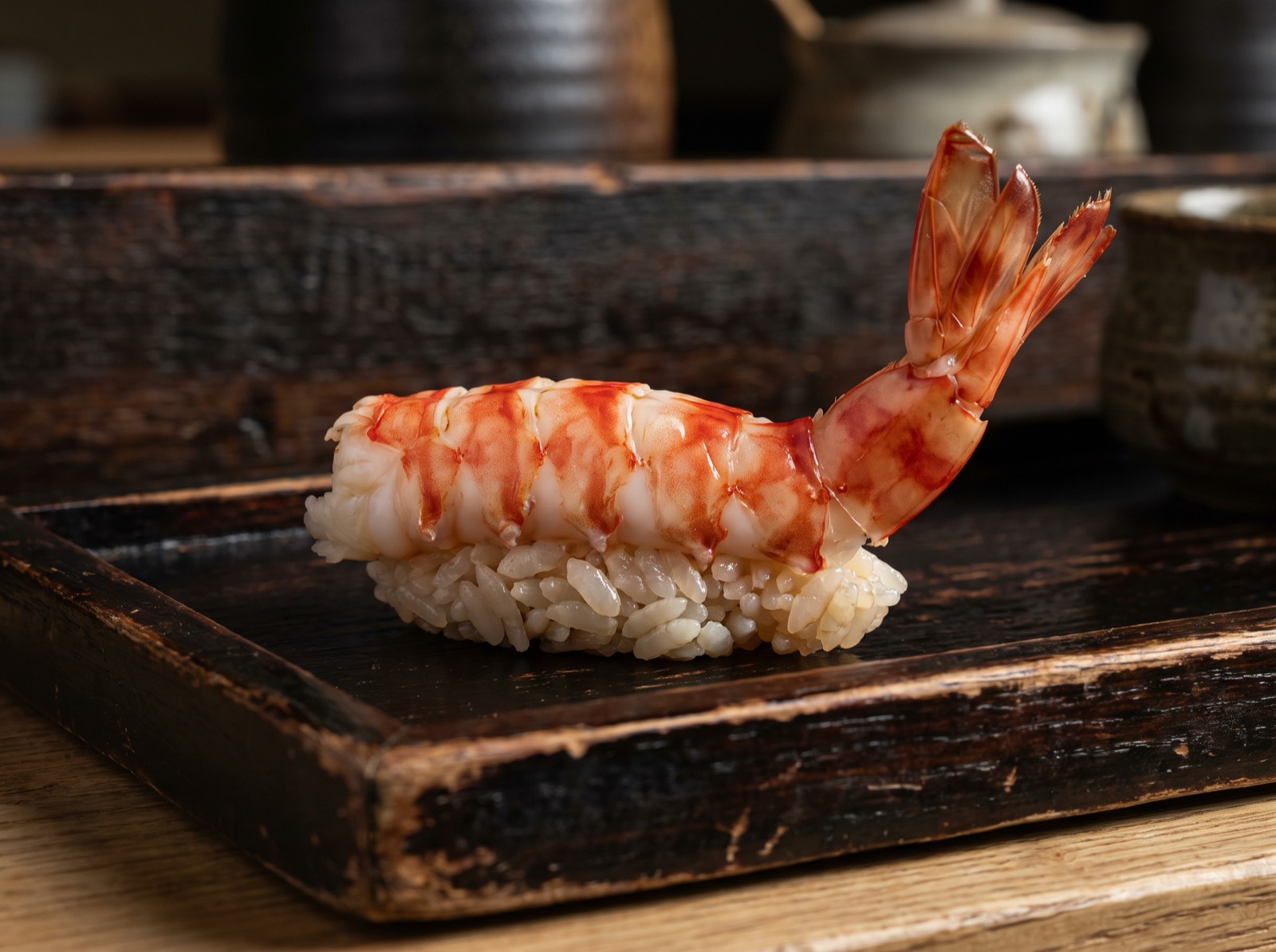
Ebi (エビ) means prawn or shrimp, and at a sushi counter it covers several quite distinct animals prepared in quite distinct ways. Three matter most, and confusing them is the most common prawn-related error in English menus: ama-ebi, botan-ebi and kuruma-ebi.
The three
- Ama-ebi (甘エビ), “sweet prawn”. Small, deep pink-orange, translucent, served raw. Soft to the point of being slippery, and distinctly sweet. Northern cold water: the Sea of Japan coast and Hokkaido.
- Botan-ebi (牡丹エビ), “peony prawn”. Considerably larger, also served raw, with a firmer bite and a fuller flavour than ama-ebi. A premium item; one prawn makes a substantial piece.
- Kuruma-ebi (車エビ), “wheel prawn”. The classical Edomae prawn, and the one served cooked. Boiled briefly, shelled, butterflied and laid over the rice. The name describes the animal curled: its banded stripes come round into the shape of a wheel.
The useful mental model is that ama-ebi and botan-ebi are raw seafood with a sweet, soft character, while kuruma-ebi is a cooked piece belonging to the same family of Edomae work as simmered anago and the egg.
When they are best
Ama-ebi and botan-ebi are cold-water animals and are generally at their best in the colder months, though both are landed across a long season and both are widely available frozen at sea, which, for prawns, is genuinely good practice rather than a compromise.
Kuruma-ebi's traditional peak is the warmer half of the year, and it is farmed as well as wild. As with most items on this site, availability on a menu is not evidence of season.
What the chef does to them
Ama-ebi: very little. Shelled, sometimes briefly chilled to firm it, laid on the rice, and often finished with a touch of wasabi under the prawn rather than a soy brush; the sweetness is easily buried. Some shops serve the head separately, deep-fried or grilled, and it is worth eating.
Botan-ebi: similarly minimal, though the size means it is often scored or split so it drapes properly. Where a shop serves the roe, a blue-green cluster on the underside of a female, it will usually be presented alongside.
Kuruma-ebi: the real work. A live prawn is skewered straight so it does not curl, boiled for a short and precisely judged time, cooled, shelled and butterflied. Cooked too long it turns woolly; cooked correctly it is springy, faintly sweet, and holds a clean snap. Some counters serve it warm, having timed the boil to the piece, which is a small logistical feat and one of the more quietly impressive things a kitchen can do.
The prawn you picture on a piece of sushi is boiled — and getting the boil right is harder than serving it raw.
Odori-ebi, and why we are not enthusiastic
Odori-ebi (踊りエビ), “dancing prawn”, is a live prawn shelled and served while still moving. It exists, it is a real practice at some shops, and visitors encounter it more often in travel content than at counters.
Our position, stated once: it is a novelty rather than a technique, the eating quality is not better than a properly handled chilled prawn, and a reader who is uncomfortable with it is not missing anything. Nobody at a good counter will think less of you for not ordering it.
How they differ from what they are confused with
- Ama-ebi is not “sweet shrimp” as a grade. It is a specific animal, and the sweetness is a real chemical property that develops in the flesh rather than a description of quality.
- Botan-ebi is not simply a big ama-ebi. Different species, firmer texture, different flavour.
- Kuruma-ebi is not a lesser choice for being cooked. It is the Edomae classic. Cooking prawns was standard practice in a period when raw shellfish was a genuine risk, and the technique survived on merit.
- “Ebi” on a cheap menu usually means neither of the three: it is most often a farmed tropical prawn, boiled, and perfectly pleasant without being any of the above.
How to say them
EH-bee, two flat beats. ah-mah-EH-bee, boh-tahn-EH-bee, koo-roo-mah-EH-bee: in each case flatten the stress and give every syllable equal length. Kuruma is the ordinary Japanese word for a wheel or a car, which makes it one of the easier ones to remember.
Edomae and Kansai
Kuruma-ebi is Tokyo's, historically and definitionally: an Edomae classic associated with Tokyo Bay, cooked, and part of the repertoire from early on. The raw cold-water prawns are northern in origin and reached counters nationally in the modern era, with refrigeration.
Osaka's pressed forms do include cooked prawn (it holds up to pressing in a way raw prawn does not), and prawn is a common component of the boxed and layered sushi sold in Kansai. See Osaka vs Tokyo sushi.
Where you will see them, and roughly what they cost
Ama-ebi is on every conveyor belt and is one of the cheapest raw items in Japan. Botan-ebi is a premium piece and priced accordingly. Kuruma-ebi at a serious counter, boiled to order, is one of the more expensive cooked items on a course; the cost is the prawn and the attention rather than either alone.
No per-piece figures from us. The reliable ordering is botan-ebi and good kuruma-ebi at the top, ama-ebi well below. See omakase price tiers. One word on the menu, three different prawns behind it.
Frequently asked questions
What is the difference between ama-ebi, botan-ebi and kuruma-ebi?
Different animals prepared differently. Ama-ebi is a small, soft, sweet cold-water prawn served raw. Botan-ebi is much larger, also raw, firmer and fuller-flavoured. Kuruma-ebi is the classical Edomae prawn and is served cooked: boiled, shelled and butterflied.
Why is sushi prawn cooked?
Kuruma-ebi is boiled because that is the Edomae treatment: cooking shellfish was standard in a period when serving it raw was a genuine risk, and the technique survived because it produces a better piece: springy, faintly sweet, with a clean snap.
Why is ama-ebi sweet?
The sweetness is a real property of the flesh rather than a description of grade, and it develops after the prawn is caught. It is why the animal is named 'sweet prawn' and why counters season it lightly; a heavy soy brush buries it.
What is odori-ebi?
A live prawn shelled and served while still moving. It is a real practice at some shops but it is a novelty rather than a technique, and the eating quality is not better than a properly handled chilled prawn. Declining it costs you nothing.
When is ebi in season?
Ama-ebi and botan-ebi are cold-water animals generally at their best in the colder months, though both are commonly frozen at sea, which for prawns is good practice. Kuruma-ebi peaks in the warmer half of the year and is farmed as well as wild.
What does kuruma-ebi mean?
'Wheel prawn'. When the animal curls, its banded stripes come round into the shape of a wheel, kuruma being the ordinary Japanese word for a wheel or a car.