The Tokyo pieces on this site sort counters by neighbourhood, by price, by opening hour, by whether the shop will seat one person, by whether anybody speaks English, and by whether a booking can be made without a Japanese telephone number. Osaka sorted by form: pressed, boxed, walked into. Kyoto sorted by age and by mackerel. Sapporo sorted by a word, because the counters there cannot agree what to call their own food. Nagoya needs none of those. In Nagoya the first question is blunter, and it comes before the menu: how do you get in at all?
Five counters were read for this article, in their own words, on their own domains. Between them they publish four telephone numbers and one flat refusal to take telephone bookings. Two of the five print no price anywhere on their sites — not a course price, not a range, not a single figure. Four of the five send you off their own domain to book. One does not, and it is also the one that tells you least. None of the five has an English page. That is the shape of the city from the outside, and it is worth knowing before you start writing emails.
How this was put together
Only each shop’s own site counts here. Every figure below was taken from a page the restaurant publishes itself, on 8 August 2026, and every site was fetched whole rather than skimmed, because the interesting facts in Nagoya are the missing ones and a missing fact cannot be found by reading the front page. Where a shop prints nothing, this article says so and leaves the line empty. Nothing has been borrowed from a listing site, a review site or a booking platform to fill a gap, even where those sites carry a confident-looking number.
That rule matters more here than in any city covered so far. Nagoya’s counters are heavily represented on the big Japanese listing services, and those services will happily quote you a price band for a shop that has never published one. A band assembled from other diners’ bills is not the shop’s price. Where the shop is silent, we have left it silent. Contradictions inside a shop’s own pages are printed as they stand, without picking a winner.
Sushi Murohashi — a mobile number, and a table that argues with itself
One minute from Exit 1 at Sakae, on the second floor of the Sun Plaza building, Murohashi is the most straightforwardly useful of the five for a visitor. It publishes prices for everything: three lunch courses at ¥5,500, ¥7,700 and ¥13,200; two dinner courses at ¥11,000 and ¥16,500; and a three-dish set at ¥3,850 that is available at the counter only. All of it tax included, and the shop says so. It also publishes its tax-invoice registration number, which almost nobody does.
The chef came out of kappo rather than out of a sushi house, and the site says so before it says anything about fish — the shop describes itself by where its cooking was learned, not by which school of sushi it belongs to. Neither Edo-mae nor any other style name appears. The rice is dressed with a sharp red vinegar, sweetness deliberately held back, and warmed to about body temperature before the fish goes on. Seats are not on a timer, which the shop states outright.
Then there is the shop-information table, which contains two rows both labelled “private hire”. The first says “none” and then talks about coin parking nearby. The second says “available, from eight people” and ends with two full stops in a row. It is not a trick question and it is not our job to resolve it: one of those rows is a template label that was never changed, and the shop is the only party who can say which. We print both.
- Where. Sun Plaza Bldg. 2F, 3-17-3 Nishiki, Naka-ku. One minute on foot from Exit 1 at Sakae.
- Booking. The telephone on 090-3930-6684 — a mobile number — or a web-booking button that leads to a listing service off the shop’s domain. Fifty per cent from two days before, the full amount on the day.
- Hours. 11:45–14:00, last orders 13:30; 17:30–23:00, last orders 22:30.
- Closed. No fixed day.
- Price. Lunch ¥5,500, ¥7,700 or ¥13,200. Dinner ¥11,000 or ¥16,500. A three-dish counter set ¥3,850. Tax included, and the shop says so.
- Seats. Fourteen: eight at the counter and six in one private room, reached by a corridor built so that guests do not pass anyone else.
Nishiki Sushi Wasyu — publishes everything, and still sends you elsewhere
A minute from the same subway exit, six floors up, Wasyu publishes more about itself than any other shop in this article. One course, ¥17,500, tax and service charge both included in the figure. Every drink priced individually, down to ¥770 for a shochu. The dashi kelp named by prefecture, the rice named by district, the nori named by bay and toasted over charcoal before it is used. Cards accepted, electronic money not. Parking none, coin parking nearby. And the tax-invoice registration number printed in full.
It is the only one of the five that declines to name a school at all. Not Edo-mae, not Nagoya-mae, not anything: the phrase on the page is that this is Japanese cooking and sushi fused together, one course, no alternatives. In a city where one shop has invented its own style name and two others lean hard on the Tokyo one, refusing to take a side is itself a position.
And yet the way in is not here. The telephone number is a mobile. The button marked “web booking” leaves for a listing service. And underneath the number, in the shop’s own words, is a sentence that gives the whole thing away: it would be smoother, it says, if you mentioned that you had seen the website. A shop only writes that when the website is not the channel — when the page you are reading and the place that takes your booking are two different things that do not talk to each other.
- Where. Exit Nishiki North 6F, 3-17-5 Nishiki, Naka-ku. One minute on foot from Exit 1 at Sakae. No parking; coin parking nearby.
- Booking. The telephone on 090-3232-1124 — a mobile number — or a web-booking button that leads to a listing service. Two days ahead; next-day bookings by telephone only. Fifty per cent the day before, the full amount on the day.
- Hours. 18:00–22:00.
- Closed. Sunday and public holidays.
- Price. ¥17,500 for the one omakase course, tax and service charge inside the figure. Every drink is priced separately on the same page.
- Seats. Ten at the counter, and nothing else. Private hire is offered.
Sushi Harutaka — no price anywhere, and two courses that are the same course
Three minutes from Sakae, on the ground floor of the Sunroad Nishiki building, Harutaka is the only one of the five with a landline. It is also the only one that names Edo-mae squarely and then explains what it means by it: curing and marinating as the point of the craft, forty-odd kinds of fish on hand at any time, four different salts, a soy dressing cooked once and softened with mirin, tuna compared across three markets before any is bought. The rice is a Yamagata variety chosen by tasting, and the vinegar is a blend of grain vinegar and sake-lees vinegar rather than the lees alone, which the shop says makes it rounder and easier for more people to like.
What the site does not contain is a number. Not one. A search of the whole thing returns no yen sign, no instance of the character for yen, and no figure of any kind. There is a page called the bill of fare; it lists three courses by name and prints nothing against them. In place of a price is an invitation: tell us your budget and we will work to it. In Nagoya that turns out to be a house style rather than an oversight — you name the number first.
The bill of fare has one other feature worth recording. Two of its three courses are named for old lunar months, Yayoi and Kisaragi, and they are listed with identical contents: the same ten lines in the same order, appetiser through to fruit. Almost certainly the page has simply not been rotated with the season it is named for. We are not going to guess. It is printed here as it appears, on 8 August 2026.
- Where. Sunroad Nishiki Bldg. 1F, 3-9-15 Nishiki, Naka-ku. Three minutes on foot from Sakae.
- Booking. The telephone on 052-212-5113 — the only landline of the five — a listing service, or Instagram. Two of the three routes are off the shop’s own domain. No cancellation terms are published.
- Hours. 17:30–24:00, last entry 23:00.
- Closed. Sunday and public holidays.
- Price. Not published. No figure appears anywhere on the site. The shop asks guests to state a budget instead.
- Seats. A shiraki counter, a room for four and a room for six. The chef, Takashi Ikeda, has run the counter since April 2018.
Sushimichi Sakurada — the counter that will not take your call
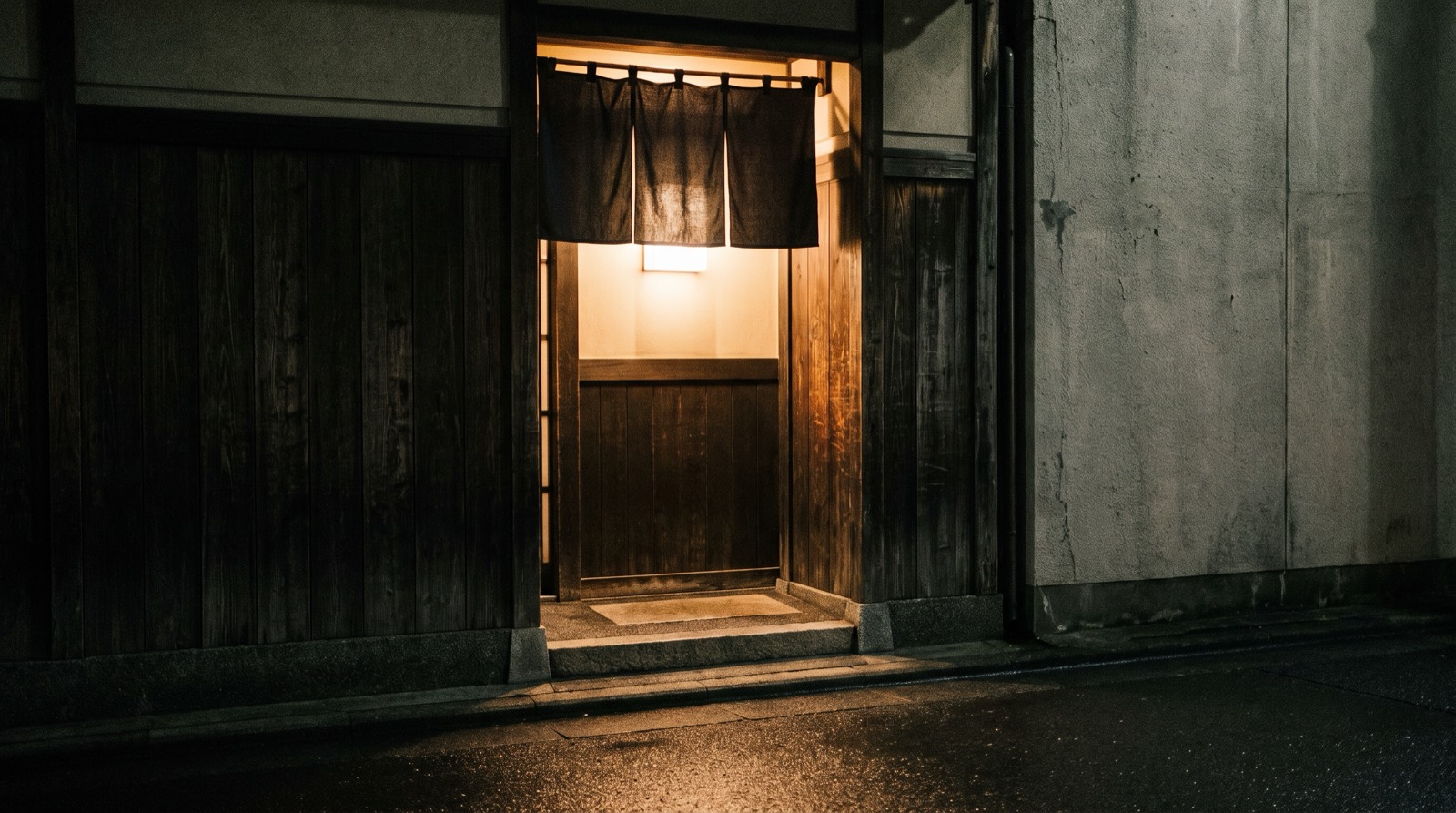
Four minutes from Hisaya-odori, behind a noren set back from the main road, Sakurada is the most celebrated counter in this article and the one that has thought hardest about the question the article is asking. It publishes both its prices without hedging: ¥38,500 for dinner and ¥24,200 for lunch, tax included, ten per cent service on top, printed on the same lines as the figures. Nine seats at a hinoki counter and nothing else. Calls are not to be taken inside the room, which the shop says plainly.
It also does something none of the other four do: it names its own school. Not Edo-mae — Nagoya-mae, a term the shop has coined for itself, meaning Tokai-region ingredients worked with Edo-mae technique. The site says the shop intends to spread that name nationally as a brand. Sapporo’s counters inherited a regional word and cannot agree on its definition; Sakurada wrote one from scratch and is trying to make it stick. The first thing served is a piece of Ariake nori made to double the usual thickness, carrying nothing but freshly cut red-vinegared rice and wasabi — the argument for the rice, made before any fish arrives.
And the telephone number is not on the site. Not hidden in an image, not further down, not on the contact page: absent from the whole domain. What is there instead is a sentence repeated at the top of every page — that telephone bookings are not currently being taken, and that you should use the site listed below. That site belongs to somebody else. Slots open at the beginning of each month for the month that follows, and the day’s first booking sets the start time for every other guest, so the hour you eat is decided by a stranger who booked before you.
- Where. HP-SQUARE MARUNOUCHI 1F, 3-22-8 Marunouchi, Naka-ku. Four minutes on foot from Exit 1 at Hisaya-odori.
- Booking. No telephone number is published anywhere, and the shop states that it does not currently take telephone bookings. One booking site off its own domain, opened at the start of the month for the following month. Book by the day before; tell them three working days ahead to cancel; from two days before it is the full amount.
- Hours. Lunch from 12:00, dinner from 18:00, by reservation only. The day’s first booking sets the start time for everyone.
- Closed. No fixed day.
- Price. Dinner ¥38,500 and lunch ¥24,200, tax included, with ten per cent service added.
- Seats. Nine at a hinoki counter, and nothing else. Private hire available. Telephone calls are not taken inside the room.
A shop that publishes its price to the yen and refuses to publish a telephone number has not been careless. It has decided which questions it is willing to answer, and it has answered them in public.
Sushi Kanoh — the only door that belongs to the shop
Kanoh is out of the centre, in Chikusa-ku behind a temple, with a lit bamboo grove behind it and six seats at the counter — seven if everyone is friendly. The chef, whose surname is the only part of his name the site gives, spent sixteen years in Ginza, Shibuya, Kichijoji and at Kanayama here in Nagoya before opening it. The tuna comes from one named wholesaler at Toyosu. The technique paragraph lists six verbs — curing, simmering, steaming, marinating, steeping and resting — which is a longer list than any other shop here offers.
It is the exception this article was looking for. There is a telephone number, a mobile written with spaces instead of hyphens, and there is a booking form, and both of them belong to the shop. No listing service, no booking platform, no third party anywhere on the domain. Of the five, Kanoh is the only counter whose entire way in is its own.
Which does not make it the most open. There is no price on the site — no yen sign, no figure, nothing under the heading that says omakase. And the one line of practical information the shop does publish twice disagrees with itself: fifteen minutes on foot from Kakuozan, it says, and 578 metres, on the same line. That is a walking speed of about thirty-nine metres a minute. Owning your own front door, it turns out, is not the same as leaving it open.
- Where. 1-44-5 Shiroyama-cho, Chikusa-ku, in the back lane behind a temple. The shop writes both “fifteen minutes on foot from Kakuozan” and “578 m” on the same line.
- Booking. The shop’s own mobile, 080 7213 1134, and the shop’s own form. The only one of the five with no link to an outside service. By the day before; same-day enquiries by telephone. Private hire from four people.
- Hours. 17:30–23:00, last entry 20:00.
- Closed. No fixed day.
- Price. Not published. No figure appears anywhere on the site, including under the heading for the omakase course.
- Seats. Six at the counter, seven at a squeeze. No smoking anywhere. Cards accepted.
What the five have in common
Four of the five hand the booking to somebody else. Two of the five publish no price at all. Three of the five give a mobile number as the shop’s telephone, and the most celebrated of them gives no number whatsoever. None of the five has an English page, an English menu, or an English word on the site beyond a shop name in roman letters. A visitor without Japanese who works only from these five sites can learn what two of the counters cost and can reach exactly one of them directly.
There is one more thing, and it explains some of the sameness. Three of the five sites — Sakurada, Murohashi and Wasyu — are built on the same commercial template, and it is not hard to see: the same page names in the same order, the same map-printing helper link, the same cookie notice, and in two cases the identical sentence asking you to mention that you saw the website. The same template turns up outside Nagoya too — one of the Sapporo counters covered elsewhere on this site runs on it. So this is not a Nagoya company and not a Nagoya conspiracy. It is simply worth knowing that when three shops phrase something the same way, the phrasing may not be theirs, and that a page which reads like a shop’s voice is sometimes a supplier’s.
Reading a Nagoya booking page in about a minute
- Look for a telephone number first, and notice whether it starts 052 or 090. A mobile is normal here and is not a warning sign; no number at all is a policy, and the policy will be written down somewhere near the top.
- Find the word for the bill of fare and check whether there is a figure under it. In this city a named course with no price is common, and it usually comes with an invitation to state your budget. Decide yours before you call.
- Check where the booking button goes. If it leaves the shop’s domain, the cancellation terms that bind you may be the platform’s rather than the ones printed on the shop’s page — read both.
- Look for a release date. Several counters here open a month’s worth of seats at once at the start of the previous month; if you arrive mid-month, the answer is not that the shop is full but that you are asking on the wrong day.
- Look for a line about start times. If the day’s first booking sets the hour for everyone, booking early buys you the time as well as the seat.
None of that is a substitute for asking. But it will tell you, before you spend an evening on it, which of these five you can actually reach from where you are sitting — and that is the part Nagoya makes unusually hard to work out.
If you want to book one of these
Several of the counters described above answer the telephone only in Japanese, and a few of them take bookings by no other route. AutoReserve is a Japanese reservation service with an English interface, and it states that it will place the call on a diner’s behalf where a restaurant takes reservations by telephone alone. We have not tested it against every restaurant on this page, and a listing there is not a guarantee of a seat — the doors described above are the doors either way.
Frequently asked questions
Can I book any of these five in English?
Not from the shops’ own sites. None of the five publishes an English page, an English menu or English booking instructions. Four of the five route bookings through Japanese listing services, some of which have English interfaces of their own; that is the platform’s doing, not the shop’s, and this article does not treat a platform’s page as the restaurant’s.
Why do two of the shops not publish prices?
They do not say why. What both do publish is an alternative: Harutaka asks guests to state a budget and says it will work to it. That is a different transaction from a fixed course price, and it assumes a conversation before the meal rather than a figure on a page.
Is a mobile number a bad sign?
No. Three of the five counters here publish one, including the one that publishes its tax-invoice registration number and the price of every drink it serves. In Nagoya a 090 or 080 number is simply how a small counter answers the phone.
What is Nagoya-mae?
A term one shop in this article, Sakurada, has coined for its own sushi: ingredients from the Tokai region worked with Edo-mae technique. It is not a regional tradition with other practitioners, in the way Ezo-mae is used across Sapporo. It is a single house’s brand, and the shop says openly that it intends to spread it.
If I can only book one of these, which is the most reachable?
Kanoh, on the evidence of the sites alone — it is the only one of the five whose telephone and booking form both belong to the shop, with no third party in between. It is also the one that publishes no price, so reachable and informative are not the same thing here.