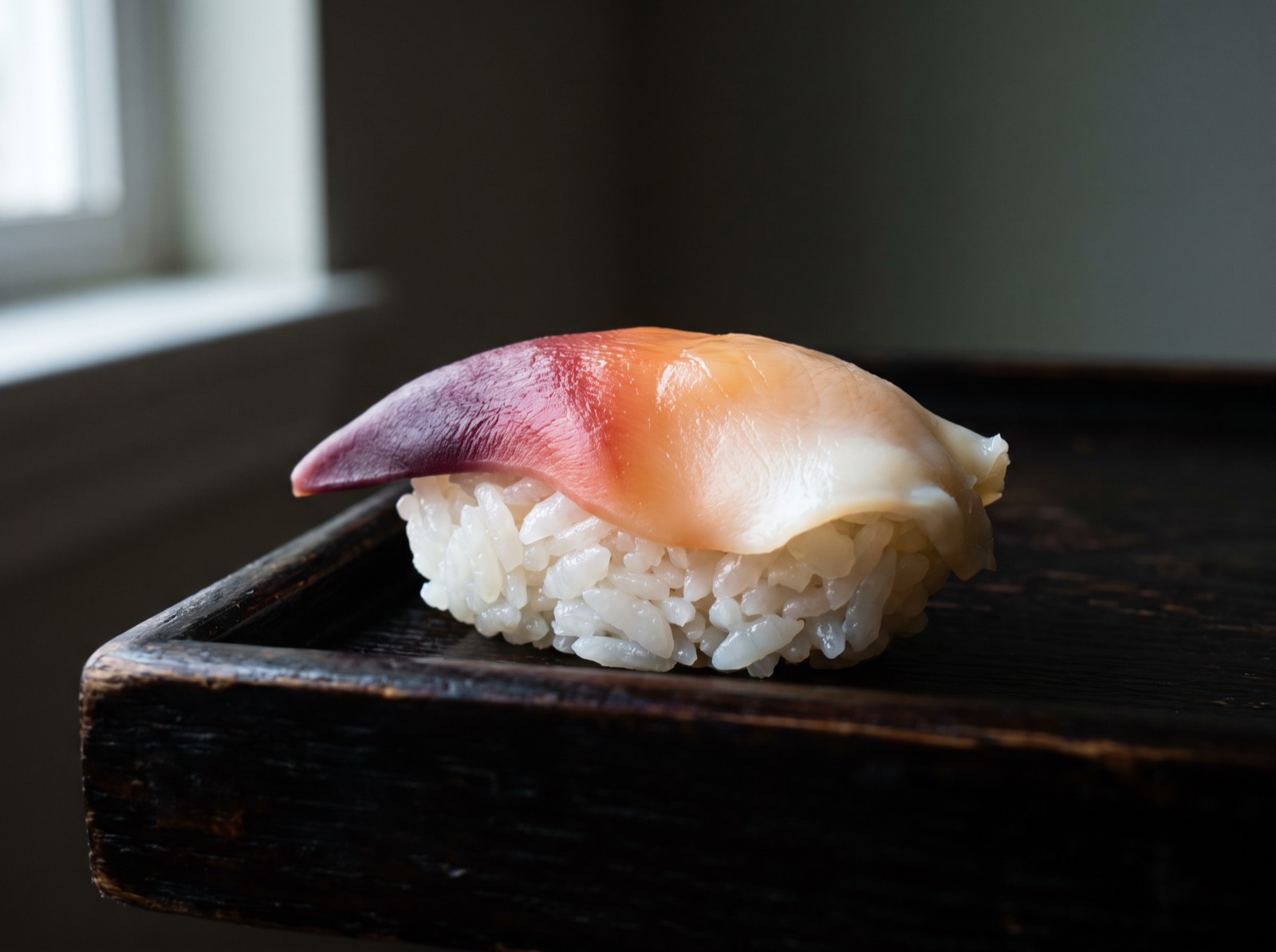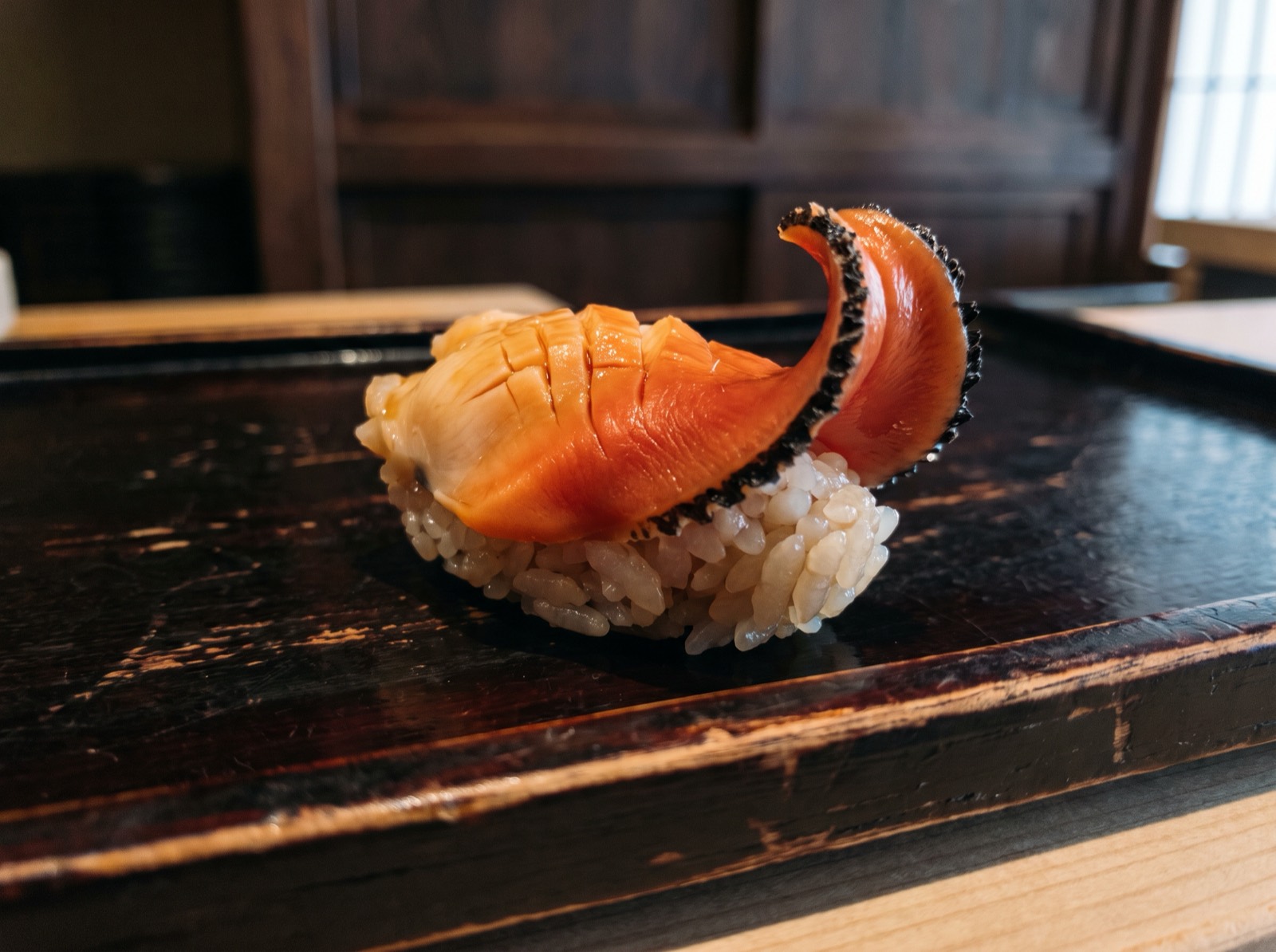
Order torigai and what arrives is already finished: a glossy black-topped piece, its foot butterflied flat across the rice, the shell it came in nowhere in sight. Nobody at the counter opens one in front of you, and by the time a piece reaches a diner, the one moment that would show what the animal looked like alive has usually already happened, somewhere else.
What it is
Torigai (トリガイ) is a cockle, a small clam that sits in the shellfish case alongside hokkigai and akagai. What is served is the foot, the muscular part the animal uses to move and burrow, sliced open and laid flat rather than left curled in its shell.
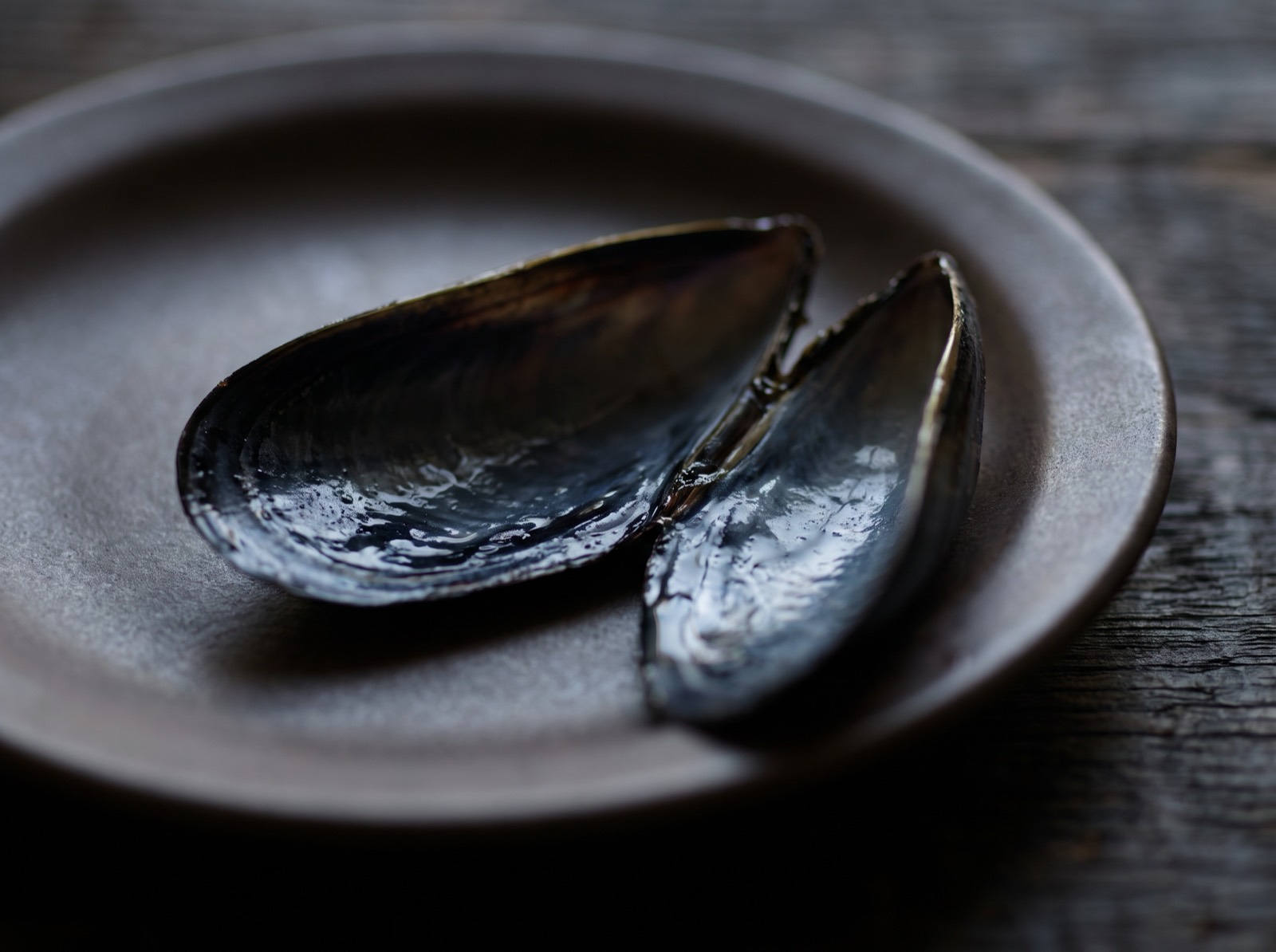
That shell is thin and breaks easily, and the fact shapes how the animal reaches a kitchen at all. A large share of the supply is shucked and blanched close to where it is caught, before it is ever sold on; a fragile shell is a liability once it is in transit, and removing it early removes the risk. What travels onward, in that case, is already the piece a diner will eventually be served, several steps removed from the live animal.
What marks the flesh out, in either state, is a glossy black membrane across its surface, unlike the pale or pink tones of most of its neighbours in the case. It is not a treatment or a dye; it is simply what a healthy piece of torigai looks like, and it is present before any heat touches it at all.
When it is used
Torigai is at its best in spring. Japanese-language accounts of the shellfish case group it with 蛤, hard-shell clam, as one of the pieces said to announce the season. Its supply does not behave like a typical spring item, though: the literature describes catches swinging between good years and poor ones more sharply than its neighbours, tied in part to how badly the animal fares in the hottest water of summer.
Some of that peak-season character is reproductive rather than purely seasonal. As the animal approaches spawning its ovary develops and swells, and the trade literature credits that development with the extra sweetness a piece carries at the height of the season — the same flesh, thickened and sweetened by what is happening inside it rather than by anything a kitchen does.
What the chef actually does
Two different chains bring torigai to a counter, and they diverge at the shell. In the more common one, the animal is opened, cleaned and blanched close to where it was caught, then sold onward as a prepared product; a kitchen buying this way is buying something the sea has already released from its shell. In the other, used where a shop wants the raw version or wants to control the cooking itself, the cockle arrives alive and still closed, and the kitchen does the opening.
Either way, that opening never happens in front of a diner. There is no tableside shucking of torigai the way there might be for an oyster. Whichever chain a piece travelled through, the shell is already gone and the black membrane is already facing up by the time the piece is set on the rice.
What is not settled, once the flesh is open, is how much heat it then receives, and the literature is explicit that this varies. A piece can be served entirely raw, blanched only enough to leave it half-cooked, or blanched through, and a kitchen working with more than one preparation may use different degrees for different purposes — a fully blanched piece for nigiri, a barely-touched one alongside sake, judged by the chef rather than fixed by a recipe.
- Landed and shucked. The fragile shell is removed close to the point of catch or, less often, at the counter itself, from an animal that arrived alive.
- Cleaned. The foot is trimmed of anything that is not the muscle to be served.
- Butterflied. Opened flat so it lies across the rice rather than sitting in a cupped shape.
- Heat, to a chosen degree. Raw, half-cooked or blanched through, chosen by the kitchen and by what the piece is for.
- Served with soy, occasionally with a squeeze of citrus, the black membrane facing up.
Why it is done
The reasoning given for applying heat at all is about what it does to the surface, not about safety: a blanch sharpens the line between the dark membrane and the pale flesh beneath it, and is credited with concentrating the sweetness of the piece. The gloss of the membrane, separately, is treated as one of the simplest checks a buyer has for freshness — the blacker and shinier the shell or the exposed flesh, the more recently it was taken.
The deeper reason the opening happens elsewhere is more practical than technical: a broken shell in transit is a loss, and a shell removed at the source is a shell that cannot break on the way. It is a different kind of decision from ikejime, which turns on chemistry timed to the moment of the catch rather than on logistics solved before the catch is even sold. But for a diner the two land in a similar place: a piece of the animal’s history that happens before the counter, told rather than shown, with nothing on the plate to prove which chain a given piece came through.
Whichever chain a piece travelled through, the shell is already gone and the black membrane is already facing up by the time the piece is set on the rice.
How it differs from what it is confused with
The shellfish case is where a lot of English menus give up entirely, and torigai sits in the middle of that confusion rather than at its edge.
- Torigai and hokkigai are both blanched and served two-tone, but the colour works differently: hokkigai is dull grey until heat releases a pink it did not show before, while torigai’s black membrane is already on the raw animal, and a blanch only sharpens the contrast against the flesh beneath it.
- Torigai and akagai are confused for a similar reason — both carry a dark edge — but akagai is deep red underneath and is served raw at every stage; the resemblance sits at the rim, not underneath it.
- Torigai and 蛤 (hamaguri) are grouped together as shellfish that mark the arrival of spring, but hamaguri is a true two-shelled clam usually served cooked, closer to the simmered pieces named in our guide to Edomae sushi than to anything on this page.
None of the three is a stand-in for another. What they share is the case they sit in, and the habit English translation has of flattening several different animals into “clam.”
How to say it
to-ri-ga-i, four even beats, no strong stress on any of them — close enough if said as TOH-ree-guy. The first character, 鳥, is the ordinary word for bird; the second, 貝 (gai), is the shellfish ending that appears across this whole family of names, from hamaguri to hokkigai.
Where you will see it
On a menu it is written 鳥貝 or とりがい, occasionally with a note such as 生 (raw) or 湯引き (briefly blanched) attached, but often with neither. Whether a given piece was shucked that morning from a live shell or arrived already opened, blanched and days into its journey is not something a menu is obliged to say, and it usually does not.
The two supply chains do not cost the same. A shop working with live cockles it shucks itself is paying for handling the pre-blanched product skips entirely, and that gap sits underneath the price the way it does for conveyor-belt versus counter shellfish generally. What is worth carrying from this entry is simpler: the black-topped piece in front of you is the end of a story that started somewhere you were never going to be.
Frequently asked questions
What is torigai?
Torigai is a cockle, a small clam whose foot is served sliced open and laid flat, with a distinctive glossy black membrane across the surface. It is not a stand-in for hokkigai or akagai, despite sitting in the same section of the case.
Is torigai raw or cooked?
Both, and the degree is a judgement call rather than a fixed rule. A piece can be served raw, blanched only enough to leave it half-cooked, or blanched through, chosen by the kitchen according to what the piece is for.
Why is torigai black?
The black is a membrane on the animal itself, present before any heat touches it, not a colour produced by cooking. A blanch, where one is used, sharpens the contrast between the membrane and the pale flesh beneath it rather than creating the colour from nothing.
What is the difference between torigai and hokkigai?
The colour mechanism. Hokkigai is dull grey raw and only turns pink when heat releases a pigment that was not visible before; torigai’s black membrane is already there on the living animal, and blanching only sharpens it.
When is torigai in season?
Spring, grouped in Japanese accounts of the shellfish case with hamaguri as one of the pieces said to announce the season. Its catch is described as swinging more sharply between good years and poor ones than its neighbours.
Where is torigai shucked?
Usually not in the kitchen you are eating in. A large share of the supply is opened and blanched close to where it was caught, before it is ever sold on; the rest arrives alive and is opened by the kitchen itself, but always before the piece reaches the counter.