There is a job behind almost every piece of sushi at a serious counter that is not done in a kitchen, is not done by the person who hands you the piece, and is not something you could watch even if you asked to. It is ikejime (活け締め): killing the fish, in a specific way, in the minutes after it is caught. By the time a shop takes delivery, the decision has already been made.
What it is
Ikejime means killing a fish instantly with a blade, at or near the point it is caught, rather than letting it die on its own. The reason given for doing it this way is specific: an instant kill slows the loss of the compounds that give the fish its savoury taste — compounds that a fish which struggles and dies slowly has already begun to spend. It is not a cure, not a marinade, not a cut for the plate. It is closer to a single decision, made once, that everything a kitchen does to the fish afterward depends on.
That sets it apart from the other work described in our guide to Edomae sushi. Curing, marinating, simmering and ageing are jobs a chef controls, adjusts and is judged on, piece by piece, at the counter. Ikejime happens once, to the whole fish, and it happens before any of that is even possible.
Where and when it happens
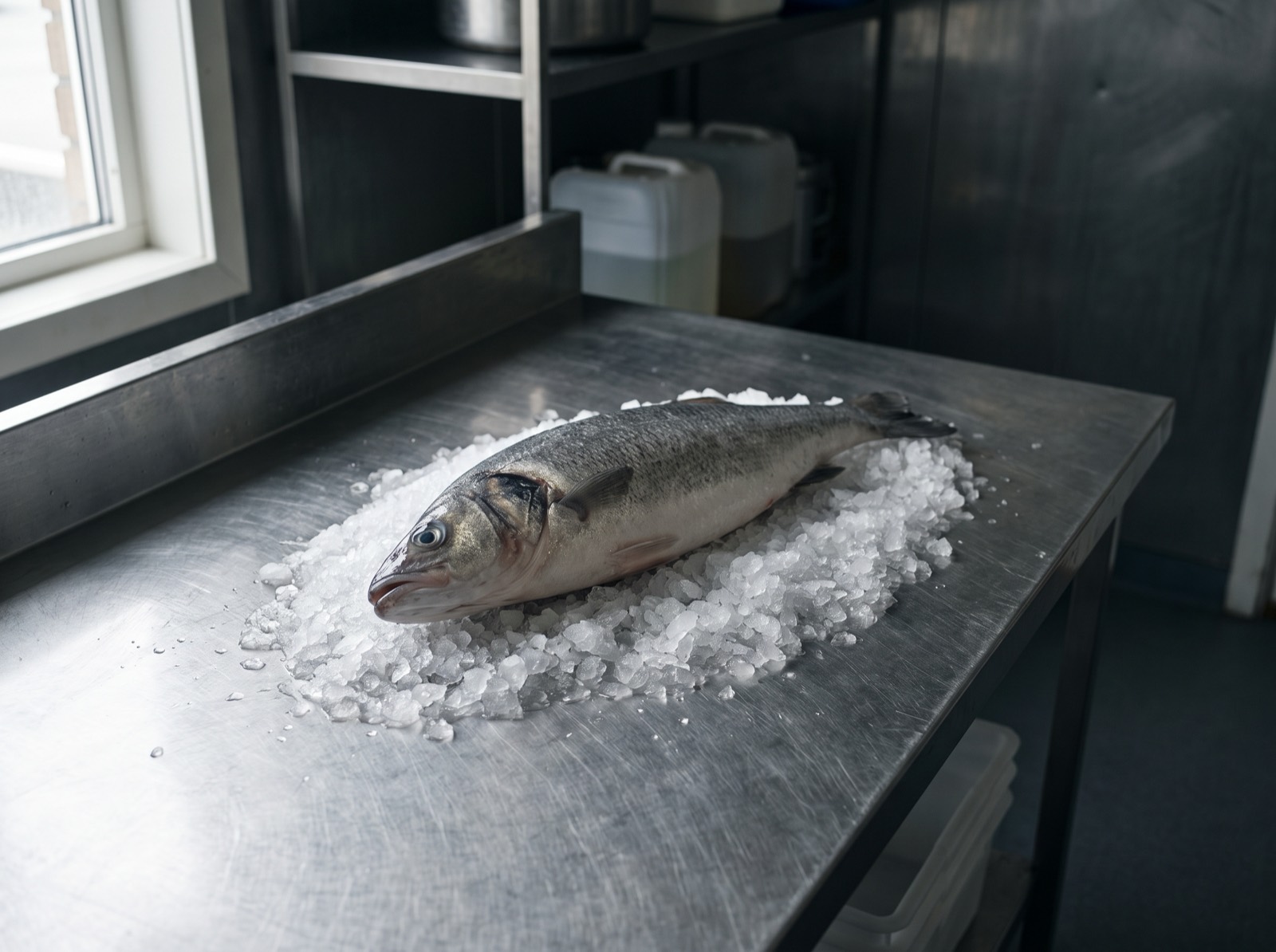
It happens at sea or at the dockside, in the first minutes after a fish is caught — not in a restaurant kitchen, and not by a sushi chef. Japanese-language accounts of the practice describe it as work usually carried out by the fisherman who caught the fish, or by the wholesaler who buys it, before the fish is ever sold on. A market may finish the job — scaling, gutting, a further rinse — but the kill itself happens earlier, and somewhere else.
That is the fact this entry exists to sit with. A diner can watch a piece of kohada being cured, watch tuna being sliced, watch an egg being rolled. Ikejime is the one job in that chain that happens before all of it, somewhere the customer will never be. Whatever a counter tells you about it, you are being told, not shown.
What is actually done
The method set out in Japanese fish-handling references is a single deliberate cut or strike at the base of the skull or spine, severing or destroying the part of the nervous system that controls movement, which kills the fish at once rather than letting it thrash toward death. Blood is drained soon after, usually through an incision near the gills or the tail, often with water run through the fish to help it clear.
- The kill. One deliberate cut or strike, at or very near the point of catch, in place of a slow death by suffocation or exhaustion.
- The blood. Drained shortly afterward, usually through an incision near the gills or the tail.
- The cleaning. Scaling, gutting and any further trimming, which typically happen later, at the market or in the kitchen, not at the point of catch.
Not every fish caught in Japan receives this treatment, and the reason is usually practical rather than a judgement about the fish. Species caught one at a time — tuna is the example most associated with the practice — are the ones ikejime fits most naturally. Small fish taken in bulk by net are generally handled differently; there is no moment at which any one fish in a netful could be singled out for it. The absence of ikejime on a given fish is often a fact about how it was caught, not about the standards of whoever caught it.
Why it is done
The reasoning in the Japanese sources is about chemistry, not welfare, and it is worth being precise about which chemistry. A fish that thrashes as it dies spends, in that thrashing, some of what produces its savoury taste after death. An instant kill stops that expenditure before it starts, which is the mechanism ikejime relies on, and the reason the definition in our own fact index describes it as slowing a loss rather than preventing spoilage.
We are deliberately not naming that compound, or attaching a duration to how quickly it is otherwise lost, because we do not have a public, citable source for those specifics, and the trade literature we consulted was written for a kitchen rather than for footnoting. What is documented plainly, and consistently, across the Japanese-language references behind this piece is the direction of the effect: instant kill, slower loss. That is the claim this entry stands behind, and no more than that.
None of this is a claim about food safety. Ikejime concerns the chemistry behind taste after death, not pathogens or spoilage in the food-safety sense; what actually keeps raw fish safe to eat in Japan is a separate, regulatory story, set out in is sushi safe to eat in Japan.
What follows from the chemistry is a second effect, and it is the one that matters most to a kitchen: a fish’s own processes, largely undisturbed after a clean death, change on their own timetable. That is why an Edomae counter can rest a fillet overnight, cure it, or age it for longer, in the ways set out in our piece on Edomae sushi. None of that later handling starts from a stable baseline unless the fish was killed cleanly at the start. Ikejime is not one of the four jobs described in that piece. It is the condition that makes the four jobs possible.
Ikejime is the one job in that chain that happens before all of it, somewhere the customer will never be.
How it differs from what it is confused with
The direct contrast is with nojime (野締め), which Japanese references on fish handling place next to ikejime for exactly this reason: nojime is not really a technique so much as the absence of one, a fish left to die on its own after capture rather than killed deliberately. A fish that is not killed outright continues to struggle until it dies naturally, which is the version of dying that ikejime exists to shorten. The sources we consulted describe the resulting fish as the poorer of the two, and treat ikejime, not nojime, as the baseline a serious kitchen works from.
The second is shinkeijime (神経締め), which is not a rival technique but a supplementary one, mainly used on larger fish. Japanese sources describe ikejime on its own as leaving a big fish capable of further reflexive movement for a time after the kill — movement from the nervous system rather than the fish being alive — and shinkeijime addresses that directly, by passing a wire through the spinal canal to destroy the nerve itself. Where it is used, it is used after ikejime and in addition to it, not instead of it: the base practice in the sources is ikejime first, with shinkeijime applied as the individual fish requires.
How to say it
i-ke-ji-me, four beats, with no stress on any one of them; close enough said as ee-keh-jee-meh. The word is built from 生け (ike, living) and the same root, shime (締め, to close or tighten), that appears in su-jime and kobu-jime — the family our kohada entry and our Edomae guide both use for curing. Ikejime is the same root applied to the fish’s death rather than to what is later done to its flesh.
Where you will see it
Occasionally a menu or a shop’s own description will use the word directly — sometimes with the shorthand 活〆 in place of the full 活け締め — set next to a fish’s name. Where it appears, it is presented as a claim about the sourcing behind that fish, not as something the kitchen itself performed.
More often it is not mentioned at all, because at a counter buying seriously handled fish it tends to be assumed rather than advertised, in the same way a shop does not print that its rice was cooked. Its absence from a menu tells you nothing reliable either way.
Either way, this is a fact about the fish that a diner cannot verify at the table. Unlike the cure on a piece of kohada or the glaze on a piece of eel, ikejime leaves nothing on the plate that confirms it happened. You are trusting the chain that delivered the fish to the counter, not judging a technique with your own eyes, and no amount of attention at your seat changes that.
Every other job on this site — the salt, the vinegar, the soy, the years-old glaze — happens close enough to the counter that a diner can, in principle, see or taste some evidence of it. Ikejime happens first, farthest away, and leaves no mark at all. It is the one piece of an Edomae fish’s history that you are simply told.
Frequently asked questions
What is ikejime?
Killing a fish instantly with a blade, at or near the point it is caught, instead of letting it die on its own. The purpose stated for it in Japanese sources is that an instant kill slows the loss of the compounds behind the fish’s savoury taste.
Does the sushi chef perform ikejime?
Usually not. Japanese-language accounts describe it as work typically done by the fisherman who caught the fish, or by the wholesaler who buys it, at sea or at the dockside, before the fish is ever sold to a restaurant.
What is the difference between ikejime and nojime?
Nojime (野締め) is a fish left to die on its own after capture, without a deliberate kill; it continues to struggle until it dies naturally. Ikejime is the deliberate, instant kill that nojime lacks, and Japanese sources describe the nojime result as the poorer of the two.
What is shinkeijime, and is it the same as ikejime?
No. Shinkeijime is a supplementary step, mainly used on larger fish, in which a wire is passed through the spinal canal after ikejime to destroy the nerve and stop further reflexive movement. It is applied in addition to ikejime, not instead of it.
Does ikejime make sushi safer to eat?
That is not the claim. Ikejime concerns the chemistry behind taste after death, not pathogens or spoilage. What actually keeps raw fish safe to eat in Japan is a separate regulatory framework, covered in our guide to whether sushi is safe to eat in Japan.
How would I know if the fish in front of me was ikejime?
In most cases, you cannot verify it from your seat. A menu occasionally states it, sometimes with the shorthand 活〆, next to a fish’s name, but that is a claim about sourcing, not something you can see or taste for yourself.