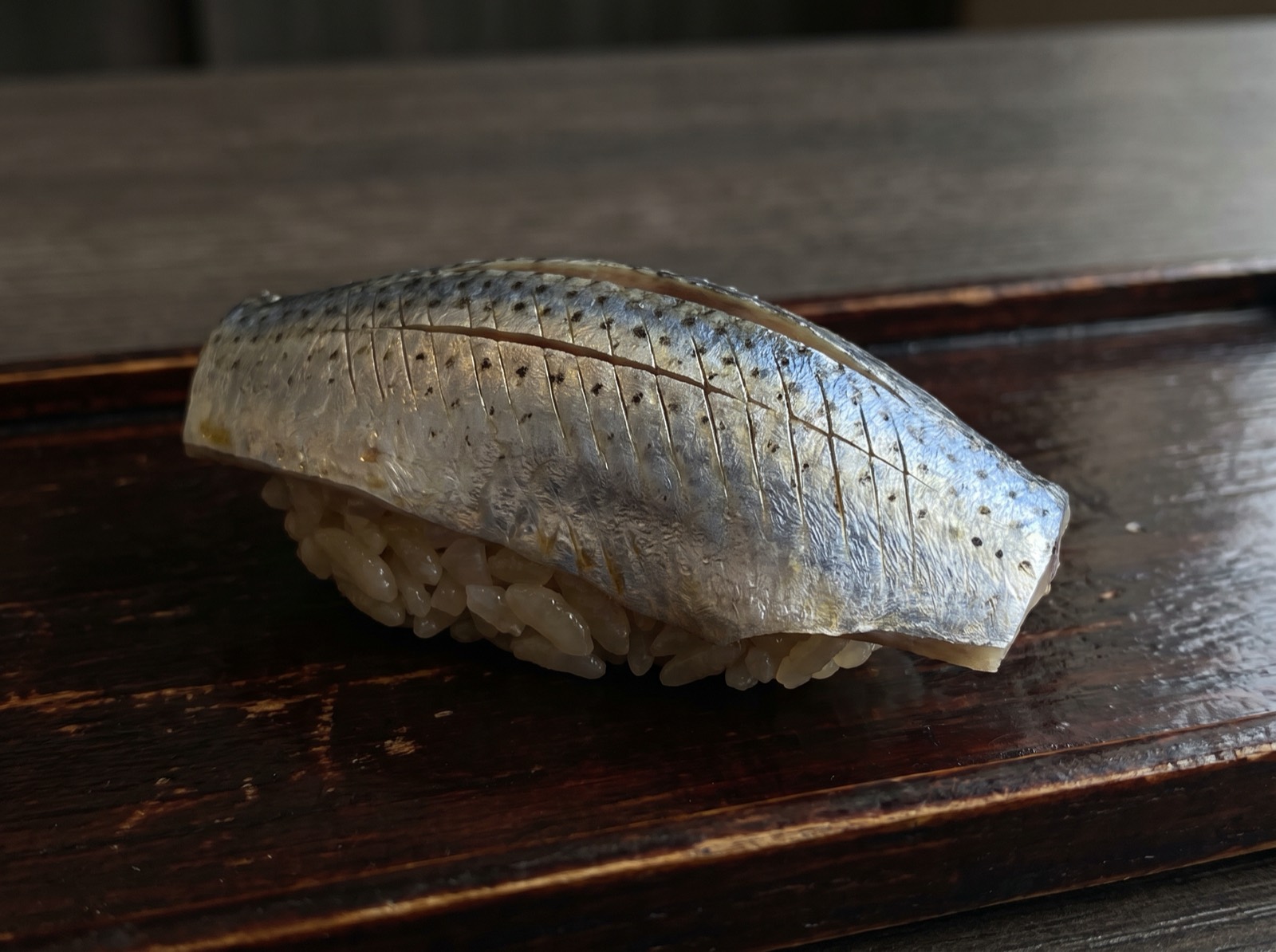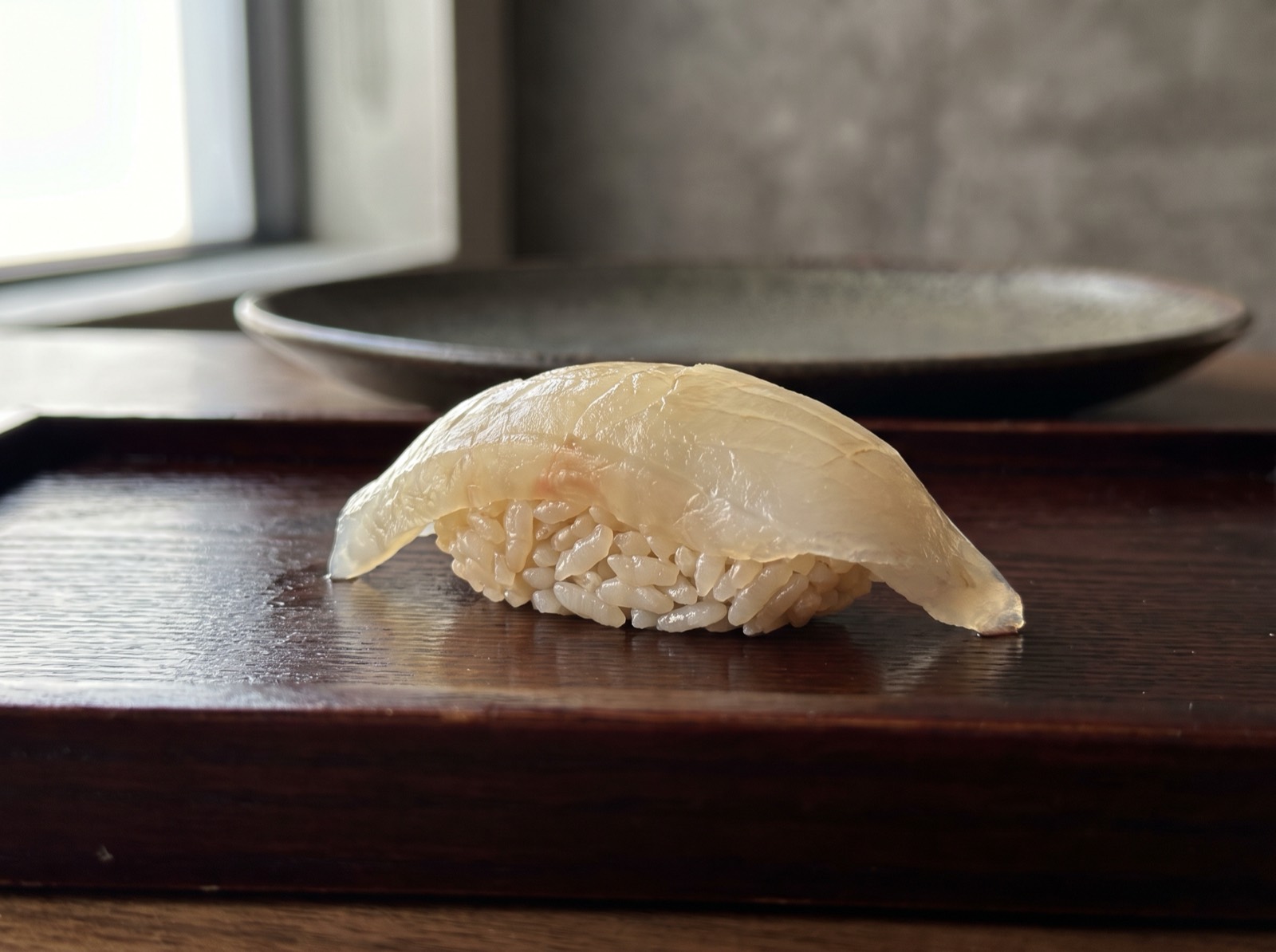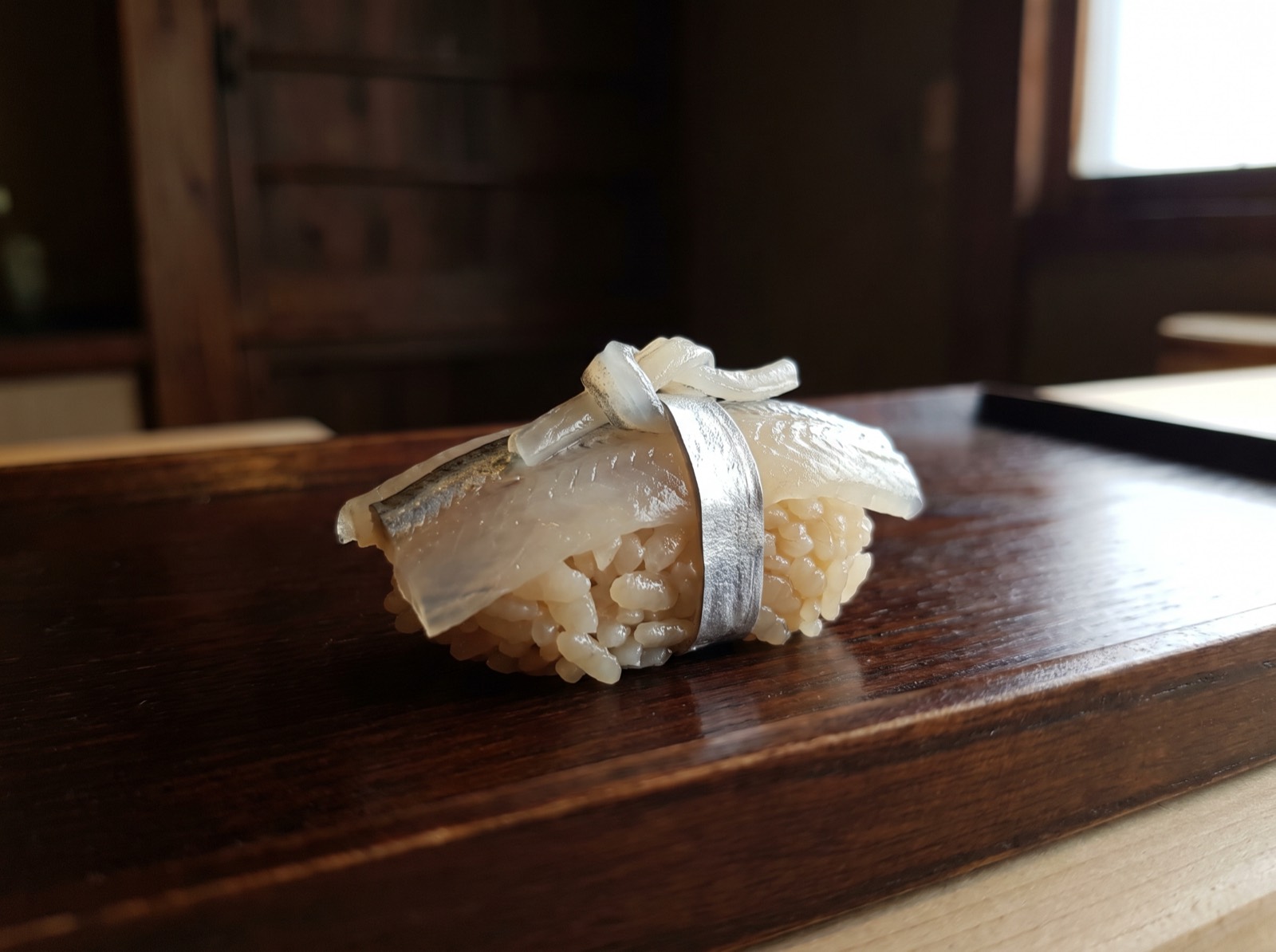
Sayori (サヨリ, Japanese halfbeak, Hyporhamphus sajori) is a long, needle-thin spring fish with a lower jaw that extends into a beak tipped in red. It is lean to the point of austerity, faintly sweet, and one of the very few items at a counter where the chef shapes the piece rather than simply slicing it.
What it is
A surface-swimming fish, slender enough to be described in Japanese by comparison to pencils and door bolts — small ones are enpitsu (エンピツ, pencil), and the large ones that command the price are kannuki (カンヌキ, the bar across a gate). The upper body is silver-blue, the flank carries a bright silver stripe, and the flesh is white, translucent and almost fat-free.
It belongs, loosely, with the hikarimono — the silver-skinned fish — but it does not behave like the others. Where kohada and iwashi are oily and need curing or aromatics to manage, sayori is clean, delicate and needs nothing taken away from it. The problem is the opposite one: there is very little there, and the chef has to make that into a piece.
The black belly
Open a sayori and the lining of the body cavity is jet black — a startling contrast with flesh that is otherwise almost white. It has to be scrubbed out completely, and a piece with any of it left reads as careless immediately.
The Japanese expression hara-guroi (腹黒い), “black-bellied”, means scheming or two-faced, and it is popularly attached to this fish: beautiful outside, dark within. Whether the phrase came from the fish or merely found it is not something we can document, and we record the association as an association.
When it is best
Late winter into spring, and it is one of the pieces that tells you the season has turned at a counter that follows it. The large kannuki fish come at the top of that window and are treated as a different order from the small ones.
What the chef does to it
The fish is opened, the black lining removed, the fine skin peeled — sayori skin lifts off in one piece if it is done right — and then the shaping begins, because a fillet this thin cannot simply be laid over rice.
- Folding. The fillet is doubled or triple-folded so the piece has height and the silver line appears more than once.
- Tying. A slender fillet is knotted, or twisted into a spiral. This is the presentation the fish is best known for and it is genuinely difficult on flesh this fragile.
- Kazari-bōchō (飾り包丁). Decorative scoring across the surface, as on kohada — it catches light along the silver and helps the piece sit.
- A brief salting, sometimes a brief vinegar. Light and short. Sayori will not survive the kind of cure a mackerel takes.
None of that is showing off. A thin, flat, near-flavourless fillet laid straight onto rice eats like a wet strip of paper; folded, it has body, and the piece works. This is one of the clearest cases on a counter where the visual and the practical are the same decision.
There is almost nothing in this fish. Everything you taste is a decision about shape.
How it differs from what it is confused with
- Sayori and sanma. Pacific saury is also long and silver, but it is an oily autumn fish with a strong flavour and no beak. They are opposites in almost every respect except the silhouette.
- Sayori and kohada. Both silver, both often scored, but kohada is cured hard in salt and vinegar and tastes of the cure. Sayori is barely treated and tastes of the fish.
- Sayori and needlefish. Both have extended jaws; the halfbeak extends only the lower jaw, which is what the English name records. Sayori is the smaller, finer-textured one and the one that reaches a sushi counter.
How to say it
sa-yo-ri, three even beats, no stress. Kannuki is ka-n-nu-ki, with the n held as its own beat. If you want to ask for the large ones by name, that is the word, and using it will get a reaction.
Edomae and Kansai
A thin, lean, expensive-by-the-gram fish whose whole value lies in knife work is about as Edomae a proposition as exists, and sayori sits comfortably in the Tokyo repertoire alongside the other silver fish. It is a spring marker there.
It is eaten in Kansai as well, more often in vinegared and pressed preparations that suit the western tradition described in our comparison of the two cities. The tied and folded nigiri, though, is a counter dish and belongs to the east.
Where you will see it, and roughly what it costs
At counters that follow the season, in spring, and very rarely anywhere else. It is not a conveyor-belt fish: the labour per gram is too high and the piece does not survive sitting on a belt.
No per-piece figure from us. Large sayori are not cheap and small ones are unremarkable, and the gap between them is real. If you see it listed, it is a reasonable indicator that the shop is buying to the season rather than to a standing list. Our season calendar covers what else marks spring.
Frequently asked questions
What is sayori?
Japanese halfbeak: a long, slender spring fish with a lower jaw extended into a red-tipped beak. The flesh is white, translucent and almost fat-free, and it is usually folded, tied or scored rather than laid flat on the rice.
Why is sayori folded or tied?
Because the fillet is too thin to work as a flat slice. Laid straight on rice it has no body; folded or knotted it gains height and texture. The shaping is practical as well as decorative.
Why is the inside of a sayori black?
The lining of the body cavity is naturally jet black. It has to be scrubbed away completely during preparation, and any of it left in the piece is an immediate sign of careless work.
What does kannuki mean on a sushi menu?
A large sayori. The word means the bar across a gate, and it is the trade term for the biggest of the season. Small ones are called enpitsu, pencils. The two are priced very differently.
When is sayori in season?
Late winter into spring. It is one of the pieces that signals the turn of the season at a counter that buys to it, and it is rarely available outside that window.
Does sayori taste of anything?
A clean, faintly sweet, very delicate flavour with almost no oil. It is not a fish that announces itself, which is why the knife work and the shaping carry so much of the piece.