Misoshiru (味噌汁) — miso soup — is the name most visitors reach for, though the trade’s own word for the item is simply the bowl, o-wan (お椀). It turns up at some point in most sit-down sushi meals, in one form or another. One thing is worth clearing up before anything else: miso is also the trade word for the soft organ inside a crab or shrimp shell, an entirely different thing that happens to share the name — that sense belongs to our guide to kani, and this article does not go back to it. What follows is about what is actually in the bowl, when it turns up, and why a sushi restaurant’s version is not quite the same soup you would get anywhere else.
What it is
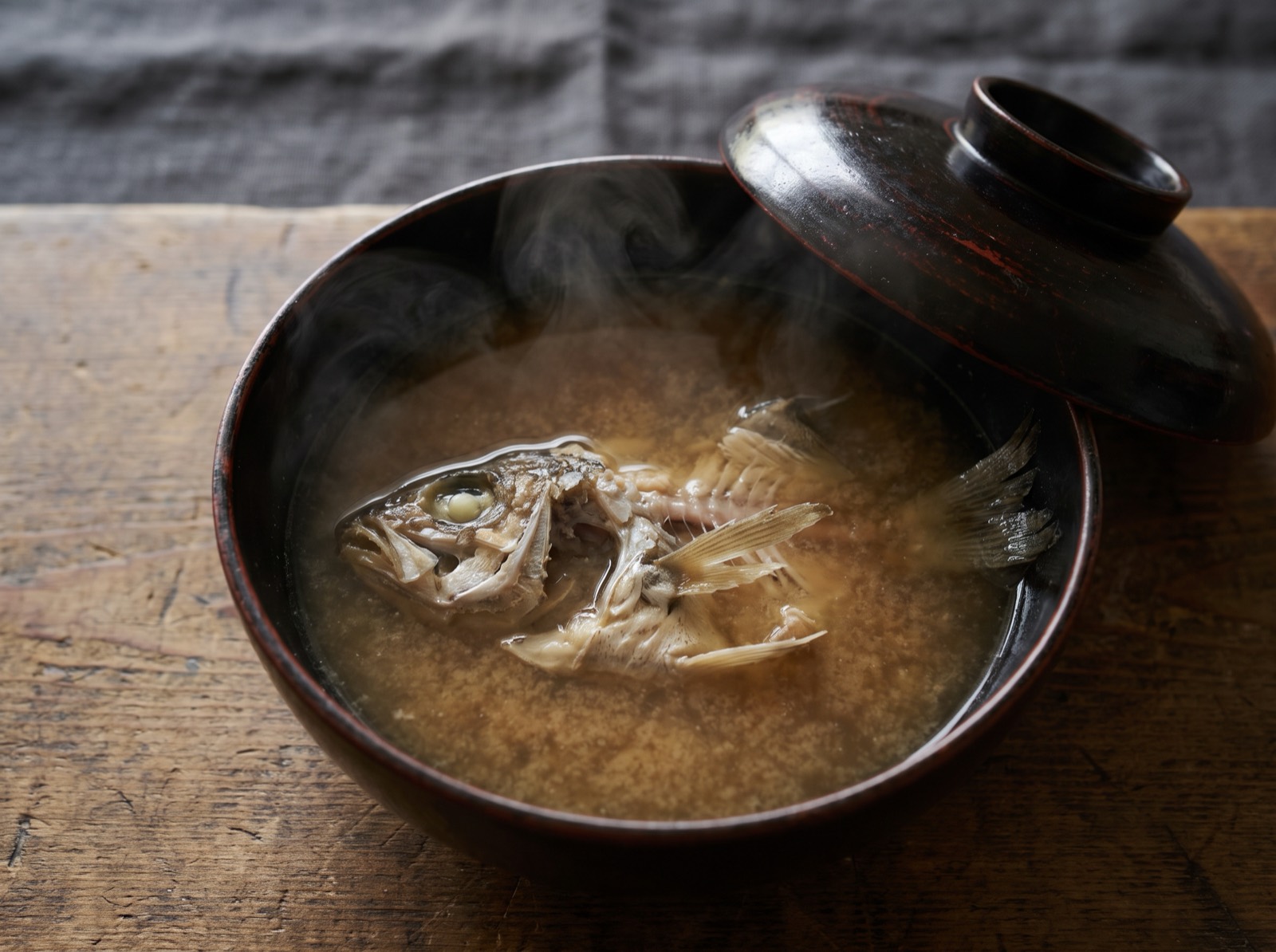
O-wan is the general word for the soup course; what is actually in it is not fixed. Misoshiru — a dashi-based broth thickened with fermented soybean paste — is the most familiar answer, but it is not the only one. A clear broth with no miso in it is more likely to be suimono (吸い物) or, when it is built specifically on fish, ushiojiru (潮汁), seasoned with salt rather than paste. A version made specifically from the head, bones and other trimmings of a fish is ara-jiru (あら汁), and it can be finished with or without miso.
The name on the menu tells you less than it seems to. What the different versions share is less about the seasoning on top and more about the base underneath, which is where a sushi restaurant’s bowl tends to part ways with the soup you would get at home or at an ordinary noodle counter.
When it is used
Ask when the bowl comes and the answer depends on which counter you ask. What holds across the sources consulted for this site is narrower than a fixed rule: the bowl tends to arrive after the sushi rather than before it, whatever else changes about the order of the meal. Beyond that, timing is a house decision rather than a convention with one answer.
The Japanese reference material that catalogues this part of the menu groups the bowl with a short, recognisable set of other non-nigiri dishes — grilled fish, sashimi, tempura, dessert — and treats all of them as reset points ordered alongside a drink rather than a separate meal bolted onto the sushi.
- At some counters, it closes the meal — the last thing set down once the nigiri is finished.
- At others, it appears mid-course, grouped with the other things eaten between pieces: a grilled dish, a plate of sashimi, dessert.
- At others again, it is not automatic at all: a side dish you order the way you would order tempura or a plate of sashimi, rather than something the house brings without being asked.
What the chef actually does
Professional recipe collections for this course read less like a soup chapter and more like an extension of the fish work happening elsewhere in the kitchen. The base is rarely one fixed thing:
- A clear broth built on the bones and head of a fish, close to ushiojiru.
- A soup finished with shirako, fish milt, stirred in at the end.
- A broth made from the leaner, more sinewy cuts of tuna that are no good for nigiri.
- A miso soup carrying seaweed rather than fish at all.
Where the base is fish, it is very rarely the same cut that just went out as nigiri — it is what did not become a piece, cooked down rather than set aside.
Not every shop works this way, and not every bowl is fish-based to begin with; a version finished on seaweed alone owes nothing to whatever fish came through the kitchen that day. But the pattern behind ara-jiru specifically — a soup built from the head, bones and trimmings of a fish — shows up often enough in the professional literature that it is fair to call it the logic behind this course generally, whether or not a given shop uses that name for its bowl.
Why it is done
The reasoning is closer to economy than to garnish. A sushi restaurant buys whole fish and turns a small fraction of each one into nigiri; heads, bones, collars, roe sacs and the leaner trimmings are the rest of the animal, and a kitchen built around not wasting fish has an obvious use for them once the parts that become nigiri have been cut away. A soup built on those parts also does the ordinary job any broth does at the end of a rich meal: it arrives warm, it is plain next to what came before it, and it closes a sequence of raw fish and vinegared rice with something cooked.
What is often in the bowl is what did not become a piece of nigiri — cooked down rather than set aside.
How it differs from what it is confused with
- Misoshiru and kani miso. Same word, unrelated thing: kani miso is the soft organ inside a crab or shrimp shell, not a soup at all. See our guide to kani.
- Misoshiru and an ordinary bowl of miso soup. The seasoning can be identical; the base often is not. A sushi restaurant’s bowl is more likely to be built on fish trimmings than the general-purpose dashi used elsewhere, which is the difference described above.
- Misoshiru and chawanmushi. Chawanmushi is a savoury steamed egg custard, not a soup, and it can fill a similar slot in a set course — something warm and cooked, arriving toward the end of a meal built on raw fish. Some counters serve one, some the other, and some serve both in the same set; one arriving does not mean the other is coming too.
How to say it
Misoshiru is four even beats, mi-so-shi-ru. O-wan, the more general word for the bowl itself, is two beats after the honorific: o-wan. Ushiojiru is u-shi-o-ji-ru; ara-jiru is a-ra-ji-ru, from ara (あら), the fish trimmings, plus jiru, broth. None of these are among the handful of words you actually need at a counter — for those, see our guide to the words you’ll hear, which also covers gari and the tea.
Where you will see it
At kaiten-zushi (回転寿司), built for self-service, food comes off a belt or a screen and each item carries its own price; soup, when it is on the menu at all, tends to be one more thing you order rather than something that arrives automatically at a fixed point in the meal. At a counter working through a set course, the bowl is more often folded into the sequence — brought without being asked for, at whatever point in the meal the house has decided it belongs.
Where a set course includes it, it is normally part of the price rather than billed separately. Where it is not part of the set, it is ordered the way any other side dish is, and priced the same way. Either way, do not expect a spoon — the bowl is drunk from the rim, and our etiquette guide covers exactly how to hold it.
If a shop does not bring it automatically and you want it anyway, asking is entirely normal — it is treated as an ordinary side dish rather than a special request. The reverse also holds: if you would rather skip it, saying so before the end of the meal is easier than sending back a bowl that has already arrived.
Frequently asked questions
What is misoshiru at a sushi restaurant?
The soup course served at some point in a sit-down sushi meal, most often a dashi-based broth thickened with fermented soybean paste. Some counters serve a clear broth with no miso in it instead, called suimono, or ushiojiru when it is built specifically on fish.
Is misoshiru the same as kani miso?
No. Kani miso is the soft organ inside a crab or shrimp shell, an unrelated word that happens to be spelled the same way. Misoshiru is the soup; see our guide to kani for the organ.
When does the soup arrive at a sushi restaurant?
It varies by shop. Some serve it last, once the nigiri is finished; some serve it mid-course alongside other side dishes; some only bring it if it is ordered, the way you would order tempura. What holds more generally is narrower: when it does appear, it tends to come after the sushi rather than before.
What is ara-jiru?
A soup or broth made specifically from the head, bones and other trimmings of a fish, rather than the cuts that become nigiri. It can be made with or without miso, and it is close to the logic behind a lot of sushi-counter soup generally.
What is the difference between misoshiru and chawanmushi?
Chawanmushi is a savoury steamed egg custard, not a soup at all, though it can occupy a similar slot near the end of a set course. Some counters serve one, some the other, and some serve both in the same set.
Do you have to order soup at a sushi restaurant, or does it come automatically?
Both happen, depending on the shop. Some include it in a set course without being asked; others treat it as an ordinary side dish that you order, the same way you would order sashimi or tempura.