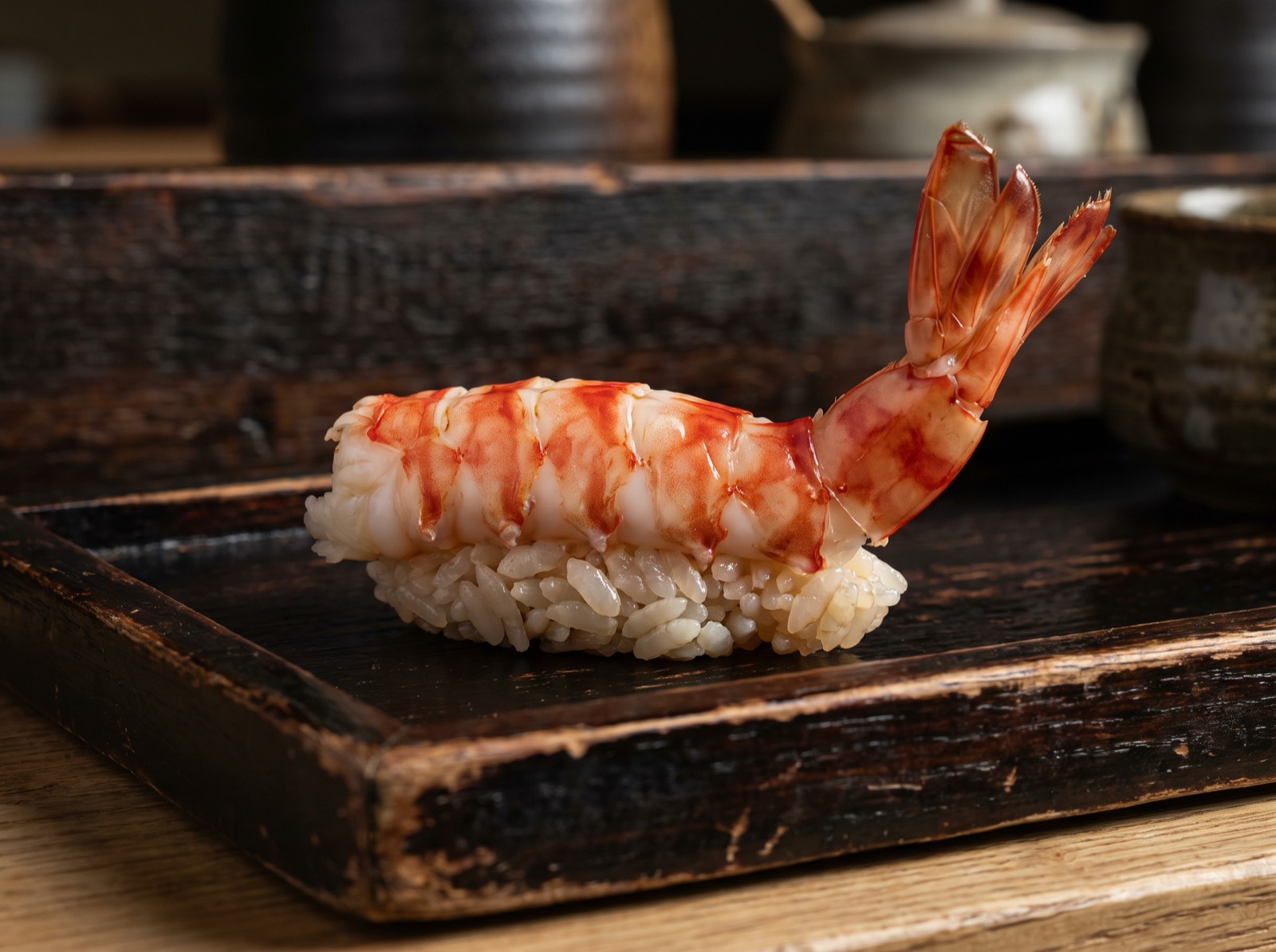
Order kani at a sushi counter and you might get leg meat from an animal too big to close your hand around, a spoonful of roe from a female a fraction of that size, or a pink-and-white stick that never swam anywhere. All three arrive under the same single word, and the word does not tell you which one is coming.
That is not a translation problem. It is how the word works in Japanese too. 蟹 covers several genuinely different animals, sold under different names by sex and by where each was landed — and, on more menus than diners realise, an entirely different foodstuff wearing the crab's name and little else of it.
What it is
The everyday assumption is that kani is a species, the way tai is sea bream or maguro is tuna. It is not. The word functions closer to a job description than a species name: something hard-shelled, jointed at the legs, that scavenges and defends itself with claws. Several animals answer to that description without being closely related, and Japanese kitchen language has never drawn its lines where a biologist would.
At a sushi counter, kani in practice narrows down to a small handful of things:
- Zuwai-gani, a slender-legged crab from cold, deep water — the one most often meant when a menu simply says kani.
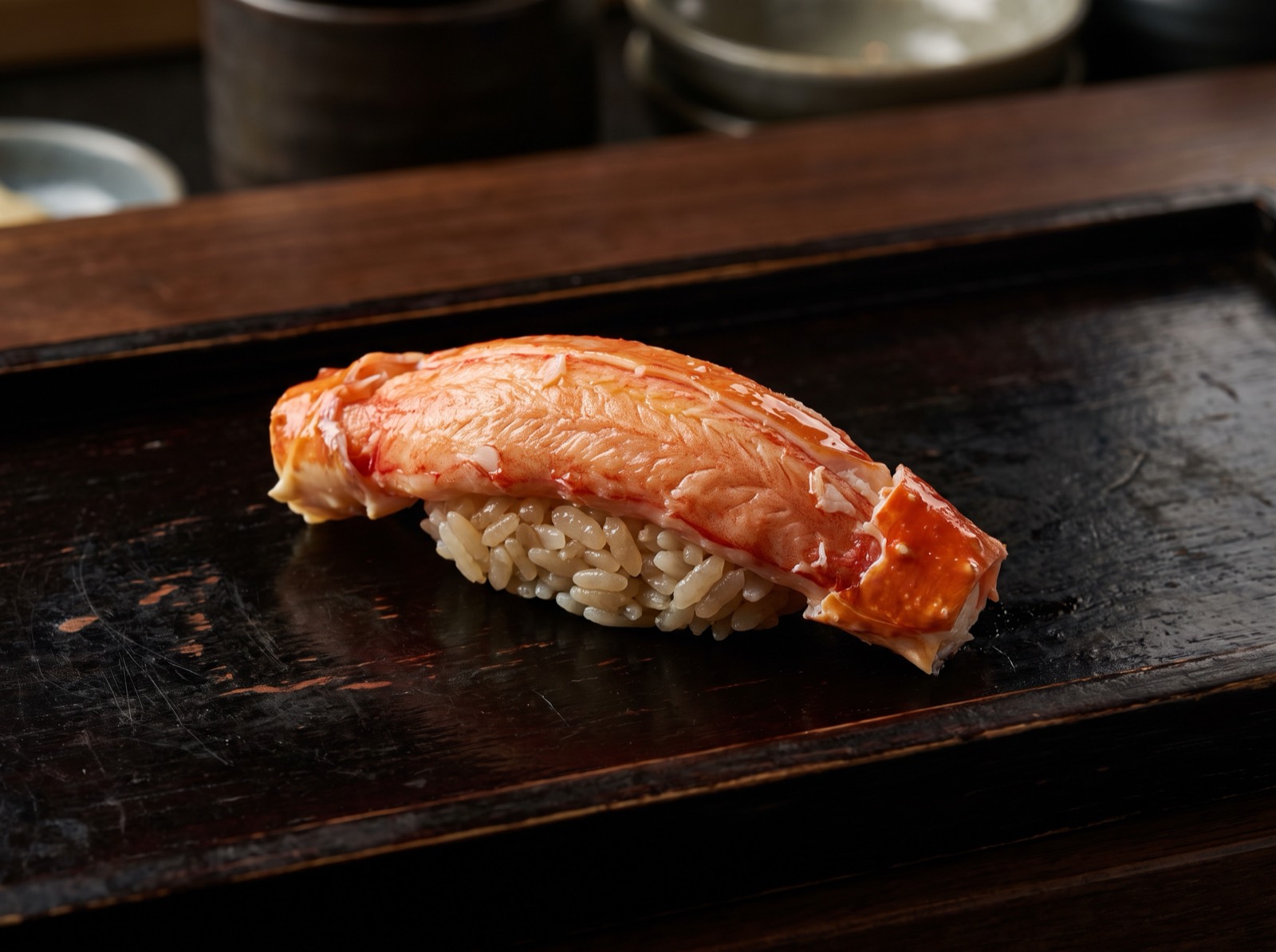
- Taraba-gani, generally called king crab in English: a much larger animal, sold almost entirely as leg meat.
- Beni-zuwai-gani, a smaller, deeper-water relative of zuwai-gani, cheaper and less often named on its own.
- Kegani, round-bodied and bristled, more often boiled and eaten whole than served as nigiri.
- Kanikama, which is not a crab at all: a manufactured stick shaped, coloured and named to stand in for one.
When it is used
Zuwai-gani and taraba-gani are cold-water animals, at their best through the colder months. Both reach the counter cooked: crab nigiri, unlike most fish nigiri, is essentially always a boiled or steamed piece rather than a raw one. Kanikama runs on a different clock entirely — no season, no boat, and far more often folded into a roll than set on its own over rice.
What the chef actually does
Taraba-gani reaches the counter as leg meat, almost always. The animal is boiled or steamed, and the meat is drawn from the legs in long fibres that separate cleanly with a light pull, then served in generous pieces, sometimes laid loosely over the rice rather than pressed flat. The area under the back of the shell, rather than being discarded, often becomes a gunkan-maki or a simple salad, dressed lightly enough that the sweetness of the meat still leads.
Zuwai-gani is smaller, and the sexes are treated as different products. The nigiri version is leg meat from a male, boiled and laid over the rice in a single piece the length of the leg it came from. A female stays far smaller, because once she reaches maturity she stops moulting and simply stops growing, and what a shop serves from her is usually roe rather than her little flesh. Roe a crustacean carries on the outside of its body, on its legs, after spawning has a name of its own in the trade — sotoko (外子) — and it is this, not leg meat, that a menu is pointing at when a dish is built around a female crab.
A third part of the animal almost never gets a line of its own on a menu: the soft, custard-like organ under the shell, called miso (みそ) in the trade — the hepatopancreas, an organ shared by crab and shrimp alike, unrelated to the soybean paste of the same name despite the coincidence. It is the most concentrated flavour on the animal, and most menus never give it a name. A shop that serves it — spooned into the shell, folded into a roll, or worked into a sauce — is serving what a lot of diners never realise is the actual point of ordering crab at all.
Colour is where the differences show most plainly. A live zuwai-gani or taraba-gani is a dull grey-blue, and turns bright orange-red only once it hits boiling water — the same carotenoid-and-protein mechanism that turns a clam pink when it is blanched, as we describe in our article on hokkigai: heat breaks apart a protein complex that had been masking the pigment, and the pigment's own colour shows through. Beni-zuwai-gani breaks that pattern. It lives deeper, and the deeper the water, the redder the shell already is before any heat touches it — shallow zuwai-gani is not red, crabs from the depths in between come out mottled pink, and beni-zuwai-gani itself can be red at the market before it is ever cooked.
Why it is done
Some of this is inherited from necessity rather than designed for flavour. Taraba-gani was, for a long time, not something anyone fished for on purpose — it turned up on cod lines set for a different animal entirely, and only became the target of a fishery once it was clear people wanted it. The name remembers this: taraba means the grounds where cod are caught, not anything about the crab. The crab is named after the fish it once rode in on.
Zuwai-gani's spread across the country followed a similar path from circumstance to convention. It used to be a regional item, eaten mainly near the ports that landed it, because a freshly boiled crab does not travel far without care. Wider availability came once inexpensive imported crab made it practical to sell far from any coast where it was caught, and only then did it become a nationwide item rather than a regional one. What looks today like an obvious counter staple is, underneath, fairly recent distribution history.
It is the most concentrated flavour on the animal, and most menus never give it a name.
How it differs from what it is confused with
Taraba-gani has a close look-alike, abura-gani, a related species from the same cold waters. The resemblance is close enough that most people, chefs included on a bad day, cannot separate them without checking a small anatomical detail nobody bothers to check once the crab is already cooked and plated, and abura-gani has, more than once, been sold under taraba-gani's name by mistake. It is not a lesser animal for being the look-alike; it is simply a different one, priced differently for reasons that have nothing to do with how it tastes.
Zuwai-gani and beni-zuwai-gani are close enough as species that, where their depth ranges overlap, they interbreed — the boundary between them is not the clean line a shared word implies. Beni-zuwai-gani is generally judged wetter and plainer than zuwai-gani, and priced accordingly, but the two are near enough to each other, biologically, that sharing a word between them is not much of a stretch.
Kanikama is the largest stretch, because it does not stretch a definition so much as ignore one. It is a manufactured stick of processed fish, formed and coloured to resemble a strand of crab leg meat, and it carries the word kani in its own name while containing none. That it can share a name with an animal it has nothing to do with is less strange than it sounds, once the earlier point is taken seriously: kani was never a scientific category to begin with. It is a kitchen word, and kitchen words get applied to whatever is close enough to answer the description — including, eventually, something that only resembles it.
- Taraba-gani vs. zuwai-gani. Size is the fastest tell — taraba-gani legs are far thicker; zuwai-gani is slimmer.
- Taraba-gani vs. abura-gani. Close enough that the word on a menu is not proof of which one you have.
- Zuwai-gani vs. beni-zuwai-gani. Colour before cooking is the giveaway where you can see it — beni-zuwai-gani is already reddish.
- Kani vs. kanikama. Texture is the tell: real leg meat separates into long fibres; kanikama shreds evenly, like the manufactured product it is.
How to say it
KAH-nee, two flat beats, no stress on either syllable. Zuwai-gani is zoo-why-gah-nee; taraba-gani is tah-rah-bah-gah-nee; kegani is keh-gah-nee. Kanikama keeps kani's first two syllables and adds a short form of kamaboko, the processed fish cake it belongs to.
Where you will see it
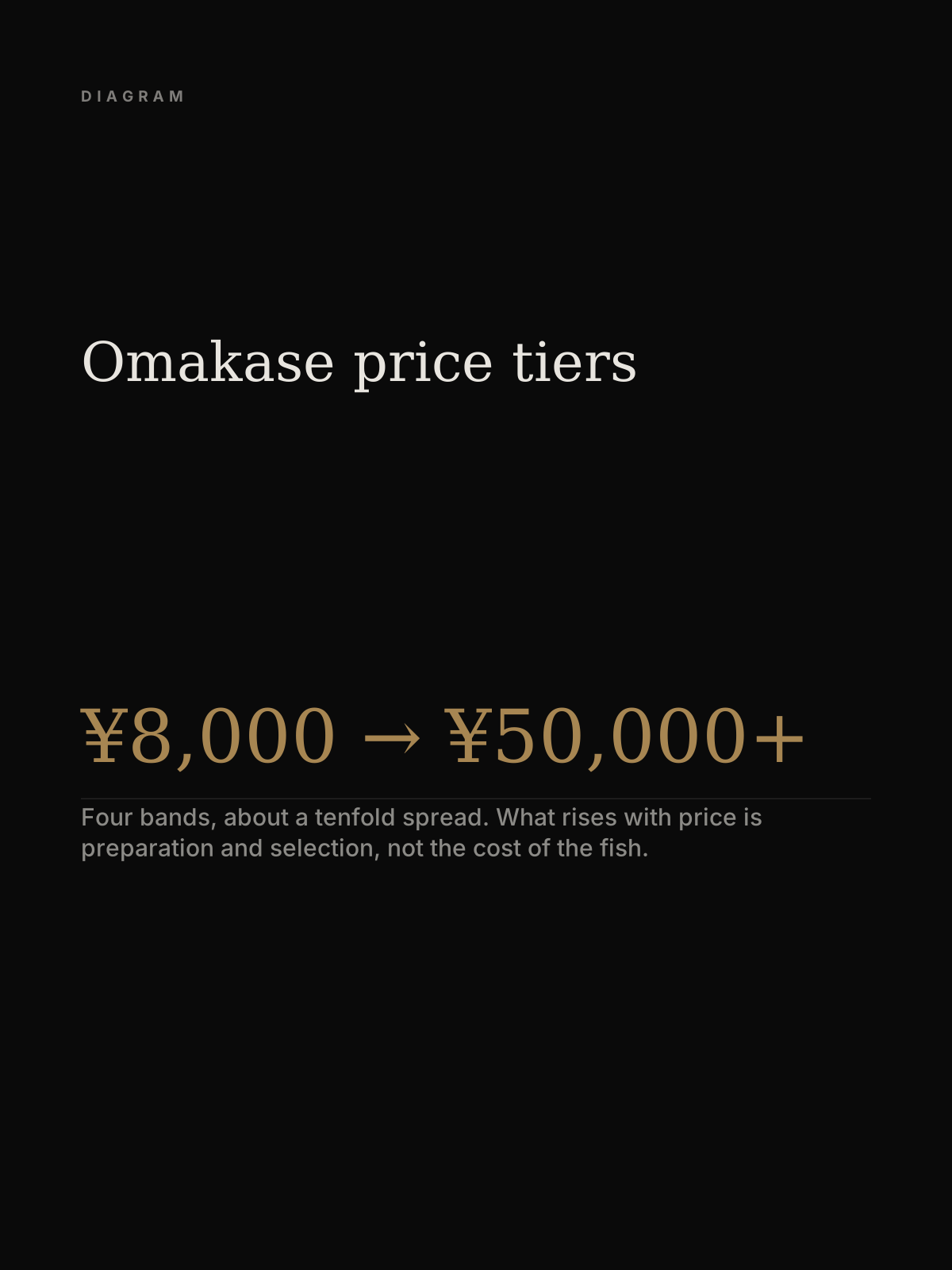
Taraba-gani leg meat and zuwai-gani nigiri both sit toward the upper end of a course, closer to the shellfish and premium items than to the everyday fish — see our guide to omakase price tiers for where that sits generally. Kani miso, when a shop serves it, tends to appear as a small course of its own, precisely because so little of it comes from any one animal.
Kanikama shows up everywhere else: in maki rolls, in salads, folded into a California roll alongside avocado, on conveyor belts and in convenience-store sandwiches, almost never at a counter otherwise serious about what it serves. It is worth noticing, the next time a menu simply says kani, that the word has just told you remarkably little about what is about to arrive.
Frequently asked questions
Is kani always real crab?
Not necessarily. Zuwai-gani, taraba-gani, beni-zuwai-gani and kegani are all real crabs sold under the word kani, but so is kanikama, a manufactured stick of processed fish shaped and coloured to resemble crab leg meat. The word alone does not tell you which one you are getting.
What is the difference between zuwai-gani and taraba-gani?
Different animals. Zuwai-gani is slimmer and more delicate, generally called snow crab in English; taraba-gani is much larger, generally called king crab, and is served almost entirely as leg meat. Zuwai-gani nigiri uses male leg meat, while a female zuwai-gani is more often served for her roe than for what little body meat she carries.
What is kani miso?
The hepatopancreas, an organ found in crab and shrimp alike — not the soybean paste of the same name, despite sharing it. It is soft, custard-like, and the most concentrated flavour on the animal, though it rarely gets a line of its own on an English menu.
What is sotoko?
Roe a crustacean carries on the outside of its body, on its legs, after spawning. A female zuwai-gani is often served specifically for this rather than for her leg meat, since her body stays much smaller than a male's.
Why does crab turn red when it is cooked?
A live crab's shell is a dull grey-blue because the pigment responsible is bound up with protein in a complex that masks its own colour. Heat breaks that complex apart, and the pigment's true colour, a bright orange-red, shows through. It is the same mechanism described in our article on hokkigai, where it turns a clam pink instead.
Is kanikama real crab?
No. It is a manufactured product made from processed fish, formed and coloured to resemble crab leg meat, and it carries the word kani in its own name while containing none of it.