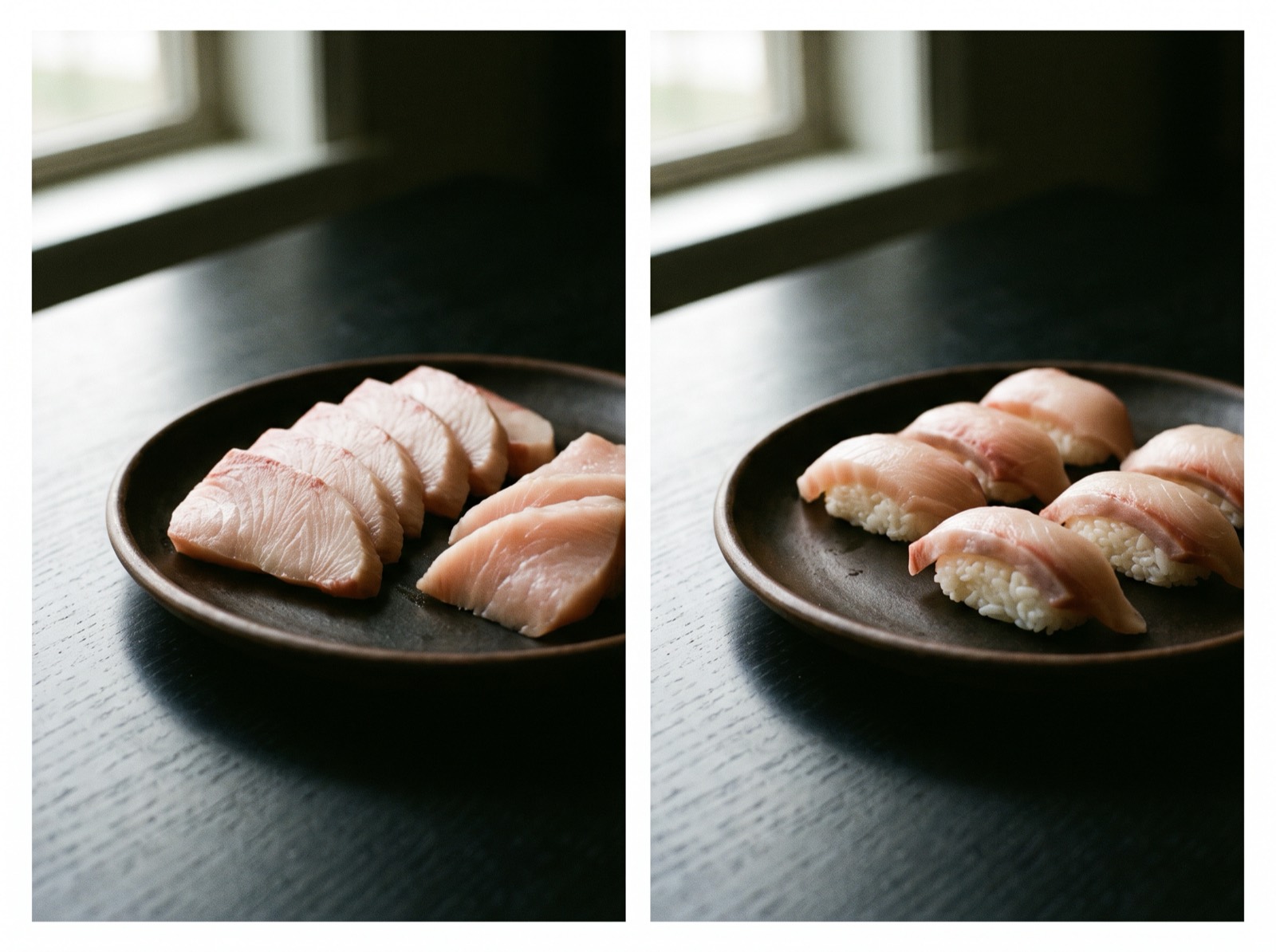
Chirashi (ちらし寿司) is a general term for sushi in which seafood and other toppings are arranged decoratively over vinegared rice, rather than pressed into individual pieces. Where nigiri makes one decision per bite, chirashi makes most of its decisions once, over the whole bowl, and lets the diner do the rest with a pair of chopsticks.
What it is
The word describes an arrangement, not a fixed recipe, which is why chirashi covers more ground than it first appears to. At its simplest it is rice in a bowl with sashimi-grade cuts laid over the top; at a specialty sushi counter, a more exacting version exists in which the ingredients are finely cut and carefully placed piece by piece rather than simply scattered, known as barachirashi, offered as a plated alternative to a run of nigiri.
Toppings are not limited to seafood. Thin strips of cooked omelette, seasoned shrimp and lightly pickled vegetables often sit alongside the raw or cured fish, adding colour and texture across the surface of the bowl rather than repeating the same note piece after piece.
That range, from a quick bowl to a chef's plated course, is the reason chirashi resists a single tidy description. What holds every version together is the rice underneath and the fact that nothing on top of it has been pressed.
When it is used
At a specialty counter, a barachirashi plate can stand in for a full run of nigiri, ordered as a single course rather than piece by piece, and it is judged the same way nigiri is: on the rice, the cut and the arrangement, without the individual per-piece decisions nigiri involves.
Away from the counter, chirashi is also one of the most common takeaway and home-cooked sushi forms, sold in single-portion boxes at supermarkets and department-store food halls.
What the chef actually does
The rice is seasoned the same way any sushi rice is, then it is what happens next that varies by version. In one course-style presentation, close in spirit to a plate of sashimi, raw cuts are arranged over the rice much as they would be arranged on a plate on their own, so that the dish reads as a sashimi course sitting on a bed of rice rather than as a mixed bowl.
This course-style version is sometimes called nama-chirashi (生ちらし), literally “raw scattered”, and the presentation sits close enough to a plate of sashimi that ordering it is really a choice between two ways of eating the same cuts: on rice, or without it.
A takeaway-style version is built differently, and deliberately so. Toppings are chosen with the trip in mind: cooked, simmered or vinegar-cured pieces that hold their texture and food safety well outside a kitchen are favoured over cuts that would suffer from raw exposure and time spent away from the counter, which is one reason a takeaway chirashi box often looks less like a sashimi plate and more like a mosaic of cooked, cured and raw elements together. We do not give a fixed length of time that a box is expected to hold up for, because the sources describe the goal rather than a tested duration.
Assembly for that style follows its own small logic. The seasoned rice is often mixed through with something finely chopped, a simmered mushroom is a common choice, so that a layer of flavour runs through the rice itself rather than sitting only on top of it. The rice is then packed evenly to the corners of the container rather than mounded loosely, since loose rice settles and shifts in transit, and the toppings are placed by colour and shape so the surface reads as deliberate rather than random, sometimes finished with a scattering of shredded nori across the top.
- Toppings. Raw cuts for a course eaten immediately; cooked, simmered or vinegar-cured pieces for a box that has to travel.
- Timing. Assembled to order at a counter, against assembled ahead for pickup or delivery.
- Packing. Rice pressed to the corners of a sealed container so it survives transit, rather than simply mounded in a bowl.
Why it is done this way
The two approaches solve two different problems with the same starting point. A course-style chirashi is built to be eaten immediately, so it can use whatever cut the kitchen would put in a plate of sashimi. A takeaway chirashi is built to survive a delay between kitchen and table, so the choice of toppings, and the way the rice is packed, is aimed at holding up rather than at matching a counter presentation exactly. Neither is a lesser version of the other; they are answers to different questions about when the food will actually be eaten.
No pressing, no forming. Most of the decisions are made once, over the whole bowl, rather than piece by piece.
How it differs from what it is confused with
- Chirashi and nigiri. The same rice and often the same toppings, but scattered or arranged over a bowl rather than pressed into individual pieces. No per-piece shaping, no pressing.
- Chirashi and a sashimi plate. A course-style chirashi can look close to a plate of sashimi, but it is built on rice; remove the rice and it is sashimi, which is a different dish entirely. See sushi versus sashimi for that line drawn in full.
- Barachirashi and chirashi generally. Barachirashi is the finely cut, carefully placed version served as a course at a specialty counter; chirashi is the broader term that also covers simpler, home-style bowls.
- Course-style and takeaway-style chirashi. One is built to be eaten immediately and can use raw cuts freely; the other is built around ingredients and packing that hold up over a delay before eating.
How to say it
chee-RAH-shee is close enough. Three even beats, chi-ra-shi, from the verb chirasu, to scatter. Barachirashi adds a beat at the front: ba-ra-chi-ra-shi.
Where you will see it
On specialty sushi menus as a plated course, usually described in English as chirashi bowl or scattered sushi; in supermarkets and department-store food halls as single-portion takeaway boxes; and at home, where it is one of the sushi forms most commonly made without any specialised equipment, since nothing needs to be pressed, rolled or shaped.
For how chirashi compares in cost and portion to nigiri and sashimi ordered separately, see sushi versus sashimi. For the full set of forms sushi takes, see types of sushi.
Frequently asked questions
What is chirashi?
A general term for sushi in which seafood and other toppings are arranged over a bowl of vinegared rice rather than formed into individual pressed pieces. It ranges from simple home-style bowls to a finely arranged plated course called barachirashi.
What is barachirashi?
A style of chirashi in which the ingredients are finely cut and carefully placed piece by piece rather than simply scattered. It is offered at specialty sushi restaurants as a plated alternative to a run of nigiri.
Is chirashi the same as sashimi?
No. A course-style chirashi can look close to a sashimi plate, but it sits on vinegared rice; sashimi has no rice at all. Remove the rice from a chirashi bowl and what remains is sashimi, a different dish.
Why does takeaway chirashi look different from a chirashi course at a sushi counter?
A takeaway box is built to survive time between the kitchen and the table, so it favours cooked, simmered or vinegar-cured toppings over raw cuts and is packed firmly so the rice does not shift in transit. A course served immediately can use raw cuts more freely.
Is chirashi cheaper than nigiri or sashimi?
It is generally considered good value for the amount of fish involved, since the same or similar toppings are served over a single bowl of rice rather than formed into separate pressed pieces, though price still depends on the specific cuts used.
How do you say chirashi?
chee-RAH-shee is understood, though it is properly three even beats, chi-ra-shi, from the verb chirasu, meaning to scatter.