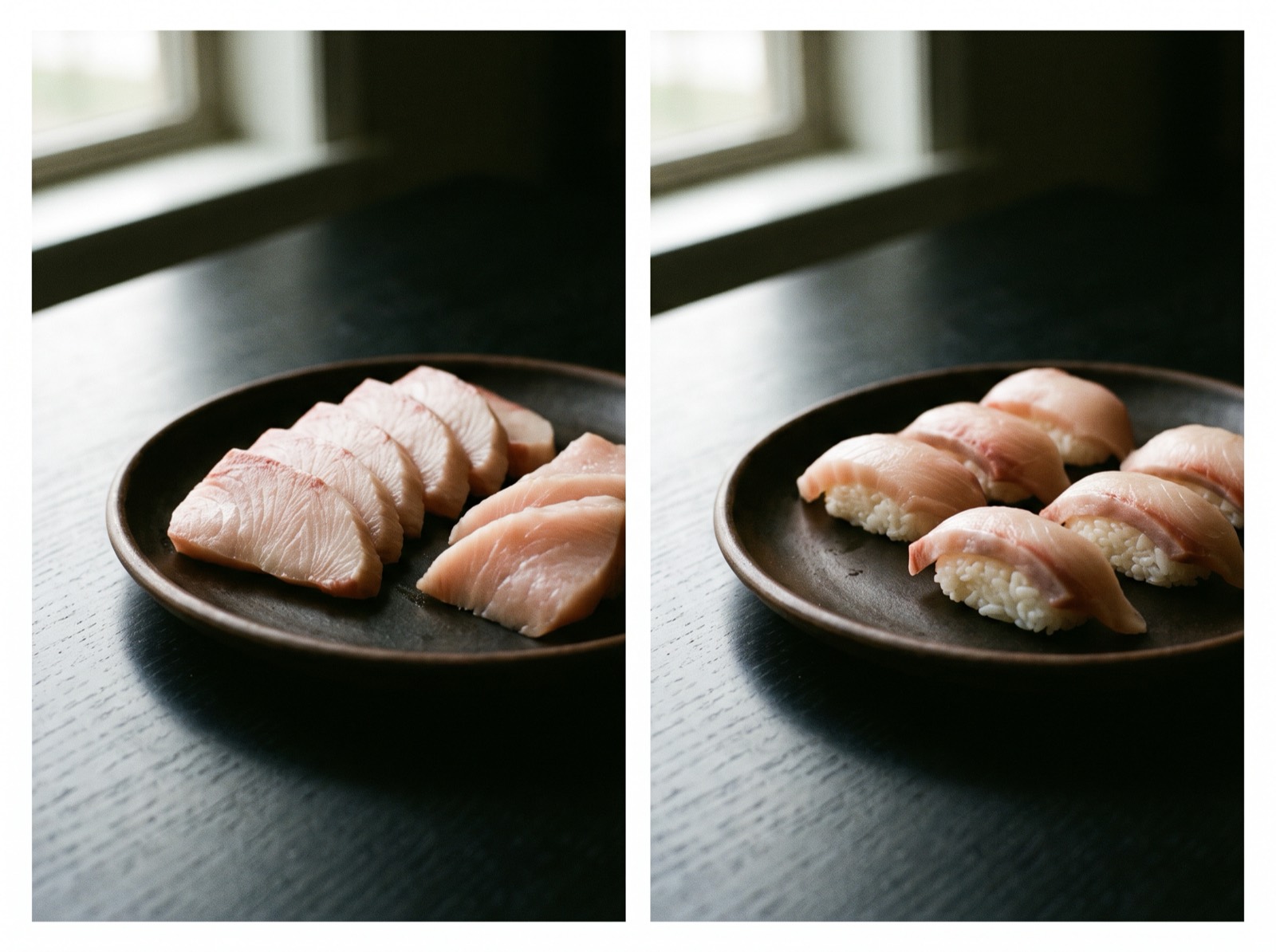
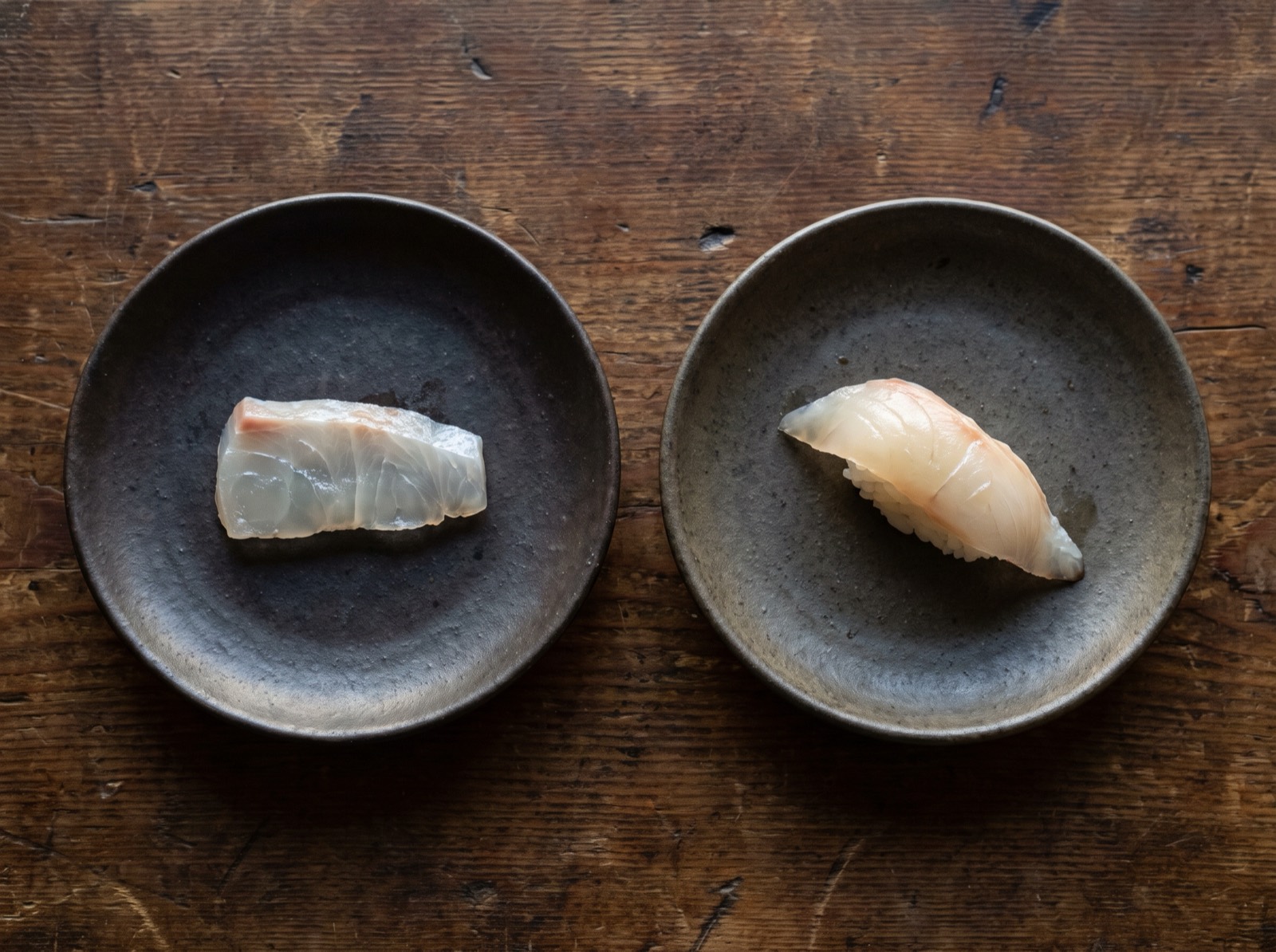
Sashimi (刺身) names fish sliced into bite-sized pieces. It is a cut, not a recipe: no rice, no wrapping, no forming by hand, only a blade drawn through a fillet in a way that decides almost everything about how the piece will eat.
What it is
The word attaches to the act of slicing, not to raw fish specifically and not to any particular presentation. What arrives on the plate is judged on three things: which fish, how it was handled before the knife touched it, and the cut itself. Nothing else stands between the diner and the fish, which is exactly why the cut carries so much of the outcome.
In the trade, moving a fish from a butchered block, or saku, into individual slices of sashimi or sushi topping is called hiku (引く), “to draw”. The word describes the motion rather than the result, and it is the same verb used for the knife stroke whether the slice is destined for a plate of sashimi on its own or for the rice underneath a piece of nigiri.
When it is used
At a counter, sashimi belongs to the opening part of a meal, eaten alongside a drink before the main run of nigiri begins. That sequencing, and how sashimi compares to nigiri once the rice is added back in, is covered in full in sushi versus sashimi and nigiri versus sashimi; this entry stays with the cut itself rather than repeating that ground.
Outside a sushi counter, sashimi also appears as its own course within a kaiseki meal, arriving as one dish among several rather than as the opening act to anything else, since a kaiseki menu has no run of nigiri waiting after it.
What the chef actually does
The knife is a yanagiba (柳刃), a long, single-edged blade, and the single edge is not incidental. Because only one face is ground, the blade can be drawn through the flesh and pulled cleanly away from the cut face rather than wedging into it from both sides the way a double-edged knife does, which is what a two-sided blade would do to a delicate fillet. Japanese kitchens hold that a single-edged blade used this way gives a smoother, more controlled cut than a Western-style knife can produce on the same fish.
The stroke itself is a draw, not a saw. The blade is set at the heel, near the handle, and pulled through the fish in one continuous arc toward the body, reaching the tip only as the slice completes. Sawing back and forth crushes the cells at the cut face and dulls the surface; a single unbroken draw, by contrast, leaves the face smooth enough to hold light, which is part of why a well-cut slice looks as clean as it tastes.
The angle of that draw is chosen for the fish, not fixed in advance. A cut made straight down, across the grain, gives a different bite than one taken at a shallow angle along it, and a chef reads the block in front of them — how the muscle runs, how much fat sits in it, how thick the fillet is that day — before deciding the angle for that particular fish. This is also why the same species can arrive cut in visibly different shapes from one counter to the next; there is no single correct angle, only a correct one for that fish.
A second, contrasting technique exists alongside the draw for jobs the draw is not suited to: a reverse stroke, blade turned edge-up and pushed rather than pulled, used for tasks like freeing a rib bone or working close along the skin, where drawing the blade the usual way would cut too deep or in the wrong direction. It is not how a slice is finished; it is a tool for the preparation before the slicing begins.
The grip matters as much as the stroke. The blade is held with the thumb and middle finger anchored near the collar, close to the handle, while the index finger rests along the spine to steady it through the draw. The cut itself is made standing rather than seated, weight balanced across both feet, so the whole arm can move through the stroke rather than just the wrist.
- The draw. Blade set at the heel, pulled through in one continuous arc toward the body. Used to finish a slice.
- The reverse stroke. Blade turned edge-up and pushed rather than pulled. Used before slicing begins, for freeing a bone or trimming skin close along the flesh.
Why it is done this way
A cut face is not neutral. It changes how much of the fish's own moisture and fat reach the tongue on first contact, and a torn or sawed face releases both less cleanly than a face left smooth by one continuous draw. The technique exists because the difference is tasted immediately, not because it looks more skilled.
The word describes a cut, not a category of food. Nothing else stands between the diner and the fish.
How it differs from what it is confused with
- Sashimi and nigiri. Sashimi is the cut alone, with no rice; nigiri sets the same kind of slice, or a topping cut for the purpose, onto a hand-formed base. The full comparison is in nigiri versus sashimi.
- Sashimi and sushi generally. Since sushi is defined by vinegared rice and sashimi has none, sashimi sits outside the category entirely even though it is served in the same meal. See sushi versus sashimi.
- Sashimi and raw fish. The two overlap heavily but are not the same claim. Sashimi describes a cut; the fish under it can be, and often has been, cured, seared or otherwise treated before slicing.
- The draw and the reverse stroke. The draw finishes a slice; the reverse stroke is a preparation tool used before slicing, for jobs like removing bones, not an alternative way of cutting the final piece.
How to say it
sah-SHEE-mee is close enough and is the form most English speakers already use. Properly it is three even beats, sa-shi-mi, none of them stressed. Yanagiba, the knife, is ya-na-gi-ba, and the name means “willow blade”, after its long, slender shape.
Where you will see it
On the menu of nearly every sushi counter, listed by fish rather than by the word itself, and at izakaya, kaiseki restaurants and home tables well beyond the world of sushi specifically. It is also sold pre-sliced in supermarkets and depachika food halls, cut by machine or by hand depending on the shop and the price.
At a counter it is dipped by the diner in soy sauce, usually with a little wasabi worked in beforehand rather than added at the table. How that is done, and where sashimi falls in the order of a meal, is set out in how to eat sushi.
Frequently asked questions
What is sashimi?
Fish sliced into bite-sized pieces, served without rice or any wrapping. The word describes the cut rather than a specific dish or a claim about rawness; what matters is which fish, how it was handled, and the cut itself.
What knife is used for sashimi?
A yanagiba, a long, single-edged blade. The single edge lets the knife draw cleanly through the flesh and pull away from the cut face, which a double-edged blade cannot do in the same way on a delicate fillet.
What does hiku mean in sushi?
"To draw." It is the trade word for cutting a fish from a butchered block into individual slices, whether the slice becomes sashimi on its own or a topping for nigiri. It names the motion of the knife, not the result.
Why is sashimi cut with a single drawing motion instead of sawing?
A single continuous draw leaves the cut face smooth; sawing back and forth crushes the cells at the surface. The smoother face releases the fish's own moisture and fat more cleanly on first contact, which changes the taste, not just the appearance.
Is sashimi always raw?
No. Sashimi describes the cut, not the state of the fish. The fillet underneath can be, and often has been, cured, seared or otherwise treated before it is sliced.
How do you say sashimi?
sah-SHEE-mee is understood, though it is properly three even beats, sa-shi-mi, with no strong stress on any of them.