There is no licence to become a sushi chef in Japan. The training is long — the trade’s own figure is about ten years — but that figure is a convention inside the craft, not a legal requirement, and nothing in Japanese law obliges the person forming your nigiri to hold any qualification at all. What Japan licenses is a title, chōrishi, which a cook may or may not choose to hold, and one fish, fugu, which may be handled only by someone a prefecture has examined. The distance between those two facts is the most misunderstood thing about the counter.
What the law actually asks
The Cook’s Licence Act — Act No. 147 of 10 May 1958, published by Japan’s Ministry of Health, Labour and Welfare — defines a chōrishi in its second article as a person licensed by a prefectural governor to use that title while working in cooking. Article 3 places the granting of the licence with the prefecture, not with the national government. That is the first thing English-language accounts usually get wrong.
The second is what the licence does. Article 8 says only that a person who is not a chōrishi may not use that title, or any title confusingly similar to it. It protects the word. It does not reserve the work. Nobody needs it in order to cook, or to stand behind a counter. Opening premises is a separate question under a separate law: a restaurant needs a business permit from the prefectural governor under Article 55 of the Food Sanitation Act, and must name a food-hygiene supervisor. A chōrishi licence is one of the qualifications that fills that post without sitting the training course — which is the only point at which the licence touches the running of a shop.
The Act comes closest to a requirement in Article 8-2, which asks operators of premises that cook and serve food to large numbers of people to endeavour to place a licensed chōrishi at each site. Endeavour is the operative word: a duty of effort, not a condition of trading. A ten-seat counter is not the kind of premises the article has in view in the first place.
One administrative thread runs alongside it. Article 5-2 requires chōrishi working in those larger premises to file their name and address, as they stand on 31 December, with the governor of the prefecture where they work — every second year, by 15 January of the year following. It is a headcount, not an inspection.
What is genuinely mandatory has little to do with the chef’s credentials and everything to do with the room. Japan’s Ministry of Health, Labour and Welfare states that since 1 June 2021 every food business in the country, a sushi counter included, has been required to run hygiene management on HACCP principles; small operators may follow a simplified handbook written for their sector. That is the law that actually governs whether your meal is safe, and it attaches to the business rather than to the person.
The one fish with a licence
Fugu is the exception, and the exception is strict. Pufferfish may be handled only by a person whom a prefectural governor recognises as able to identify the species and remove the toxic parts — or by another person working under that person’s supervision. There is no informal version of this.
Until recently, what that recognition required depended on where you were. Each prefecture ran its own scheme, the requirements differed, and a certificate earned in one was not necessarily honoured in the next. National criteria issued by the Ministry of Health, Labour and Welfare on 31 October 2019, last revised on 10 March 2025, changed that. They require the knowledge and the technique to be confirmed by examination, and they state plainly that practical experience is difficult to assess objectively and is not appropriate as a criterion on its own — a striking sentence to find in a trade that otherwise measures everything in years served. A handler certified under the national criteria is now, in principle, accepted by other prefectures.
So a country that asks nothing of the person slicing your tuna requires a formal examination before anyone touches a pufferfish. Both positions are defensible, and read together they tell you where Japanese food law puts its attention: on hazards it can define, and not on craft it cannot.
The ten years
Which leaves the ten years unexplained by statute, and explained instead by the trade itself. The saying is meshi-taki san-nen, nigiri hachi-nen — three years on the rice, eight years to form. The arithmetic does not add up, and is not meant to. The point of the phrase is the order, not the total: the rice comes first, and it comes first for years.
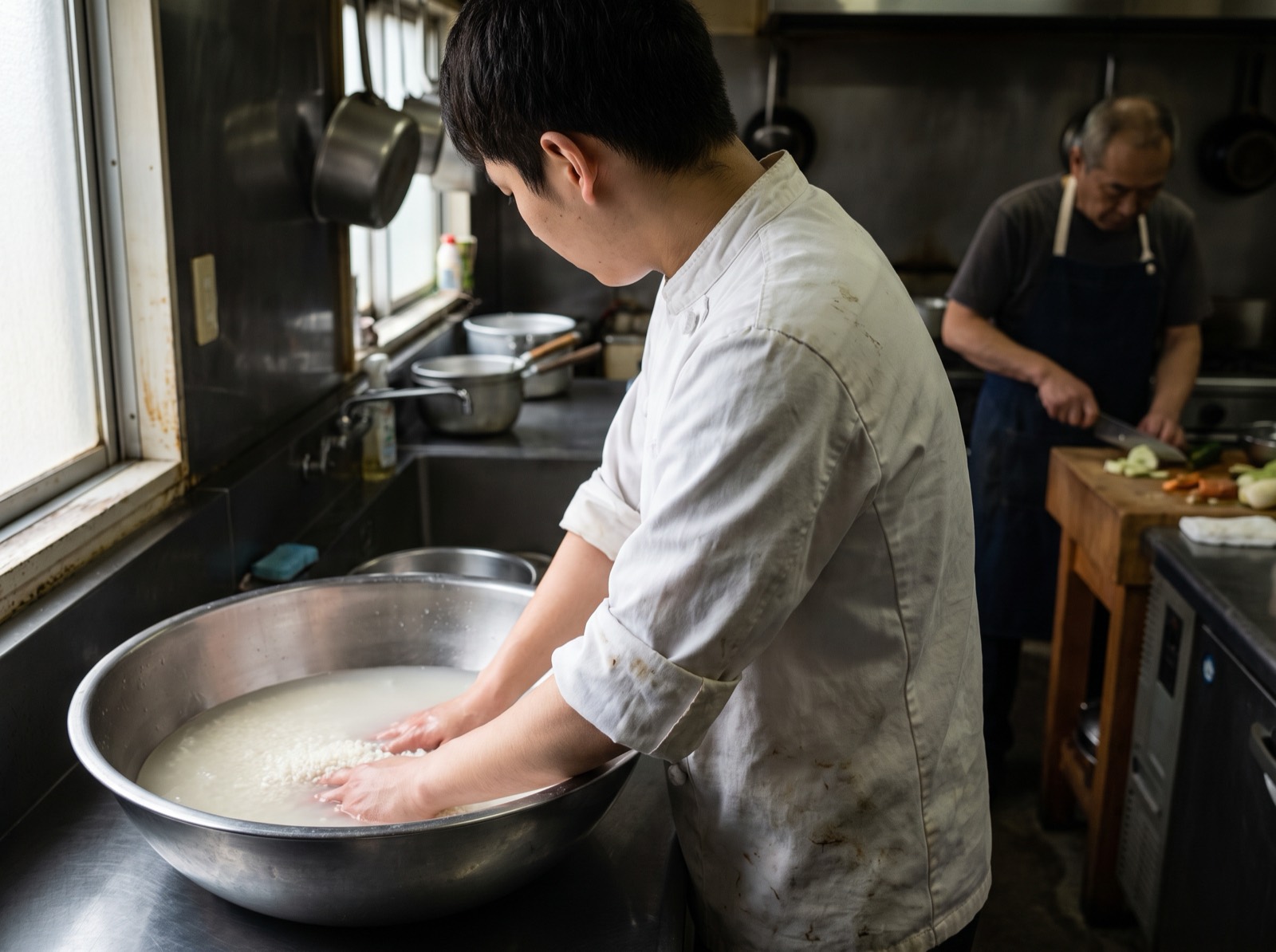
The early years are not spent learning to make sushi. They are spent on the room. An apprentice cleans, carries boxes, runs errands, washes rice and watches. The kitchen word for that position, oimawashi, translates roughly as the one who gets chased around, and it is unglamorous by design. The argument behind it — and it is an argument, defended and attacked inside the trade — is that a counter cannot be taught in a classroom, only absorbed: the tempo of a service, how a regular is greeted, how the boss’s hand changes between eight o’clock and eleven.
The criticism of that system is neither new nor foreign. Ten years is a long time on very little money, the years are not standardised, and what you learn depends entirely on the person you learn it from. Culinary schools now offer shorter routes, and the chōrishi licence itself can be taken by examination with no apprenticeship behind it. The law prefers neither path. What a given counter prefers is a separate question, and it is not settled.
The stations
The vocabulary of the progression is the vocabulary of Japanese kitchens generally, and a sushi shop uses it much as any other kitchen does. The English below is a gloss, not a rank.
Oimawashi (追い回し) — the first years. Cleaning, errands, deliveries, washing rice, being sent for whatever is missing. The station has no contact with the guest and, for a long while, none with the fish.
Wakiita (脇板) — beside the board. Preparation out of sight of the counter: breaking down fish, curing and marinating, keeping stock and knives in order. This is where the technique is actually acquired, and where most of a shop’s work happens before anyone sits down.
Itamae (板前) — in front of the board. The literal meaning is exactly that: the position standing at the cutting board. In a sushi shop it is the person forming nigiri to order, in front of the guest, with nothing hidden.
Taishō (大将) — the counter. Buying, hiring, the room, the guests, and the decisions that cannot be delegated: what was worth taking at the market this morning, and what the meal will therefore be tonight.
The law asks nothing of the person making your sushi, and a great deal of the person making your fugu. The ten years are the trade’s own idea. It has never needed a statute to enforce them.
Why it starts with rice
The first real job an apprentice is given is the rice, and that is not because it is the easy one. Shari — rice seasoned with vinegar, salt and sometimes sugar, cut and cooled and then held near body temperature — is the only component of the meal that appears in every single piece. A shop can buy exceptional fish and still be undone by it.
It is also the hardest part to hide. A slice of tuna is judged by the market before it is judged by the chef. The rice is entirely the shop’s own: its vinegar, its ratio, its timing, the temperature it is held at through a three-hour service. Nothing about it can be bought in.
Which is why the years spent on it are not a hazing ritual, whatever else the apprenticeship may be. A cook who cannot make the rice cannot be trusted with the fish, because the fish will be sitting on their mistake.
What this means at the counter
Practically: do not ask whether the chef is licensed. The answer carries no information, because the licence governs a word rather than the work, and a shop with three decades behind it may well have nobody holding one.
The things that do carry information are visible without asking. Whether the rice arrives at temperature and holds it through the meal. Whether the seasoning is done in the kitchen or left to you and a bowl of soy sauce. Whether the person at the board looks at the guest before deciding what comes next. None of that is regulated, and all of it is the job.
And if there is fugu on the list, you may take the certification behind it seriously — that one really is a matter of examination, and of a prefecture’s signature.
Frequently asked questions
Do you need a licence to be a sushi chef in Japan?
No. Japanese law requires no qualification in order to cook or to work at a sushi counter. The Cook's Licence Act protects the title chōrishi — under Article 8 an unlicensed person may not call themselves one — but it does not reserve the work itself. Opening a restaurant is a separate matter: that needs a business permit from the prefectural governor under the Food Sanitation Act and a named food-hygiene supervisor, a post a chōrishi licence qualifies you for without further training.
What is a chōrishi licence, then?
A title licence granted by a prefectural governor under Article 3 of the Cook's Licence Act of 1958. It permits the holder to use the title chōrishi while working in cooking. Article 8-2 asks operators of premises serving large numbers of people to endeavour to place one at each site — an effort duty, not a condition of trading.
How long does it take to become a sushi chef?
By convention, around ten years, expressed in the trade as three years on the rice and eight years to form. That is a custom inside the craft rather than a legal minimum. Culinary-school routes are shorter, and the chōrishi licence can be taken by examination with no apprenticeship at all.
Is fugu treated differently?
Completely. Pufferfish may be handled only by a person a prefectural governor recognises as able to identify the species and remove the toxic parts, or by someone working under that person's supervision. National criteria issued on 31 October 2019 and last revised on 10 March 2025 require that the knowledge and technique be confirmed by examination, and state that practical experience alone is not an appropriate criterion.
What does itamae mean?
Literally, in front of the board — the position standing at the cutting board. In a sushi shop it refers to the person forming nigiri in front of the guest. It is a description of where someone stands, not a certified rank.
Can you become a sushi chef without an apprenticeship?
Yes. Nothing in law requires one, and the chōrishi licence has an examination route. Whether a particular counter will hire on that basis is a matter for that counter; the argument over it is live within the trade.
Is a sushi restaurant inspected at all?
Yes, but at the level of the business rather than the chef. Since 1 June 2021 every food business in Japan has been required to run hygiene management on HACCP principles, with a simplified sector handbook available to small operators.