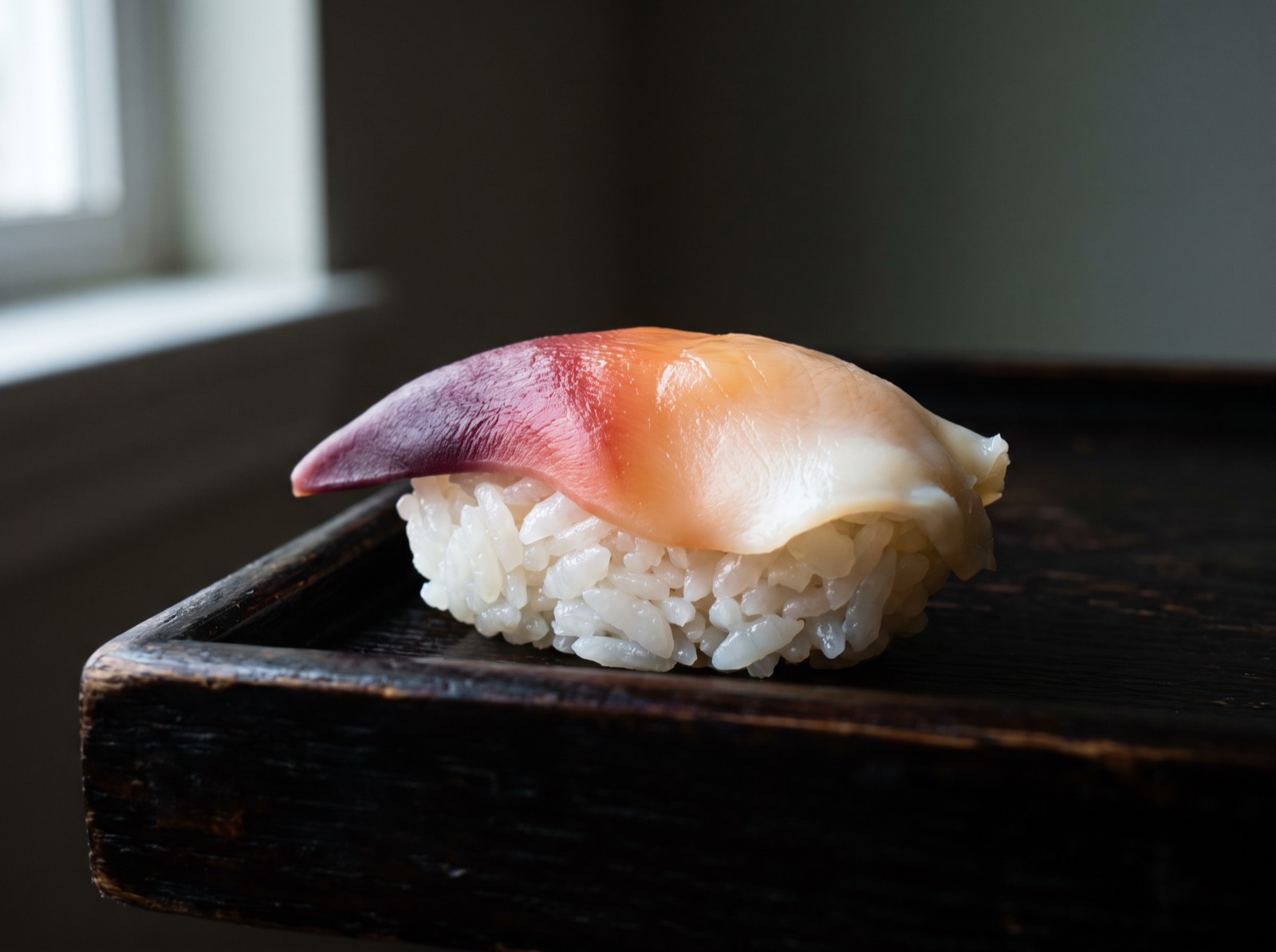
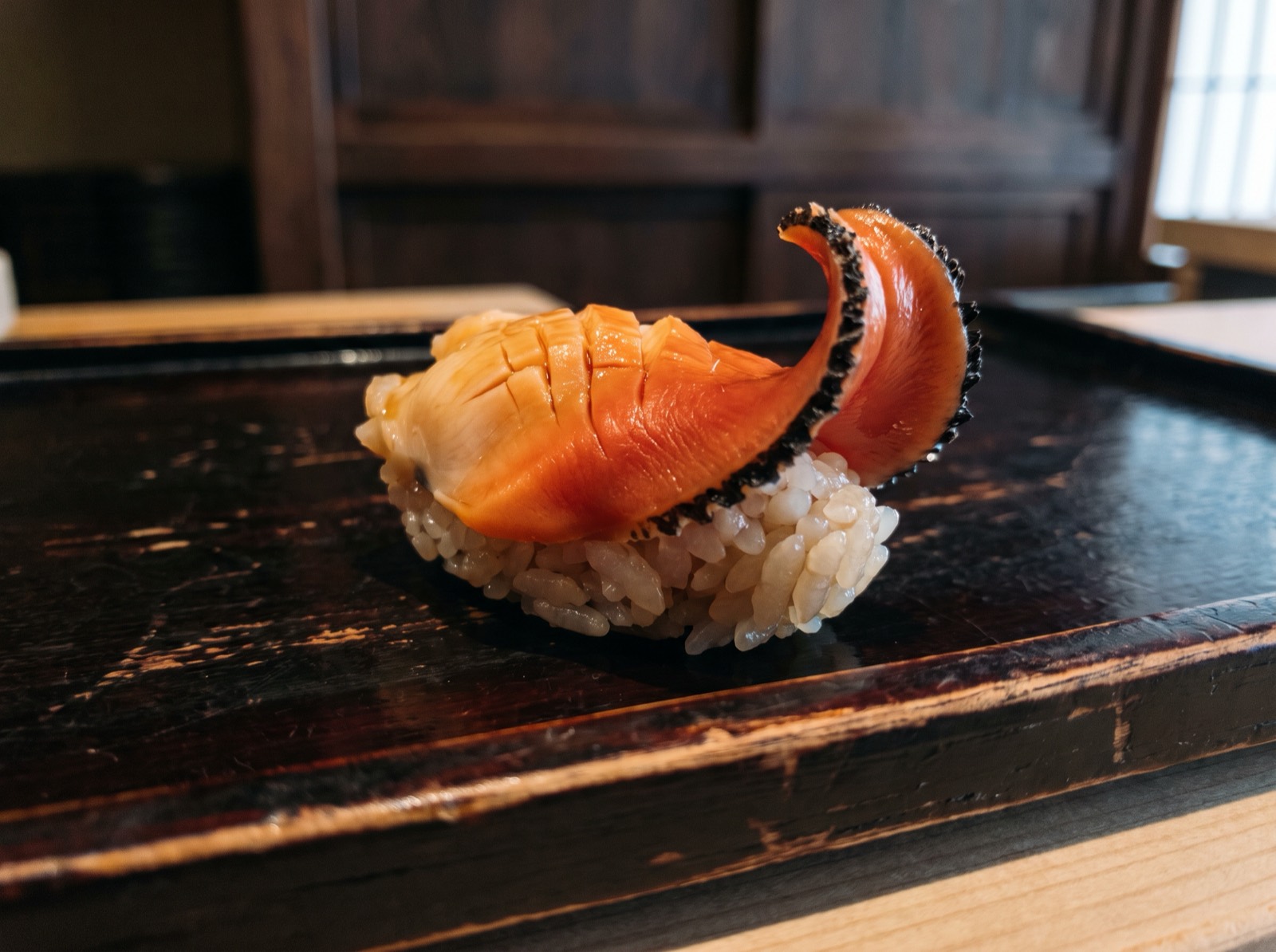
Mirugai (ミル貝) is the market name for a large clam whose siphon — the muscular tube it uses to draw in and expel seawater — is too long to fit inside its own shell. The siphon is the only part that reaches the counter. The animal's formal name is mirukui (ミルクイ); mirugai is what gets printed on the case and said out loud, and the two names are used for the same clam.
What it is
The siphon sits too far outside the shell to be withdrawn fully, so it stays exposed, thick and often noticeably long. On a live clam the protruding length usually carries a dark, almost black covering, and that covering is not part of the animal: it is a foreign seaweed called miru (海松) that attaches itself to the exposed tube and has to be scraped off before the siphon can be used.
The name is where a common story runs ahead of the facts. It is often said that the clam is called mirukui, “miru-eater,” because it appears to be eating the weed stuck to its own siphon. Our sources describe the feeding itself differently: the siphon draws in seawater and the animal takes its food from the organic matter carried in it, rather than from the seaweed growing on the outside of the tube. The weed is fouling, not food, and the resemblance to eating is exactly that — a resemblance.
When it is best
Our sources do not agree on the exact window. One places the season from autumn into spring; others place it from winter into spring. We are not going to split the difference into a date range neither of them gives. What they agree on is the shape of it: mirugai is a cold-to-cool-water item, at its best somewhere in the colder half of the year, and not a summer clam.
The clam is not eating the seaweed on its siphon. It is filtering the water for something else entirely, and the seaweed is simply what grew there.
What the chef does to it
- Opens the shell live, cutting the adductor muscle with a shucking tool or a knife so one side comes free.
- Pulls the siphon out and rinses it well, separating it from the rest of the body.
- Scrapes the dark outer skin from the siphon — the attached seaweed, not the clam's own tissue — working carefully so the cut does not mark the surface that becomes the topping.
- Keeps only the siphon. Inside the animal, the usable tube and the remaining body are treated as two separate things, and only the tube goes onto rice; the rest is not served as sushi topping.
- Serves it raw, usually cut open flat and sometimes lightly scored, for a firm, faintly springy bite and a saline sweetness stronger than most raw shellfish carry.
Honmiru and the substitutes
True mirukui — the clam our sources call honmiru, “real miru” — has grown harder to find in recent years, and scarcity has pushed it toward the expensive end of the shellfish case. Where it is scarce, a related but different clam sold as shiromiru, “white miru,” commonly stands in for it, siphon and shell both paler than the true clam.
Our sources are direct about the two not being close relatives: despite the shared half of the name, honmiru and the substitute clam sold as shiromiru are unrelated species, and an imported clam sometimes sold under a similar name is unrelated to true mirukui as well. The substitute is a legitimate item in its own right, with a comparable texture and a flavour most of our sources describe as milder than the real thing, not a fake pretending to be one.
How it differs from what it is confused with
- Mirugai and shiromiru. The names sound like variants of each other. The animals are not related; shiromiru is a different clam that happens to be sold under a similar name, generally paler and, by most accounts, a step behind true mirukui in flavour.
- Mirugai and other sushi clams. Hokkigai is served for its foot, the muscular base the animal uses to move. Mirugai is served for its siphon instead, with the rest of the body set aside entirely — an unusual division among the clams that reach a counter.
- The “eating miru” story and what the clam actually eats. The name suggests the animal feeds on the seaweed attached to it. It does not; it filters the water, and the weed is simply what has grown on the exposed part of the siphon.
How to say it
mi-ru-ga-i, four even beats. You will hear mirugai at the counter and on the price board; mirukui (mi-ru-ku-i) is the clam's proper name and turns up more in writing than in speech.
Where you will see it, and roughly what it costs
More often at a specialty counter than on a belt: the clam has to be opened and trimmed to order, most of what is bought is discarded, and true mirukui is not easy to source in quantity. A shop that is serving the real thing rather than the substitute will generally say so, the same way a good shop is direct about the origin of its other shellfish.
We are not going to put a price on it here. What is worth knowing is that mirugai and its substitute sit at different points on the case for a reason grounded in scarcity rather than showmanship, and asking which one you are being served is a reasonable question at any counter that carries it. For where a course like this fits into a bill, see omakase price tiers.
Frequently asked questions
What is mirugai?
Mirugai, or mirukui, is a large clam served for its siphon, the muscular tube it uses to draw in and expel seawater. The siphon is too long to fit inside the shell, so it is the only part of the animal that is used; the rest is set aside.
Why is mirugai also called mirukui?
Mirukui is the clam's formal name; mirugai is the market term used at counters and on price boards. Both refer to the same animal.
Does mirugai really eat seaweed?
No. A dark seaweed called miru often attaches itself to the exposed siphon and is commonly blamed for the name, but the clam feeds by filtering matter from the water, not by eating that weed. The seaweed is scraped off before the siphon is served.
What is shiromiru?
A related but genetically distinct clam commonly sold in place of true mirukui, which has become harder to find. Shiromiru has paler flesh and shell and a flavour most sources describe as milder, despite the similar name.
When is mirugai in season?
Sources place the peak differently, from autumn into spring by one account and winter into spring by others, but all agree it is a cold-to-cool-water item rather than a summer one.
How do you pronounce mirugai?
mi-ru-ga-i, four even beats. Mirukui, the clam's formal name, is mi-ru-ku-i.