No certificate is required to make sushi in Japan. What exists is a handful of documents that get lumped together under “sushi chef certification” in English: a cook’s title, an optional national grade of sushi cook, a licence for pufferfish, a hygiene role inside a shop, and a permit that belongs to the premises. They answer different questions, they are issued by different offices, and only some of them say anything about how a person cooks. The short account of why none is required is in how you become a sushi chef; this page goes document by document.
Five documents, five different questions
Read in order, the list is shorter than the search results suggest. The chōrishi licence is a title held by a person. The sushi-cook grade is an optional national certificate above it. The fugu licence is permission to handle pufferfish. The food-hygiene supervisor is a post a shop must fill. The business permit is held by the shop itself. A last thing, the completion certificate from a private sushi course, is not a legal document at all.
Most of them are issued locally. The cook’s licence comes from the prefectural governor. The fugu recognition and the business permit come from the governor or, in a city or special ward that runs its own public health centre, from the mayor or ward head. The supervisor is simply named by the operator, and the sushi grade is the exception: it comes from the Minister of Health, Labour and Welfare. The cook’s licence itself is granted by a prefectural governor under a national Act, so “national qualification”, as English-language accounts often call it, is a loose description rather than an exact one.
The cook’s licence: what a chōrishi licence proves
- What it is. Under the Cook’s Licence Act (Act No. 147 of 1958), a chōrishi is a person licensed to use that title while working in cooking (Article 2).
- Who issues it. The prefectural governor, on application (Article 3). The prefecture keeps a register of licence holders, entry in the register is what grants the licence, and the governor then issues the licence certificate (Article 5).
- How you get it. Two routes. One: a year or more at a cooking-school facility the governor has designated, studying cooking, nutrition and hygiene. Two: at least two years working in cooking in premises of a kind set by ministerial ordinance, then a pass in the examination the governor runs. Both routes presuppose the schooling that would let a person enter upper secondary school (Article 3, Article 3-2).
- What it proves. That you completed one of those two routes. Its test is general knowledge and skill in cooking, nutrition and hygiene, not nigiri.
- What it does not prove. That you are permitted to cook, which needs no licence, or that a shop is permitted to serve.
The two-year route is the one that matters to a counter apprentice, because the ordinance defines which kitchens count. It lists institutional kitchens such as dormitories, schools and hospitals, and a set of licensed food businesses; the restaurant business is the first item on that list, and coffee-shop trade is excluded. Examination dates and fees are a matter for each prefecture, which runs the examination.
The licence can also be lost. A governor may decline to grant one to a person addicted to narcotics, opium, cannabis or stimulants, or to anyone sentenced to a fine or more, and may revoke one if the holder, through their own fault, caused food poisoning or another serious hygiene incident in the course of cooking work (Articles 4-2 and 6). It is a credential with conditions, not a lifetime badge.
Why the licence is a title, not a permission
Article 8 says that a person who is not a chōrishi may not use that title, or any title confusingly similar to it, and Article 11 attaches a fine of up to 300,000 yen to breaking that rule. What is fined is the use of the word. Cooking itself is untouched.
The Act does lean on shops in one place. Article 8-2 asks operators of premises or businesses of a kind set by ministerial ordinance, ones that cook and serve food to large numbers of people, to endeavour to place a licensed chōrishi at each site. The ordinance’s list includes the restaurant business and sets no size limit of its own, so a sushi counter is within its reach. It is still a duty of effort, not a condition of trading. A sushi shop can therefore have no licence holder behind its counter and be entirely lawful, and a shop that has one has not thereby become better or safer on that account alone. For the wider picture of what the law does and does not ask of the person at the board, the explainer on the craft of the itamae sets it out.
The sushi-cook grade: the national certificate that names sushi
- What it is. A title, sushi-ryōri senmon chōrishi (specialist chōrishi in sushi cookery), one of six cuisine grades that follow a national cooking-skills assessment (Cook’s Licence Act, Article 8-3).
- Who issues it. The Minister of Health, Labour and Welfare, who delivers a certificate to those who pass. The Minister may entrust the handling of applications and the running of the examinations to a designated body (Act, Article 8-3; enforcement regulation, Articles 21 and 25).
- How you get it. A written and a practical examination, held at least once a year. The candidate chooses one practical subject from six; sushi cookery is one. To sit it you must be a chōrishi with at least eight years in premises or businesses of the kinds the regulation lists, at least three of them as a licence holder; or six years if you graduated from a designated training facility, again with three as a licence holder; or be someone the Minister deems equivalent (Articles 15 to 17).
- What it proves. That the holder passed the national assessment with sushi cookery as the practical subject, and may use the title (Article 22).
- What it does not prove. Anything the law requires. Nobody needs it to form nigiri or to open a shop, and it does not reserve the work to its holders.
It is the only certificate in this list that names sushi, and it is optional. It also sits on top of the cook’s licence rather than beside it: the main eligibility routes start from a licence already held and years already served.
The fugu licence: the one that tests the person
- What it is. Recognition that a person can identify the species of pufferfish and remove the toxic parts.
- Who issues it. The prefectural governor or equivalent authority.
- How you get it. National criteria issued by the Ministry of Health, Labour and Welfare on 31 October 2019, last revised on 10 March 2025, provide that the knowledge and the technique are to be confirmed by examination. They state that practical experience is hard to assess objectively and is not appropriate as a criterion on its own. A handler certified under those criteria is, in principle, accepted by other prefectures.
- What it proves. That you may handle fugu, or supervise others who do.
- What it does not prove. Anything about the rest of the menu.
The rule itself is not tucked away in the cook’s licence statute. It sits in the same table of the food-sanitation regulations as the hygiene-supervisor rule discussed below: an operator who handles pufferfish must have it handled by a recognised person, or in that person’s presence. Here the criteria say plainly that years of experience alone are not enough.
The food-hygiene supervisor: a post, not a rank
Ask a shop owner which certificate they hold and the answer may well be this one, shokuhin eisei sekininsha (food-hygiene supervisor). It is the document most often mistaken for a chef’s qualification, and it is not one.
- What it is. A person the operator designates. Appended Table 17 to the enforcement regulation of the Food Sanitation Act requires the operators it covers, a restaurant among them, to designate one.
- Who issues it. Nobody issues a licence; the operator names a person who qualifies. A licensed chōrishi, a confectionery hygiene technician, a dietitian, a registered dietitian or a ship’s cook qualifies, among others, as does a person who meets the standard for a food-sanitation inspector or manager.
- How you get it. Anyone else attends a course run, or approved, by the prefectural authority. The length, fee and schedule are set locally and are not stated in the regulation.
- What it proves. That the shop has a named person responsible for day-to-day hygiene management, who follows the operator’s instructions and may advise the operator, whose opinion the operator must respect. The supervisor is also expected to attend refresher courses regularly.
- What it does not prove. Any cooking skill. The person need not be the one who makes the sushi.
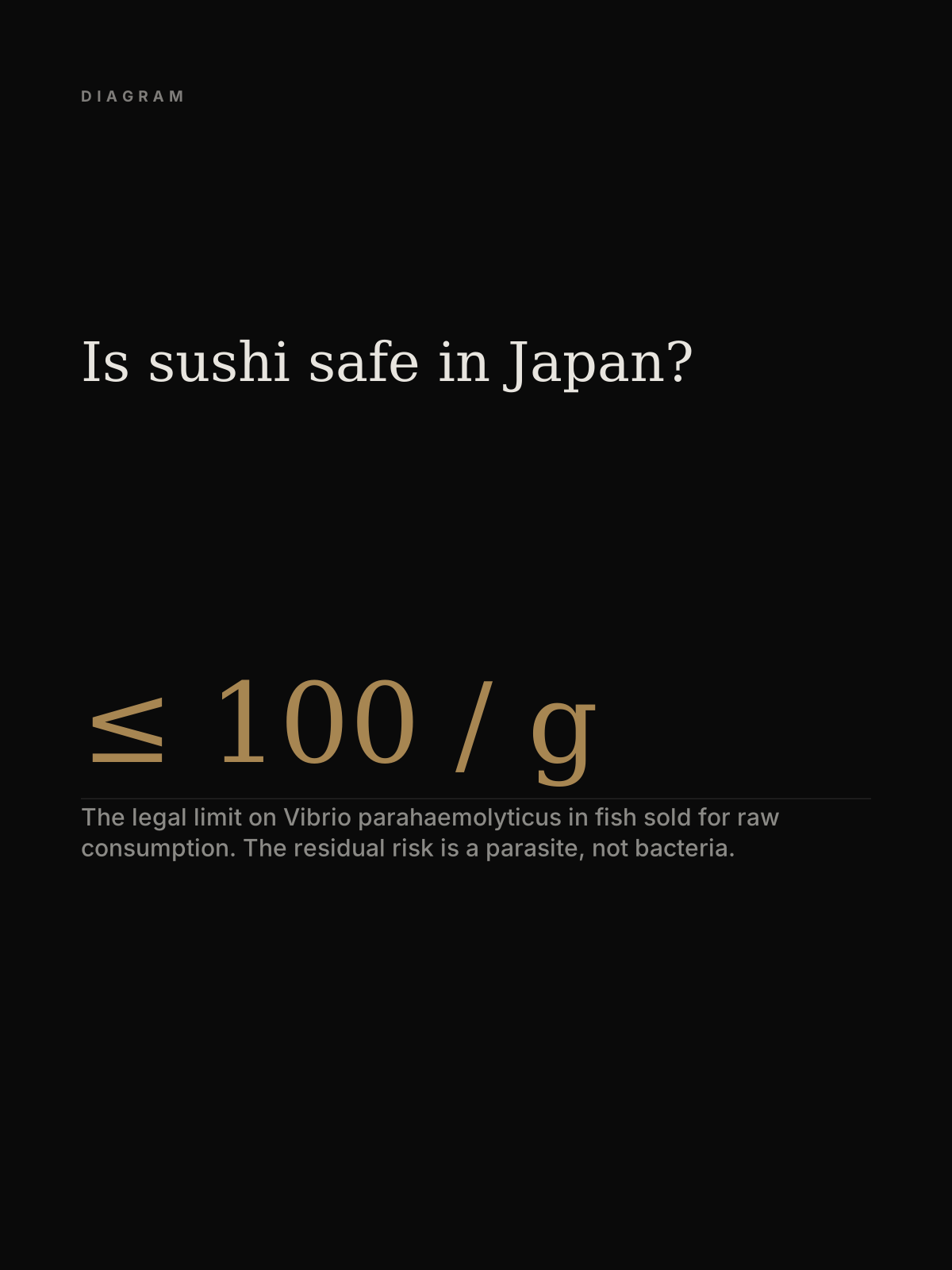
This is also where the cook’s licence quietly meets the shop. A licence holder can fill the supervisor post without sitting the course. That is one of the points at which the licence touches the running of a business, and it is a convenience, not a requirement. The hygiene regime behind it, including the HACCP obligation that applies in principle to every food business since 1 June 2021, is covered in is sushi safe to eat in Japan.
The business permit: issued to the premises
- What it is. The permit that lets a shop operate as a restaurant business under the Food Sanitation Act.
- Who issues it. The prefectural governor or, in a city or special ward that runs its own public health centre, the mayor or ward head (Articles 55 and 76). The prefecture sets facility standards by ordinance (Article 54).
- How you get it. By applying for the premises. The application names the applicant, the premises and the kind of business, the food-hygiene supervisor with their qualification and the course attended, and a drawing of the structure and equipment. If the premises meet the standard the governor must grant the permit, though the Act lets the governor refuse an applicant who falls under its listed disqualifications.
- What it proves. That these premises, run by this operator, passed the facility standard when it was granted. The governor may attach a validity period of not less than five years.
- What it does not prove. Who stands behind the counter. The application asks for a supervisor, and not for a sushi chef.
Hence the distinction that most of the confusion comes from. The licence belongs to a person and says nothing about a shop. The permit belongs to a shop and says nothing about a person. You need the second to open a restaurant. You do not need the first to cook in one.
Sushi school certificates
Private sushi courses may issue their own certificates of completion. They are a record that you took the course. They are not one of the routes to the cook’s licence, which recognises a training facility only if the governor has designated it (Article 3), and they are not the Minister’s sushi-cook grade, which is earned through the national assessment. Whether a given shop values one is the shop’s business, as it is with the ten years of apprenticeship.
Japan certifies a title, a fish and a set of premises, and names a hygiene post. One national grade names sushi, and nobody has to hold it.
What this means for the person at the counter
Asking whether the itamae is certified tells you little. The cook’s title says nothing about the rice, the knife or the service, a shop with decades behind it may have no holder at all, and the one grade that names sushi is optional, so its absence proves nothing either. If you want to know what the person at the board knows, watch the board, and read the words you will hear at a sushi counter to know what you are watching.
The documents that do carry information are the two you can see the effect of. A fugu dish on the list means a recognised handler was involved, and under the national criteria in force since 2019 that recognition is confirmed by examination. A restaurant open to the public needs a permit, and the application names a person responsible for hygiene. Neither tells you the sushi will be good. Both tell you who answers for the parts the law cares about.
Frequently asked questions
Is there an official sushi chef certification in Japan?
Not a required one. The law asks for no qualification to make sushi. Optional ones exist: the cook’s title (chōrishi) and, above it, a national grade, sushi-ryōri senmon chōrishi, awarded by the Minister of Health, Labour and Welfare after an assessment with sushi cookery as the practical subject. Separate from these are fugu recognition, the food-hygiene supervisor a shop must name, and the business permit issued to the premises.
How do you get a chōrishi licence?
The prefectural governor grants it on application, under a national Act. There are two routes: a year or more at a cooking-school facility the governor has designated, or at least two years of work in cooking in premises of a kind set by ministerial ordinance followed by a pass in the chōrishi examination.
Does a sushi restaurant in Japan need a licensed chef?
No. Opening a restaurant needs a business permit and a named food-hygiene supervisor. A licensed chōrishi can fill the supervisor post without the course, and the Cook’s Licence Act asks operators of the premises listed by ministerial ordinance, the restaurant business included, to endeavour to place one at each site. That is a duty of effort and not a condition of trading.
What is a food-hygiene supervisor?
A person each covered operator, a restaurant included, must designate under the food-sanitation regulations. It is a post, not a licence: a chōrishi, a dietitian and certain other qualified people can hold it directly, and anyone else attends a course run or approved by the prefecture. The post concerns hygiene management, not cooking skill.
Does a sushi school certificate count as a qualification?
Not in law. The cook’s licence recognises only training facilities the governor has designated, and the Minister’s sushi-cook grade is earned through a national assessment. A private course certificate records that you took the course, and its value is up to whoever reads it.